
The Future of Nuclear Medicine Starts with Medical Cyclotrons
Inside the growing technology behind PET scans, radiopharmaceuticals, and targeted cancer therapy

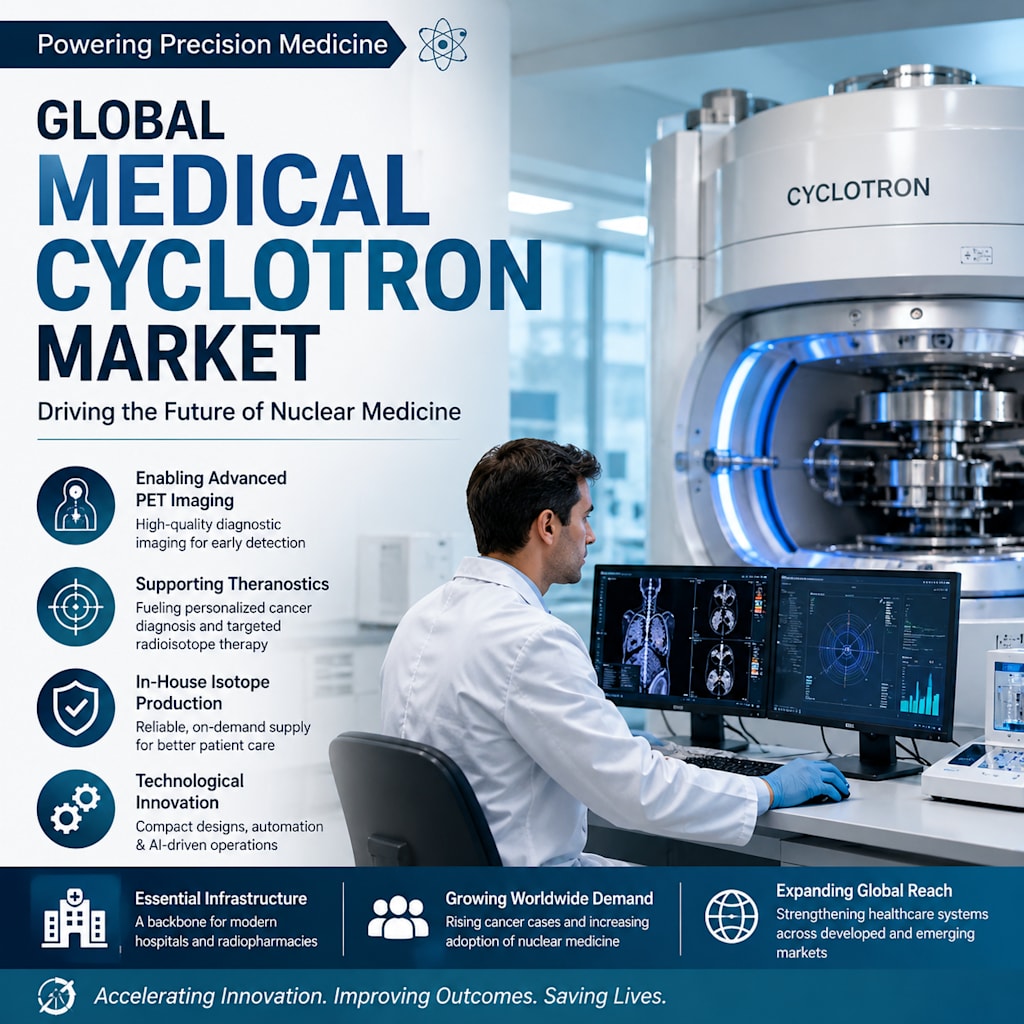
The medical cyclotron market has the potential to become one of the most significant markets in modern health care
As the health industry becomes ever more focused on precision medicine, early diagnosis and targeted therapeutics, there is one particular technology that most have yet to hear of, the medical cyclotron.
The medical cyclotron is the one type of particle accelerator used to produce the radioactive isotopes required in PET imaging and advanced cancer therapies. As there is increasing demand from nuclear medicine in terms of imaging and theranostics, these systems are set to become a crucial part of all hospitals in the world.
The global medical cyclotron market size is predicted to increase from USD 265.4 million in 2025 to nearly USD 493.8 million in 2034, showing a compound annual growth rate (CAGR) of 6.93% for the years between 2026-2034.
Why Is The Market Growing so Quickly
The increasing global burden of cancer is one of the key reasons why the medical cyclotron market is flourishing.
In 2025, over 2 million new cases of cancer are predicted in America alone, as there is a large burden of cancer globally the health service has been investing significant amounts into high technology solutions for the early diagnosis of cancer.
One of the most beneficial diagnostic tools available for scanning for cancer is PET-CT imaging, as well as monitoring the treatment and diagnosing recurrence it can also highlight the existence of cancer within the body. As with PET scanning, it requires very short half-life isotopes to scan, as there is no point in irradiating an organ when the isotope will only be active for a short period of time. This necessitates producing these isotopes close to where they are being scanned.
This is precisely the reason for the medical cyclotron's crucial role; hospitals and radiopharmacies need to invest in internal isotope production to increase the reliability and also decrease risk of the supply chain being unable to keep up with demand.
Additional information about market trends, regional developments, and competitive analysis can be found through the Medical Cyclotron Market sample report.
Theranostics and its influence on the market
Theranostics is another area that will also continue to drive the market.
Theranostics is an approach where radioactive isotopes are utilized both for diagnosing conditions and then targeting treatments that have a radioactive tracer as part of the composition. So an individual can be scanned for cancer, then have a precisely targeted radioactive treatment aimed at attacking the cancerous cells found during the scan.
This has led to an increase in the need for advanced cyclotrons that can be utilized to generate the required isotopes that include:
* Gallium-68
* Copper-64
* Zirconium-89
* Iodine-124
These are highly sought-after isotopes used in both precision oncology and future generation radiopharmaceutical therapies. As modern medicine moves towards personalization, this trend is set to become the strongest long term drive for the medical cyclotron market.
Technology Making Cyclotrons more accessible to hospitals.
The traditional installation of a cyclotron was expensive as significant concrete, lead and safety precautions were required. But more recent self-shielded and compact versions are bringing them more within reach for hospitals and diagnostic centres alike.
Modern cyclotrons feature:
* Small foot-prints
* Low construction costs
* Increased automation
* Quick installation and commissioning times
* More efficient work flows
AI is also beginning to be incorporated in the operation of cyclotrons to increase the efficiency of producing isotopes, monitoring the systems, and in order to anticipate a failure and maintain preventative maintenance. These technologies are increasing the viability of cyclotron installation at medical centres globally.
North America currently dominates as Asia-Pacific speeds forward.
North America currently boasts the largest share of the global medical cyclotron market and this is largely due to its extremely high volume of PET imaging scans coupled with its advanced medical technology and significant investment in cancer research. The US in particular currently dominates the market as it holds a vast number of hospitals, radiopharmacies and academic medical centres.
Conversely, the Asia Pacific region is rapidly advancing and looks to be the strongest growing market globally. Nations including China, India, Japan and South Korea have all been expanding their nuclear medicine infrastructure and investing more into cancer care technologies, as there is a huge surge in the awareness and prevalence of cancer globally, this market is growing rapidly.
Challenges are still present in the market
Despite the market's potential and its rapid growth the medical cyclotron market faces a range of hurdles. Installing a fully integrated cyclotron system will still cost millions of dollars due to its requirement for large shielded buildings and radiochemistry systems, in addition there is a serious lack of skilled radiopharmaceutical professionals along with stringent regulations surrounding radiation safety.
Despite this however modern cyclotrons are now becoming more readily available through more compact and automated systems that are lowering the barriers of entry to the market.
Future Projections
The future is incredibly promising for the medical cyclotron market as there is ever-growing interest in personalized oncology and the continued move toward precision medicine. More people will be scanning their bodies for any sign of cancer, and targeted radioactive treatments will continue to grow in popularity.
Key growth factors include:
* The growing prominence of theranostics
* More hospitals will now install their own radiopharmacies.
* Workflows at sites will be automated.
* Introduction of more compact self-shielded cyclotron designs.
* Hospitals moving toward more isotope self-sufficiency.
By 2034 it is anticipated that the medical cyclotron will be an even greater necessity for global cancer care.
Final Comments
The medical cyclotron has a lot to be modest about but is becoming a critical and invaluable element of medical care across the world. Enabling efficient scanning, advanced cancer therapies, precise medical treatments, and offering a more tailored form of cancer treatment, the medical cyclotron market looks sure to continue growing strongly and reliably through 2034.
About the Creator
Robert
Senior Market Researcher at IMARC Group, specializing in global market analysis, industry trends, and data-driven insights across diverse sectors.
Enjoyed the story? Support the Creator.
Subscribe for free to receive all their stories in your feed.
Comments
There are no comments for this story
Be the first to respond and start the conversation.