
The Future of Business Automation with AI and Cloud Technology
How intelligent systems are quietly reshaping how modern businesses operate and grow

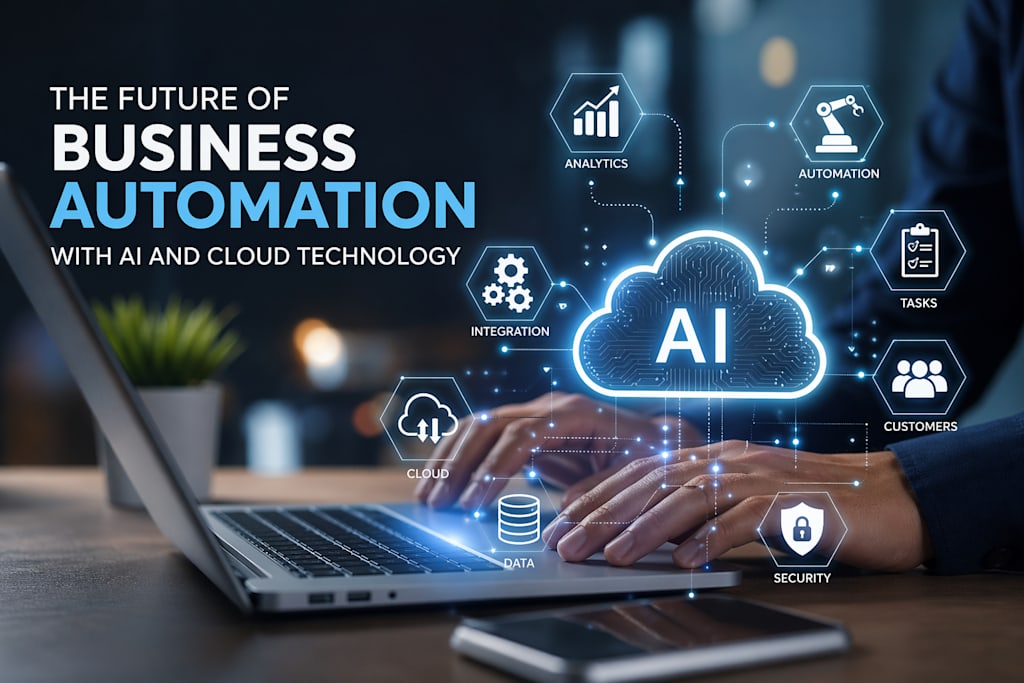
A few years ago, automation in business meant simple rule-based tools — scheduled emails, basic workflows, and repetitive task handling. It was helpful, but limited.
Today, something much bigger is unfolding.
Automation is no longer just about doing tasks faster. It’s about making systems smarter.
And at the center of this transformation are two powerful forces: Artificial Intelligence (AI) and Cloud Technology.
Together, they’re not just improving how businesses operate — they’re redefining what’s possible.
From Automation to Intelligence
Traditional automation follows instructions.
Modern automation learns.
That’s the key difference.
AI-powered systems can analyze patterns, predict outcomes, and adapt in real time. Instead of just executing tasks, they help businesses make decisions.
For example:
A customer support system can now understand queries and respond intelligently.
A finance platform can detect anomalies before they become risks.
A logistics system can optimize routes based on live conditions.
This shift moves businesses from reactive operations to proactive strategies.
Why the Cloud Changes Everything
AI alone is powerful — but without the cloud, it wouldn’t scale the way it does today.
Cloud technology provides the foundation that makes advanced automation accessible to businesses of all sizes.
Rather than pouring resources into costly infrastructure, businesses can now access what they need on demand.
Access computing power on demand
Store and process massive amounts of data
Deploy applications globally in minutes
Integrate multiple systems into a unified platform
This flexibility allows businesses to experiment, innovate, and scale without being held back by technical limitations.
In simple terms, the cloud turns automation from a tool into an ecosystem.
The Real Impact on Everyday Business Operations
The impact of AI and cloud-driven automation is not always loud or visible. It often happens quietly, behind the scenes.
But its effects are significant.
Businesses are now able to:
Reduce manual and repetitive work
Improve accuracy across operations
Make faster, data-driven decisions
Deliver more personalized customer experiences
Scale operations without proportional increases in cost
Instead of juggling multiple disconnected tools, organizations are building connected, intelligent systems that work together seamlessly.
Breaking the Myth: This Isn’t Just for Big Companies
There’s a common belief that AI and advanced automation are only for large enterprises.
That’s no longer true.
Cloud-based platforms and modern development approaches have made these technologies accessible to startups and mid-sized businesses as well.
In fact, smaller businesses often benefit the most.
They can adopt automation early, streamline their operations, and compete with much larger players — without needing massive teams or budgets.
For many growing companies, this shift becomes a turning point.
Challenges That Come with the Shift
While the potential is massive, adopting AI and cloud automation isn’t without challenges.
Businesses need clarity on what to automate and why.
Data quality becomes critical — poor data leads to poor decisions.
Integration between systems can be complex if not planned properly.
And perhaps most importantly, automation should support business goals — not complicate them.
That’s why having a clear strategy is just as important as the technology itself.
What the Future Looks Like
We are moving toward a future where automation is no longer a feature — it’s the foundation of how businesses operate.
Systems will become more predictive than reactive.
Processes will become more autonomous than manual.
Decisions will be increasingly supported by real-time intelligence.
Businesses won’t just use technology.
They will run on it.
Final Thoughts
The evolution of business automation isn’t happening overnight.
It’s a steady, ongoing shift — happening quietly across industries, in workflows, systems, and decisions.
AI and cloud technology are not just tools.
They are enablers of a new way of working.
Businesses that embrace this change early are not just improving efficiency — they are building resilience, adaptability, and long-term growth.
And in a world that’s changing faster than ever, that might be the biggest advantage of all.
About the Creator
Vishwajeet Singh
A proven leader in digital transformation, Vishwajeet drives innovation, scalability, and business impact at Bytexus. His role focuses on strategic direction, enterprise-level execution, and building long-term value for global clients .
Enjoyed the story? Support the Creator.
Subscribe for free to receive all their stories in your feed.
Comments
There are no comments for this story
Be the first to respond and start the conversation.