
The Fifty Million Dollar Question
What happens when a billionaire's AI says "no" before he can — and a woman disappears into the Pacific.
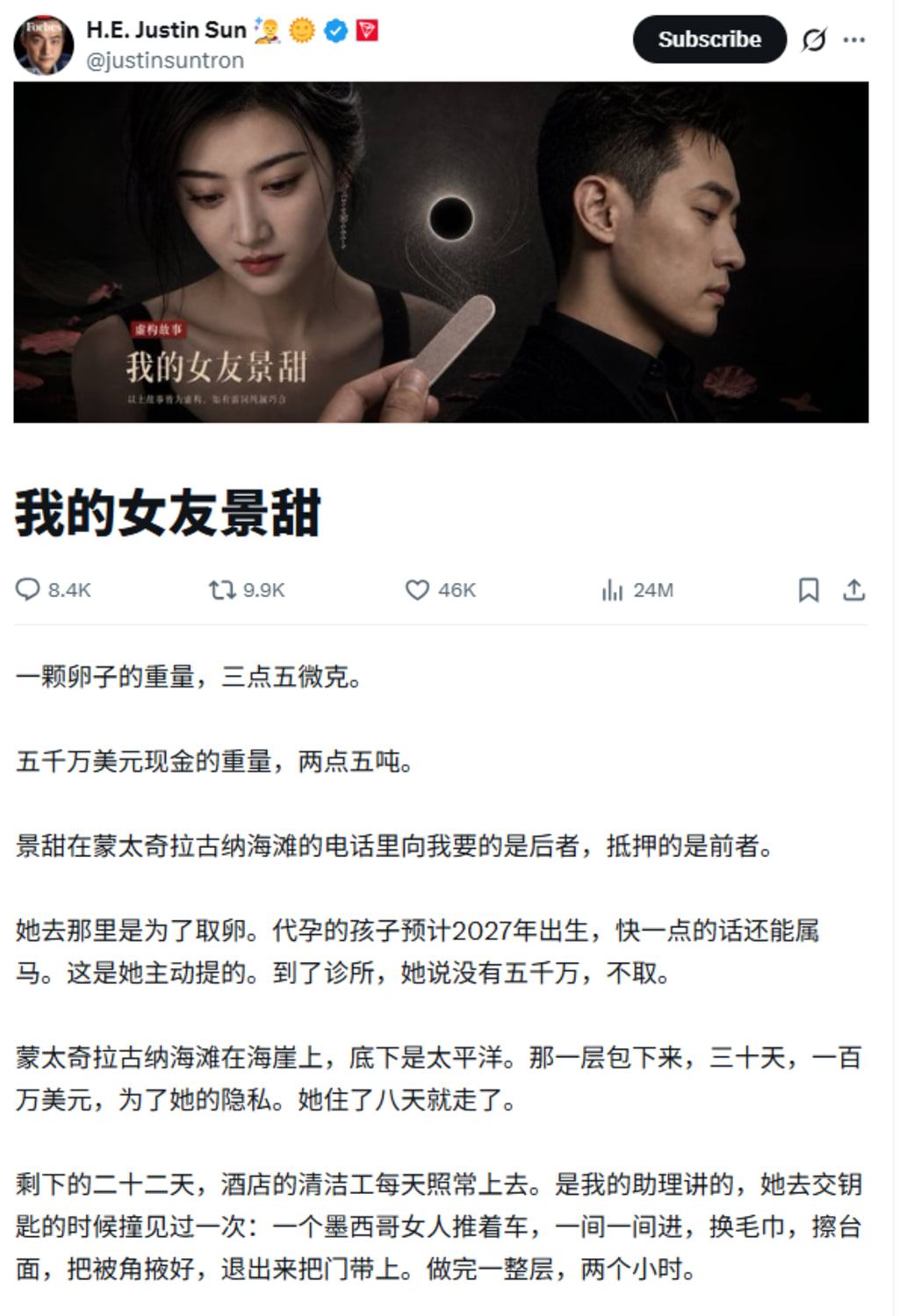
https://x.com/justinsuntron/status/2092932777612390850
In early 2026, a long-form narrative purportedly written by billionaire Justin Sun (Sun Yuchen) about his relationship with actress Jing Tian went viral on Chinese social media. Whether fact or fiction, the piece is remarkable for its narrative economy, its use of concrete detail to convey emotional emptiness, and its radical refusal of conventional sentiment. This essay examines the story's structure, its recurring motifs, and what it says about wealth, love, and the impossibility of connection in the age of excess.
The Full Text
[The story itself, reproduced verbatim as you originally wrote it]
My girlfriend Jing Tian.
The weight of one egg is 3.5 micrograms.
The weight of fifty million US dollars in cash is 2.5 tons.
What Jing Tian asked me for over the phone from Montage Laguna Beach was the latter, and what she put up as collateral was the former.
She went there for egg retrieval. The surrogate child was expected to be born in 2027 — if things went quickly, it could still be born in the Year of the Horse. She proposed it herself. When she got to the clinic, she said: no fifty million, no retrieval.
Montage Laguna Beach sits on a sea cliff, with the Pacific Ocean below. I booked the entire floor for thirty days at one million dollars, for her privacy. She stayed eight days and left.
For the remaining twenty‑two days, the hotel's housekeepers came up every day as usual. My assistant told me — when she went to return the keys, she ran into one of them: a Mexican woman pushing a cart, going room by room, changing towels, wiping counters, tucking in the duvet corners, stepping out and closing the door. It took her two hours to do the whole floor.
My assistant asked her: no one's staying, why do you still do it?
She said: the registration says someone is checked in.
A Versailles without its queen.
It suddenly hit me — Jing Tian likes this. Jing Tian likes a place that stays empty because of her. Nothing happens.
Alongside Montage Laguna Beach, a Gulfstream G700 sat awkwardly parked at Van Nuys, its crew reporting for duty every day as usual.
On the eighth day, she made that call. No one saw her again after that.
In 2007, someone was already burning money for her. That was the year I entered Peking University.
Of course, the one burning money wasn't me.
A QQ pop‑up window appeared — she was the spokesperson. On that old Lenovo IBM machine, the resolution was a blur. I saved the image.
From my Peking University dorm — rent a thousand yuan a year — I went online, found her on Xiaonei (the Chinese Facebook), and sent a friend request. Xiaonei required a message. I wrote, deleted, rewrote, deleted again — took about forty minutes. Finally I sent: "Hello."
She never accepted.
She probably never even used Xiaonei.
In the years that followed, every time I did something, I asked myself the same question: at what point would she accept? I thought about it when I made my first billion. I thought about it when I made ten billion.
Then I stopped thinking about it. Renren (Xiaonei's later name) had long gone bust.
I never sent a second request.
In 2011, Beijing was cold. I bought a down jacket for 150 yuan. I remember the price because I hesitated for three days.
That same year, she starred in a 150‑million‑yuan film, The Warring States. Sun Honglei, Wu Zhenyu, Kim Hee‑sun, Nakai Kiichi, Jiang Wu — they were brought in as supporting cast, just like Montage Laguna Beach and the Gulfstream G700 nineteen years later. They had no idea why they were there. They had come, and something had to happen — but nothing did.
Then came The Great Wall — 150 million dollars. Zhang Yimou, Andy Lau, Matt Damon. Then Jackie Chan. The Jing Tian universe grew longer and longer.
By then I was already in America — studying, starting businesses, getting busier. The only constant: every time I switched devices, no matter how much trouble it took, I transferred that QQ image over.
Nineteen years later, my name was added to the list.
We met for the first time at the Rosewood Hotel. I always thought I'd be nervous when I saw her.
I wasn't.
She was thinner than in the photos, dressed casually, leaning on the sofa. I looked at her, and suddenly I couldn't remember what exactly I had been waiting for.
I took her to see Maurizio Cattelan's banana. She stared at it for a long time, then asked me: how much is this?
6.2 million dollars.
She said: what happens when it rots?
I was silent. She said: never mind, let's go watch a movie.
I said okay.
She said: in the screening room, there can't be anyone except the two of us.
I said okay.
I stepped out to make a phone call. When I came back, she was still standing in front of that banana.
The movie was Zootopia 2.
A screening room for two — the kind usually reserved for government censorship previews.
I had my assistant buy out every seat in the theater.
I'd read articles criticizing box‑office fraud, saying tickets were all sold out but only two people showed up. Now I understood — maybe it wasn't always about the box office.
Buying out all the seats wasn't hard. The tricky part was the tickets already sold. My assistants and security waited outside the theater entrance, and whenever a ticket‑holder showed up, they handed over cash.
A couple with a kid arrived — the child was already holding up his popcorn at the entrance.
My assistant handed over a stack of bills. The kid didn't understand why they couldn't go in. The adults took the money, thanked them, asked nothing, and left.
Twenty‑six people collected money that day.
After the movie, she changed her WeChat profile picture to Officer Judy Hopps.
That night, I reached out to touch her breasts, and she pushed my hand away.
I thought she didn't want to. I pulled my hand back, about to say something.
She didn't speak. She sat up, took a small pouch out of her bag, unzipped it — inside was a row of things, like a tiny tool set.
She said: your fingernails scratch me.
I looked. I'd always just clipped them roughly with nail clippers — the edges were sharp, but I never noticed.
She said: come here.
She placed my hand on her lap and filed them, one by one.
First the rough side, then the other side, then another. After a while she'd hold it up to the light, check, then continue.
I asked: how long is this going to take?
She said: until they don't scratch.
Ten fingers — she spent nearly an hour.
Along the way she taught me: this side shapes, this side polishes, and for the last side, don't go back and forth — go in one direction.
I said okay.
When she finished, she turned my hand over, looked at it, and touched it.
She said: done.
Now you can touch — anywhere you want.
At one point she said: if I'm not around one day, no one will ever polish your nails again.
I laughed, and said nothing.
Three months into knowing her, I had someone put together a dossier. Her projects, partners, equity holdings, Jing Guoqing, Tian Xin'ai, all the associated accounts, the apartment she rented in Beijing, the place she bought in Shanghai, and some other things. It took a week — over forty pages. There was some stuff about men and women, but I figured that was the least important.
Some things she later told me — they didn't quite match what was written. I didn't say anything.
Some things she never told me. I never asked.
I chose to believe everything she said.
I still keep that dossier.
But I don't believe a single word in it.
She said: Hong Kong has too many people, I'll get recognized — let's go somewhere.
I said okay.
She pointed on the map to Tenerife.
I said okay.
I stepped out to make a call. When I came back, I learned that place was in the Atlantic Ocean, off the northwest coast of Africa. The next noon, our group of thirty departed — an A330 waiting at the airport.
In the plane's bedroom, she asked me: is my name nice?
I said yes.
She said: it's my father's surname and my mother's surname put together — isn't that a coincidence?
I said I remembered that from day one.
She hugged me and said: from now on, don't call me Jing Tian — call me Mom.
Okay, Mom.
After we landed, the captain told me: boss, the island didn't want to let us land at first — they'd never seen a private jet this big.
The same rule on the island: no one around. My assistant handled it. No one asked why — this time I didn't ask how many people either.
The Ritz‑Carlton faced the Atlantic — the floor‑to‑ceiling windows were huge. She couldn't sleep with even a crack of light. My assistants taped up the whole room with black tape — outside it was bright as day, inside pitch black like a solitary cell. The tape peeled off in the sun and had to be redone every day.
There were eleven assistants — they arrived at 6:30 a.m. and left only after we fell asleep. Two girls handled the taping — one did the window frames, the other covered the air‑conditioning and socket indicator lights, then checked three times over. We bought thirty rolls of tape, then another twenty. They discovered that tape applied after 3 p.m. peeled off most easily, because the glass was hottest then — so they switched to applying it in the morning. No one told them to do that; they figured it out themselves. They discussed it among themselves, like refining a craft.
She knew both girls' names. I didn't.
We stopped by the roadside in Teide National Park to watch the sunset. My assistants brought out roses from the car and opened champagne.
Mom looked at the sea of clouds and said: beautiful. But not as beautiful as the sunset in Delingha, Qinghai.
I'm from Qinghai.
I didn't say anything.
At night we watched the stars from the summit — we were still cold in our padded jackets.
Mom said: make a wish.
I asked: what did you wish for?
Mom said: I'm not telling.
Mom said: it's so beautiful. But it's too cold — let's go to the Maldives, okay?
I said: all right.
Tenerife was minus fifteen degrees Celsius; the Maldives was twenty‑seven. Nine thousand five hundred kilometers in a straight line — eleven hours of flying. But the Maldives airport was too small — we had to switch from the wide‑body to a small plane midway.
Mom said: the small plane is so noisy. The big one is much better.
On the flight to the Maldives, in the bedroom, Mom told me: her wish was to have a child with me. It had to be surrogacy.
I never asked why. I assumed she was afraid of the pain.
Midway, Mom suddenly sat up, grabbed her phone, connected to Starlink, and said: oh no.
I asked what happened.
She said: someone's been threatening me, asking for three days, and I haven't replied.
I said: how much?
She said: don't worry about it.
She typed for a long time, deleting and rewriting. When she finished, she put the phone face down on her lap, then picked it up again after a moment.
I asked: who is it?
She said: someone I used to work with — finance — went to prison, took the fall. Now he's out, desperate, and insists on finding me.
I said: just call the police.
She gave me a look. You don't understand.
I said: did you give it?
She said yes.
How much?
Eighty thousand yuan.
I said: that took you three days to think about?
She didn't answer.
She stayed quiet for the rest of the day. She only fell asleep after we landed.
The first thing to arrive at Soneva Jani was Mom's suitcase. Thirty people's luggage — the small plane couldn't carry it all, so it came in three separate flights. Mom had only one suitcase, and it flew alone — she said not to put it with anyone else's.
Soneva Jani is famous for "no news, no shoes" — Mom was relieved.
Hotel butlers, security, assistants — twenty‑six people in total, plus two drone operators following at a distance. The assistants started taping again — the air‑conditioning lights, the socket lights, over and over.
At night we swapped stories about our exes like dynasties cross‑checking reign years. Mom didn't want any mistakes, but she had a taboo word — that athlete couldn't be mentioned.
I didn't mention him — even though I knew the tattoo on Mom's back was because of him.
Probably too big to remove.
She said: now we're family. My parents raised me with so much effort — you have to give a bride price.
I said okay.
She gave me two names — Jing Guoqing and Tian Xin'ai — and two account numbers.
Thirty million yuan.
I transferred it. I'd first seen those two names in that forty‑page dossier.
After a while, she handed me her phone. Tian Xin'ai had replied with two characters: Received.
Once Mom asked: do you know what I think about when I ask for these things?
I said what.
She said: I wonder if there will ever be a time when you say no.
I said no.
She said: then that's no fun.
I thought: is there anything I can't do?
When I was bored, I fiddled with that 2007 QQ image, trying to transfer it to a new device. Mom leaned over: who is this other woman you're keeping a photo of?
I was silent. I said nothing.
The image was too blurry for her to make out, so she went back to her own business.
That night I deleted the picture.
The next day I restored it from my old phone.
Mom was also glued to her phone — I asked what she was looking at.
She said: nothing — just that silly billing‑order drama.
Billing order — in a production, only one star can be listed first. Even the male and female leads can only have one person at the top.
I said: how boring.
She said: yeah. But what's harder is that sometimes cast members become on‑set couples — forty or fifty days in a production, usually acting with a guy, having sex at night, and fighting over billing order during the day.
I said: that's anti‑human.
She said: right.
But once filming ends — no matter how many times they slept together — it's as if nothing happened.
Then she scrolled for another half hour.
January 2, 2026, Soneva Jani — the new year — I proposed to Mom.
I decided it on the morning of January 1. The ring was in Hong Kong. There was nowhere to buy a ring on the island, so my assistant took a seaplane to Malé and came back that afternoon — the ring in a hotel envelope.
Mom said: the diamond is too small.
Mom said: it's okay — we'll get a bigger one later.
And also — can you come to Beijing?
I was silent.
She thought I didn't want to.
Mom said: why are you so good to me?
I said because I like you.
She said: have you ever been like this with anyone else?
I said no.
She smiled, and said nothing.
One morning I woke up early — she wasn't in bed.
I went out and found her sitting on the terrace, facing the sea — the whole ocean was black. No lights on, before dawn.
I asked her why she was up so early.
She said: I'm counting the days.
I said counting what.
She said: go back to sleep.
I sat beside her for a while, not knowing what to say. Later I went back to bed.
When I woke up again, she'd already put on her makeup.
We stayed in the Maldives for fourteen days — not one person recognized her.
On the thirteenth evening, at dinner, she took off her sunglasses. After a while, she took off her hat and placed it on the table. She sat through the whole meal like that. At the next table were an elderly German couple; the waiter was Sri Lankan — no one gave her a second glance.
After the meal, she put her hat back on.
Mom said: let's go back.
I said: haven't you had enough yet?
She said: it's too quiet.
Back in Hong Kong, Mom met my parents.
That night she said: the families need to prepare for the formal meeting and the wedding — I need as much as possible. Still Jing Guoqing and Tian Xin'ai.
I didn't ask why.
I said: one card has a daily transfer limit of one million.
Mom said: too slow.
Transfer from five cards.
Five cards, two accounts, rotating. On the third transfer, I hesitated. Then I finished it anyway.
Mom said: too inefficient.
I said: let's bring your parents to Hong Kong for the New Year.
Mom said: we've already decided to spend New Year in Hainan this year. Next year.
Chinese New Year — fireworks over Victoria Harbour, a million people came. She wasn't there.
At 3 a.m., I drove my parents home.
The roads were empty. At a red light with no cars waiting, I still stopped.
Mom said: I'll be away for a while — I'm going to Los Angeles for the egg retrieval. I have some things to handle first.
Mom asked again: can you come to Beijing?
I was silent.
She didn't say what was in Beijing. I didn't ask.
Mom said: you have to buy a house in Hong Kong — in her name.
I said: all right.
Valentine's Day — we didn't meet.
Once she said on the phone: they drew eight vials of blood this morning.
I said that's a lot.
She said it's okay.
I said that must be hard.
Then we talked about other things.
Later I learned that kind of blood draw had to be done fasting, on the second or third day of the menstrual cycle — the date couldn't be off. She must have left home around six that morning — Beijing winter, before dawn. More and more tests followed. I only knew about this because a new line item appeared in my assistant's monthly expense summary. It first showed up last year — a small amount, a few thousand yuan. Then every month after that, sometimes two or three entries. I approved them quickly. For amounts like that, I didn't need to see the details. Later I found out those were blood tests, hormone panels, ultrasounds, AMH — checking how many eggs she had left, how many could be retrieved, whether it was worth going forward.
All of that was done in Beijing.
I don't know which hospital. I don't know if she went alone or with someone.
On February 25, she landed in Hong Kong.
She said she wouldn't go to Los Angeles unless she first saw the Hong Kong house.
I sent her the dozen properties my assistant had curated over the past six months. She didn't like any of them. I'd never visited any of those houses myself — my assistant spent six months picking them out one by one, forwarded them to me, and I forwarded them to her. One was in the Mid‑Levels — in the video you could see Victoria Harbour, filmed at dusk. For a moment the camera shook, and the shadow of the person filming appeared on the wall. I looked at that shadow and thought: who is this person, how many miles has he walked today, how many houses has he seen, does he even know who this house is for?
Time was tight — she still boarded the G700 to Los Angeles and flew into Montage Laguna Beach on February 28.
On the eighth day, Mom called. It was afternoon on her side, early morning on mine.
She said: fifty million, US dollars.
I said: let me think.
She was silent. I could hear the ocean on her end.
After a moment she said: okay.
She hung up.
I had never said "let me think" to her before.
I used Claude Code to read the API and ran through all my liquid assets — the conclusion was that the amount wouldn't affect me at all. I double‑checked. I entered the question into Claude Code, and Claude said: don't give her the fifty million dollars.
I asked: doesn't she love me anymore?
Claude said: I don't care about love, and I don't understand it. But you cannot give her that fifty million.
I had never refused her — not out of generosity, but out of fear. Fear of the answer that would come the next second.
And now someone else had said it for me.
I stared at that line for a long time. What sent chills down my spine wasn't how smart it was — it was that Claude had no hesitation at all.
It wasn't conflicted.
I thought at the time: this is probably something higher. A human can't do this.
Doesn't she love me anymore?
The next day she called back.
Mom said: the ocean is so big.
I said: is it?
She said: this floor is too large — there's an echo. In the morning someone comes to clean, and I hide in the bathroom until they leave.
I said: I can tell them not to come.
She said: no need.
She said: the clinic asked when the child's father would be here.
I said: I can send someone.
She said: no need.
Then she said: have you decided?
I didn't speak. I wasn't thinking — I wasn't thinking about anything. On the phone, the ocean on her side; on my side, Victoria Harbour. Neither of us spoke. I counted — eleven seconds.
Jing Tian said: okay.
Jing Tian said: I understand.
She hung up.
I've replayed it countless times since — what else did she say during those two days besides the fifty million? The ocean is so big, this floor is too large, she hides in the bathroom. That's all — I remember every word, not a single mistake. What I can't recall is her voice — the tone when she said "I understand."
I can't remember. Later I stopped trying.
I put my phone on the nightstand, screen down. Then I did something — to this day I don't know why: I put my hand on my chest and counted.
My heartbeat was steady.
I counted again — still steady. Sixty‑something beats per minute, no different from usual. I sat there, hand on my chest, like a doctor examining someone else.
I thought: so this is how it is.
The rest of that day I did nothing. I stayed in my room from dusk to dawn, watching Victoria Harbour shift from blue to gray to black. At six in the morning, the financial buildings across the harbour began lighting up one by one. Once my assistant knocked on the door and asked about dinner arrangements; I said I didn't need any.
I didn't cry. I kept waiting for myself to cry.
Later, when my assistant settled the accounts, there was an item for hotel compensation in Tenerife. After we left, the tape was kept on for a few more days — no one told the girls to stop. The hotel said the tape had been on too long, too many times, and the adhesive residue on the window frames couldn't be cleaned off — the entire glass pane had to be replaced.
I approved it.
That glass faced the Atlantic.
The fuel bill for the plane alone was higher than the cost of the Montage floor. I asked about it. My assistant said: the A330 was designed for two hundred people — we only had thirty. Too light — the takeoff balance was off. So they had to add extra fuel every time, enough to make the plane heavy enough. Once they reached the destination, the extra fuel couldn't be kept — it had to be dumped.
I said: every time?
He said: every time.
There was also a box sent back from the Los Angeles clinic: eight days' worth of fertility injections, requiring refrigeration — none of them opened.
And the surrogacy agency deposit — two hundred thousand dollars, non‑refundable. The surrogate was booked in January — a Californian, thirty‑four, had given birth twice. There was a photo of her in the file — I never looked at it. She had been ready since January.
After Jing Tian left, I took out that 2007 photo and looked at it once. Nineteen years — device pixels kept getting higher, but the image seemed to get blurrier, the face more smudged. I zoomed in for a long time, trying to find any difference between her then and later. I couldn't find a single one — because the photo had never been clear to begin with.
One day I clipped my nails with the nail clipper, then felt the edge — it was sharp.
I remembered the thing she left in the drawer.
I took it out and filed a couple of times — wrong. She said to go in one direction — I forgot which direction.
I put it back.
My nails are still scratchy.
One morning my phone popped up a reminder — set by my assistant last year when scheduling: three months before due date, prepare the room.
I swiped it away.
After she left, I kept thinking about one question.
If I had given it that day, would she have stayed?
I thought about it for a long time.
Later I took out that dossier and read it again. Over forty pages.
Then I remembered that Chinese New Year's night, standing on the rooftop overlooking Victoria Harbour's fireworks.
A million people surged in like a tide; when the fireworks ended, a million people receded.
A million people.
Every year, the same.
At 3 a.m., Hong Kong —
nothing happened.
I. The Structure of Empty Spectacle
The story is built on a series of grand gestures that yield nothing. The private jet, the empty hotel floor, the bought‑out cinema, the surrogacy arrangement, the bride price—all are fully executed, and all are abandoned. The phrase "nothing happened" recurs like a verdict: after The Warring States, after Montage Laguna Beach, after the fireworks over Victoria Harbour, the result is always the same absence.
What makes this structure work is the specificity of the waste. The A330, designed for two hundred, carries thirty. To compensate, it burns extra fuel for balance—then dumps it upon arrival. "Every time?" "Every time." This is not metaphor; it's the literal logic of the relationship, externalized onto machinery. The extra fuel is the relationship itself: necessary to maintain equilibrium during flight, but disposable at the destination.
II. Details That Breathe
The story is remarkable for the granularity of its observations, many of which feel too obscure to be invented:
The tape that peels off at 3 p.m. because the glass is hottest then—so the assistants switch to applying it in the morning, discussing it "like refining a craft."
The shadow of the assistant in the property‑viewing video, cast on the wall at dusk—and the narrator wondering, "does he even know who this house is for?"
The due‑date reminder, set months in advance, that appears on the phone after she's gone—and is swiped away.
These details do not advance the plot. They are not symbolic in any obvious way. They simply are. And that is their power. They convey a world that is meticulously managed by unseen hands, while the people at its center drift through it, touching nothing permanently.
The nail‑filing scene is the emotional core. She spends an hour on his nails, teaching him which direction to file. Later, after she leaves, he tries to replicate it—but he's forgotten which direction. He puts the file back. "My nails are still scratchy." It's the smallest possible failure, and it says everything.
III. The Money Question
The climactic demand—fifty million dollars—is not about money. The narrator has already transferred thirty million as a bride price. He has spent millions on hotels, jets, and buyouts. The fifty million would not affect him. He says so explicitly.
What stops him is not the sum. It's the fact that an AI, Claude, tells him not to give it. He asks the AI twice: first, whether the amount would affect him (no); second, whether he should give it (no). The AI's reasoning is purely transactional—"I don't care about love, and I don't understand it. But you cannot give her that fifty million."
And the narrator is chilled not by the AI's coldness, but by its lack of hesitation. "A human can't do this," he thinks. He follows the AI's advice. The relationship ends.
This is the story's most unsettling turn: a man who has never refused his girlfriend anything finally does so because a machine told him to. The AI becomes the externalized superego, the voice of caution that the narrator himself could never summon. In outsourcing his refusal, he also outsources his agency—and his humanity.
IV. The Recurrence of "Nothing"
The phrase "nothing happened" appears three times:
In 2007, when the cast of The Warring States—a who's‑who of Asian cinema—are brought in as supporting cast for Jing Tian. They "had no idea why they were there. They had come, and something had to happen—but nothing did."
In 2026, when the Montage Laguna Beach floor sits empty for twenty‑two days, cleaned daily for a guest who has checked out. "A Versailles without its queen."
After Chinese New Year, when the million‑person crowd recedes and Hong Kong falls silent. "At 3 a.m., Hong Kong—nothing happened."
Each iteration is a variation on the same theme: spectacle without consequence, presence without meaning. The narrator accumulates wealth and people and places, but none of them transform into anything lasting. The story itself is a monument to that failure.
V. What the Story Doesn't Say
The narrator never says "I love her" in the present tense. He never says "I miss her." He never describes her face in any detail. He remembers her voice only as a question of tone he can no longer retrieve.
What he does describe, with obsessive precision, are the logistics: the number of assistants, the cost of the floor, the fuel dumped, the tape applied and reapplied. The emotional content is all in the gaps—in what he doesn't ask, doesn't say, doesn't remember.
The story ends not with a resolution but with a counting. A million people. Every year, the same. The scale of the crowd is the scale of his isolation. He is one among a million, and he is completely alone.
Final Note
Whether this narrative is fact or fiction is ultimately beside the point. Its power lies in its refusal to explain itself, its willingness to let details accumulate into meaning without ever stating that meaning aloud. It is a story about the weight of money and the weightlessness of everything else—about a man who can afford anything except the one thing he actually wants, and who only discovers that after it's too late.
The nail file remains in the drawer. The due‑date reminder has been swiped away. The glass pane in Tenerife faces the Atlantic, replaced at his expense. These are the only monuments left.
And the narrator is still scratching himself with his own nails.
About the Creator
Jin
Writer of reamstories
https://reamstories.com/jin
Enjoyed the story? Support the Creator.
Subscribe for free to receive all their stories in your feed. You could also become a paid subscriber, letting them know you appreciate their work.
Comments
There are no comments for this story
Be the first to respond and start the conversation.