
The Era of Platform Rent: Three Ledgers for Manufacturers, Distributors, and Community Shops
When disintermediation becomes re-intermediation, every layer has to answer why it still exists.
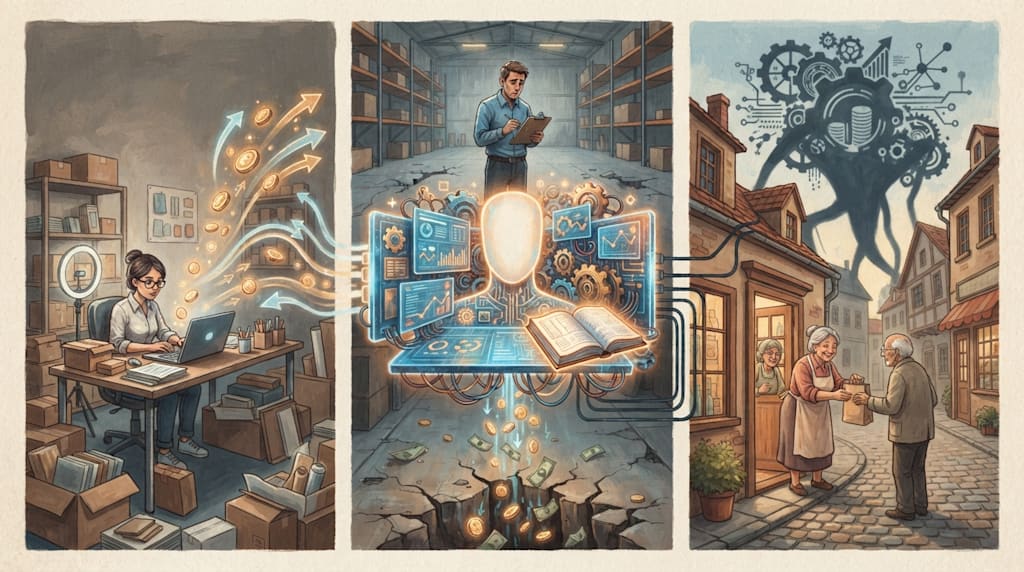
In 2025, a woman who had run a women’s clothing store in the United States for years closed her last physical location. Before pulling down the shutter, she wiped the shelves one more time, sold the last box of hangers to a secondhand shop, and turned the “OPEN” sign to its back. Then she went home, set up a ring light, and started livestreaming on TikTok Shop.
She had done the math. A single garment cost about $6 to buy. In the livestream, she listed it at $14. Platform commission was about $1. Ad spend ran $3.50 to $5. Return rates exceeded 40%. The clothes that came back had tags cut off, foundation stains on the collar, perfume on the cuffs. Some had clearly been worn. Those could only be cleared out at about $3. For every $100 in sales, she took home less than $10.
After the livestream ended, she turned off the ring light, sat in her car, and looked for stomach medicine. Her phone screen lit up: “Your campaign is out of budget.” She once said: “When I closed the store, I thought I wouldn’t have to feed the store anymore. Now I realize I’m feeding the platform.”
This is not her ledger alone. Around 2026, factories, distributors, and community shops each have a ledger. On the back cover of all three is the same line: the money was redistributed.
1. The old intermediary did not disappear. It changed form.
In the past, a row of people stood between manufacturers and consumers. National general agents, regional wholesalers, secondary distributors. Old Chen was one of them. He wholesaled food. His warehouse sat on the edge of the city, and a liquor-brand calendar hung on his office wall. He won orders by drinking with clients, moved goods by pushing inventory down the channel, and helped downstream buyers with two-month payment terms. When a customer was short on cash, he shipped first and collected at the end of the month. When the church in town held a banquet, people called him to order ingredients. When the construction-site canteen ran short on Wednesdays, they called him. He was not cheap, but he was there.
When e-commerce rose, the promise was clear: cut out these intermediaries, let manufacturers face consumers directly. The old system of national general agents, regional wholesalers, and secondary distributors was dismantled. Consumers did not end up dealing directly with manufacturers. The intermediary changed form.
It used to be a person. Now it is a system.
Today’s Amazon, Google, Meta, Apple, Uber, DoorDash, Booking, Temu, and TikTok do not produce goods, grow food, cook meals, carry packages to customers’ doors, or chat with customers for a few minutes. They hold seven decisive controls:
Traffic entry. Who the customer sees first is decided by them.
Search ranking. How much you pay and where you rank is decided by them.
Delivery network. What ships, how fast it arrives, and what shipping costs are decided by them.
User data. Who bought, how much, and whether they will buy again belongs to them.
Pricing rules. If you are a penny more expensive, they push a competitor. If you sell cheap, their cut still rises.
Ad auctions. No ad spend, no exposure. Spend, and profit is taken before the sale closes.
After-sales arbitration. How negative reviews are handled and who bears refunds is decided by them.
These seven controls are seven kinds of rent: traffic rent, ranking rent, fulfillment rent, data rent, pricing rent, advertising rent, and arbitration rent.
The regulatory record is there. In 2023, the U.S. Federal Trade Commission filed an antitrust suit against Amazon, alleging that its take from third-party sellers reached about 45%, a combined cut of commission, fulfillment, and advertising. The European Union fined Google €2.42 billion over its price-comparison shopping business, finding that it manipulated search results to favor its own service. In 2024, it fined Apple €1.8 billion over anti-steering rules in its app store. The European Commission’s long investigation into Booking’s price-parity clauses ended with the company committing to narrow such clauses. During the pandemic, New York, San Francisco, and other cities passed laws temporarily capping delivery-platform commissions at 15%, precisely because platform take rates had squeezed restaurant survival.
Costs on the brand side have shifted too. Amazon’s advertising revenue grew from about $21.5 billion in 2020 to about $56 billion in 2024. Common industry estimates show online customer-acquisition costs rising about 60% over the past five years. Gross margins may still look acceptable. Operating margins keep sliding. Volume grows. Profit thins.
On Old Chen’s warehouse wall, the calendar still says 2018. He does not understand. He did nothing wrong. Why do customers stop coming?
2. The manufacturer’s ledger: DTC absorbs the full cost
“I’m done with distributors. I’ll do TikTok Shop, Amazon Brand Store, my own website’s private domain, Instacart flash delivery. Sell directly to consumers.”
This sentence has become almost consensus among manufacturers. Liu Jie, who makes loungewear, said it too. She cut two wholesale clients, hired three young people (one to shoot video, one to run ads, one for customer service), and thought that by bypassing distributors, the margin would stay with her.
Half a year later, she did the math.
Revenue: 100
Platform commission: 15
Ad spend: 28
Fulfillment and delivery: 12
Return losses: 17
Customer service: 5
Warehousing: 6
Platform promotion discounts: 8
Profit after returns and platform costs: 9
She stared at the last line for a long time. The margin that used to go to distributors was now going to the platform as tolls, ad fees, delivery fees, and commissions.
DTC has a cost structure that is rarely explained in advance: acquisition costs belong to the platform, user data belongs to the platform, price-comparison power belongs to the platform, and repeat purchases require buying ads again. Direct sales do not mean you hold the customer. After bypassing distributors, the manufacturer must handle content production, ad buying, customer service, returns and exchanges, warehousing, last-mile delivery, review maintenance, and platform promotion sign-ups. Every item burns money. Every item lets the platform take another layer.
This group of converts has already paid tuition. Casper was once a star DTC mattress sample in the U.S. Two years after going public, it went private at a price far below its IPO valuation. Allbirds’ market value evaporated more than 90% from its peak, with high marketing expenses as a major cause. Nike loudly pushed a direct-to-consumer strategy in 2017 and compressed wholesale partnerships. In 2024 it announced it was returning to wholesale. Seven years. The industry giant verified one thing: cutting out the middleman does not mean capturing the customer.
The difference between old and new intermediaries also shows up in relationships. The old intermediary would drink with clients and offer two-month terms when cash flow was tight. The new intermediary will not. It only prompts: “Your campaign is out of budget.”
The manufacturer must answer one question: If Amazon shuts down your listing tomorrow, who can you still reach? What you hold in your hand, is it goods or customer relationships?
3. The distributor’s ledger: repriced
The middle layer is the hardest place to stand.
Manufacturers want direct sales. Platforms want centralized procurement. Retailers say, “Your quote is more expensive than Amazon Business.” Consumers say, “I can search and find the same thing.” The distributor’s three core capabilities, fronting cash, holding inventory, and drinking for relationships, are depreciating fast.
Platform centralized procurement prices are 3% to 10% lower than distributors’. Retailers’ private labels are another 10% to 20% lower. Costco’s Kirkland already accounts for about one-third of its sales. After subsidies hit, the final retail price can even fall below the distributor’s cost. Full-truck minimums, monthly payment terms, and rebates for pushing inventory, this old script fails in front of algorithms.
But one fact must be seen at the same time: platforms cannot fully replace all distributor functions.
They can deliver next day, but they do not know which corner-store owner trusts whom. They can compare prices, but they do not know who the town’s church banquet or community event calls to order ingredients. They can cover the whole city, but they do not know what the construction-site canteen runs out of on Wednesdays, or what specific concerns an elderly person living alone has when buying groceries.
These dirty jobs, relationship jobs, and on-the-ground jobs are things platforms cannot do. They do not intend to do them either.
In alcohol, because of the legal three-tier distribution system, distributors remain solid to this day. In IT distribution, Ingram Micro. In foodservice supply, Sysco. In electrical distribution, Graybar, which has operated for more than a century. None were killed by platforms. They embedded themselves in the links platforms cannot handle.
What is being eliminated is not the distributor as a group. It is the identity of “middleman who earns a resale spread.” The value of the identity “local service provider” is rising.
The distributor’s ledger should read like this:
Gross resale spread
minus warehousing costs
minus logistics and delivery
minus cost of capital tied up
minus sales expenses
minus rebates and payment-term costs
plus local service fees
plus integrated solution revenue
equals profit after local service and integration
Count only the first six lines, and distributors are shrinking. Count the last two, and distributors still have a way to live.
The distributor must answer: Are you earning money from an information gap or from local service? If manufacturers go direct and platforms centralize procurement at the same time, what do you have left?
4. The community shop’s ledger: existential value
“Amazon has same-day delivery. Walmart has citywide delivery. DoorDash has DashMart. What am I, a few-hundred-square-foot shop?”
This kind of self-doubt appears again and again among Main Street operators. What is unsettling is not the new store across the street. It is the question of one’s own existential value: Does this shop, this location, this person still have meaning in the current structure of the times?
A few concrete scenes can test the boundary between platforms and physical shops.
A pipe bursts at midnight. Does the customer look for Amazon or the owner of the hardware store next door?
A child has a fever and wants a sip of hot soup. Do you wait 45 minutes for delivery or knock on the door of the small restaurant downstairs?
An elderly customer buys groceries. Ordering on Instacart is convenient, but who helps them pick fresh produce? Who remembers they do not eat cilantro? Who, knowing they have trouble walking, brings an extra scallion on the way?
Platforms have no price advantage over physical shops, and they lack three abilities: near, know, and rescue.
A shop operator standing in front of a customer can see at a glance that the person is in a hurry today, has a child with them, has a bad back, does not eat spicy food. A large platform will not remember “Ruth’s coffee, no sugar.” The shop will.
These abilities have value. Most operators simply have not found a way to monetize them.
The community shop’s ledger:
Gross merchandise margin
minus rent
minus labor
minus shrinkage
minus utilities
minus payment processing fees
equals book profit
This ledger omits the most important part:
Regular-customer trust
plus proximity convenience
plus emergency rescue
plus local knowledge
plus emotional connection
equals unmonetized assets
If these assets cannot be converted into membership fees, service fees, reservation revenue, community-event revenue, or parcel pickup and errand revenue, the shop is left competing with platforms on price. On price, the shop loses.
The community shop must answer: Are you selling goods or the trust of this street? When customers can buy everything on their phones, why should they still push open this door?
5. Five changes happening at the same time
Agricultural consolidation. Planting and breeding are concentrating into large professional organizations. A few top companies control the main capacity.
Industrial stockization. Top companies take the mainstream market. Smaller companies turn to niche tracks.
Platform superpower. Traffic, logistics, data, and payments are held by a few giants. Amazon alone accounts for about 40% of U.S. e-commerce. Two companies eat about half the digital advertising market.
Consumer rationalization. Consumers no longer chase display. They want reliability, proximity, low prices, and transparency. Discount retailers expand rapidly. Private-label share hits record highs.
Channel restructuring. Intermediaries will not disappear. Those who “earn a resale spread” will disappear. Those who “serve” will remain.
Every party is bearing the cost.
Manufacturers try to bypass channels and reach users directly, only to find they are working for the platform. Distributors cling to agency rights and find themselves replaced by algorithms. Community shops wait for customers to walk in and get squeezed out by same-day fulfillment networks.
Every layer is going through pain, and all of them must answer the same question: What do I still have that no one else can replace?
6. Three questions you must answer yourself
If you are a manufacturer: What do you hold in your hand, goods or customer relationships? If Amazon shuts down your listing tomorrow, who can you still reach?
If you are a distributor: Are you earning from an information gap or from local service? If manufacturers go direct and platforms centralize procurement at the same time, what do you have left?
If you are a community shop owner: Are you selling goods or the trust of this street? When customers can buy everything on their phones, why should they still push open this door?
The era’s need for “people who earn a resale spread” is declining. Whether there is a need for you as an operator depends on how you answer these questions. This is more fundamental than any business technique. It determines whether you keep waiting or change how you live.
7. Three things you can do tomorrow
Manufacturers: Shift from selling goods to managing customer relationships. Build first-party data: email, SMS, membership, private communities. Calculate contribution profit after returns, not just GMV. Build a channel mix. Do not stake your life on a single platform. Develop bundled products, service products, and subscription products that platforms cannot easily price-compare.
Distributors: Shift from moving boxes to providing services. Turn installation, repair, payment terms, local procurement, last-mile delivery, foodservice supply, and community group buying into paid offerings. Productize local knowledge. Do the dirty jobs, relationship jobs, and on-the-ground jobs platforms cannot do. Do not ask, “How much longer can my agency rights last?” Ask, “What will the businesses on this street be unable to do without me tomorrow?”
Community shops: Productize trust. Membership, reservations, parcel pickup, errands, community events, regular-customer preference records, local supply-chain alliances. Do not compete with platforms on “everything” and “fast.” Compete on “near” and “know.” Let customers push open the door not because this place has the most goods, but because someone here remembers them.
Conclusion
The women’s clothing shop owner loaded the last box of hangers into her car. Her phone lit up again: “Your campaign is out of budget.” She turned off the screen, walked into a gas station, and bought a cup of coffee. The clerk asked if she wanted a loyalty card. She said yes.
Old intermediaries earn a resale spread. New intermediaries collect rent.
Manufacturers, distributors, community shops. Every layer contributes cash flow to the platform, and every layer feels like it is starting a business.
You did not fail. Your profit was redistributed.
After the alarm, change the ledger instead of complaining louder about the environment.
Change the ledger. Put profit after returns, customer relationships, and local trust on the same page.
When the ledger changes, the way you live changes.
About the Creator
Jin
Writer of reamstories
https://reamstories.com/jin
Enjoyed the story? Support the Creator.
Subscribe for free to receive all their stories in your feed. You could also become a paid subscriber, letting them know you appreciate their work.
Comments
There are no comments for this story
Be the first to respond and start the conversation.