
The Dung Beetle Story Your Textbook Got Wrong
Australia imported 53 species to handle cow dung. The successful ones came mostly from South Africa, not China.
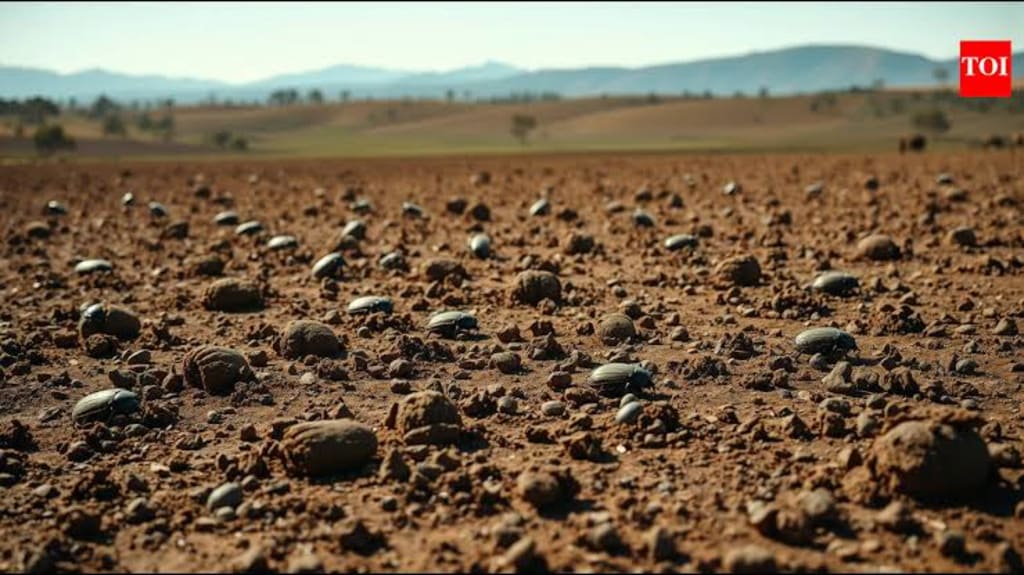
CSIRO’s public materials include a list of source countries for introduced dung beetles.
Africa: South Africa, Angola, Kenya, Malawi, Morocco, Mozambique, Nigeria, Zimbabwe. Europe: France, Greece, Italy, Spain. Asia: Iran, Sri Lanka, Turkey. Americas: Mexico.
That is the full list for the 23 species that established in Australia.
China is not on it.
Where does China appear? In a Jiangsu junior high school biology textbook.
I. Cow dung was a problem
Australia had about 29.7 million cattle and 27.8 million people in 2025. More cattle than people. China has 96.08 million cattle and 1.4 billion people. The per-capita pressure is different.
CSIRO says a cow produces 10 to 12 piles of dung per day. At 10 piles and 29.7 million cattle, Australia produces nearly 300 million piles daily. At 4 jin per pile, that is over 100,000 tonnes of wet organic matter per day.
Undisturbed, cow dung covers grass, breeds flies, and keeps nutrients at the surface. Grass cannot grow. The next herd has less to eat.
Australia had no cattle originally. Native mammals were kangaroos, wombats, and wallabies. Their dung is small and dry. Wombat dung is square. Native dung beetles evolved with that dung and handle it well. Cow dung is wet, sticky, and large. Native beetles do not gather in the season when cow dung is available, and they do not bury it quickly.
Local dung beetles could not handle introduced cow dung. That is why Australia began importing foreign dung beetles in the 1960s.
II. South Africa did most of the work
CSIROpedia records that CSIRO introduced 55 species between 1967 and 1982. Of 29 species released in northern Australia, 22 came from southern Africa. Current CSIRO materials give these totals: 53 introduced, 43 released, 23 established.
Of the 23, 13 came from South Africa and 3 from other African countries. South African beetles made up about 78.5% of cumulative releases.
The main source was southern Africa, especially South Africa. China is not a source country.
China and Australia had some scientific contact. Public checks show that the claim “Chinese dung beetles were exported to Australia and became the main force” does not match CSIRO’s list or its program account. A small experimental contact became “saving Australia.” That is inflation, not fact.
The textbook says something else. Public images show the Jiangsu junior high school biology textbook credits Chinese dung beetles and adds that “Chinese dung beetles are more diligent.” Some media outlets went further: “In Australia’s decades-long dung beetle contest, Chinese dung beetles took first place” and “Chinese dung beetles save Australia.”
A country absent from the established-species list became the protagonist. A project led by southern Africa became a story about Chinese insect diligence.
III. Three errors
First, the source country is wrong. None of the 23 established species came from China. The source country is the standard answer. A textbook can tell a story, but it cannot get that answer wrong.
Second, the cause is simplified. Australia imported dung beetles because native beetles could not handle cow dung. Scientists screened species by climate zone, active season, dung preference, and reproductive capacity. “Diligence” was not a criterion. Turning an ecological screening process into “diligence wins” turns science into chicken soup. Chicken soup is fine to drink. It is not a textbook.
Third, credit is misplaced. Dung beetles from South Africa, Zimbabwe, Kenya, and other African countries did the work. Australian scientists spent decades screening, quarantining, breeding, releasing, and monitoring them. The “Chinese dung beetles save Australia” story erases that work. South African beetles worked in Australian pastures for more than fifty years. The credit went to a country that never appeared on the list.
IV. The project was more interesting
Remove the Chinese role, and the Australian program still holds up.
Australia admitted that native beetles could not handle cow dung. It searched southern Africa and southern Europe for species that could. It did not dump beetles onto pastures. It bred and quarantined them first, checked for pathogens, then released them at selected sites. It kept monitoring: which species established, which overwintered, which buried dung.
The final count: 53 introduced, 43 released, 23 established. Different species worked in different seasons and climate zones. Most were burrowers. They dug under cow dung, moved it underground, and made dung balls. Adults ate the balls. Larvae hatched into them. Dung went into the soil. Nutrients returned. Flies lost breeding sites. Grass grew back.
Australia is a major beef exporter. These small beetles helped keep the pasture system running. The lesson is not which country’s insects won. The lesson is that one country faced a concrete ecological problem, searched the world for answers, and found most of them in Africa.
Science does not check passports. Ecological work does not follow national pride. The species that adapt go in. The species that establish count.
V. Give the credit back
Textbook errors enter exams and students’ notes. Media and short videos spread them again. They become a memory that “many people learned this as children.” Once an error is in a textbook, correction costs more.
Publishers should check CSIRO’s public materials and issue errata. Media outlets should correct headlines and wording. Textbooks do not need to be flawless. They do need to use verifiable sources for verifiable facts.
South African dung beetles and Australian scientists saved Australia’s pastures together. China is not on the list of 23 established species. China appears in some textbooks and media stories.
Give the South African beetles their credit. Give students the scientific story.
The list is complete. China is not on it.
About the Creator
Jin
Writer of reamstories
https://reamstories.com/jin
Enjoyed the story? Support the Creator.
Subscribe for free to receive all their stories in your feed. You could also become a paid subscriber, letting them know you appreciate their work.
Comments
There are no comments for this story
Be the first to respond and start the conversation.