
The Death of Class Voting: How Britain's Political Tribes Collapsed
A century of electoral data reveals that the link between class and party loyalty didn't fade gradually it collapsed suddenly, starting with Tony Blair's New Labour and accelerating with Brexit.

British politics has become increasingly volatile and fragmented, with no party able to command the substantial backing of the public that was once routine. The results from England's local elections in May illustrate just how far politics has moved from the two-party dominance that characterised much of the 20th century. And at the centre of this change lies an important element: class.
In recent decades, the electoral foundations of democracy have shifted, eroding the class basis that earlier voting habits were built upon. In the 2019 general election, Labour lost many working-class strongholds to the Conservatives, prompting questions about whether a class realignment was taking place. And in 2024, the rise of Reform UK in many working-class areas left some wondering if it is now the new party of the working class.
New research examining how the party system has developed across 37 general elections in Britain, from 1885 to 2024, offers a definitive answer. By taking an unprecedented long-term perspective, the study situates contemporary debates about the party system within more than a century of social and political change. The findings offer important evidence about when and why the decline of class-based voting occurred.
The Three Phases of Class Voting
The research, based on a unique dataset combining election results at constituency level with census data, reveals three distinct phases in the relationship between class and voting.
Phase One: The Rapid Emergence (1906–1922)
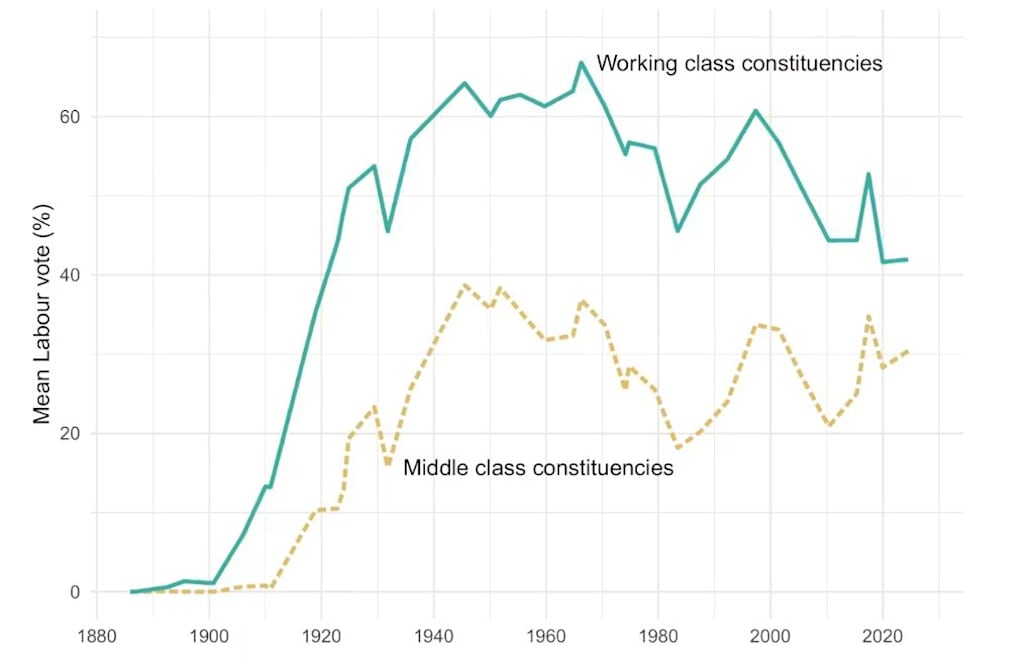
While there is some evidence of class voting between Liberals and Conservatives in the late Victorian era (1885–1901), this collapsed in the early 20th century. It was replaced by a rapidly emerging class divide between Labour and Conservative strongholds a gap that crystallised within two general elections of mass enfranchisement in 1918. In the space of five elections, spanning 16 years, the difference in Labour support between the most working-class and most middle-class constituencies grew from seven percentage points in 1906 to 34 points in 1922.
Phase Two: The Stable Era (1923–1992)
This class cleavage remained remarkably stable, showing little change from the 1920s to the 1990s. During this time, people living in more working-class areas tended to vote Labour and middle-class areas Conservative. Despite fluctuations in the overall level of support for Labour, the difference between the most working-class constituencies and most middle-class constituencies remained steady, with a mean difference of 29 points.
Phase Three: The Collapse (1997–2024)
The dissolution of the class divide is a relatively recent and abrupt phenomenon, unfolding almost entirely during and after the New Labour period from 1997. The class difference dropped from 31 points in 1992 to 24 points in 2010, then fell further to just 12 points in 2024. This was the smallest class difference in Labour's support since 1910, and the party's lowest share of the vote in working-class constituencies since 1918.
The New Labour Effect
The timing of the decline is crucial. Many debates about class and voting patterns centre on whether the narrowing of the gap reflects a gradual process underpinned by social change, or whether it is a more abrupt shift brought about by the actions of political parties. The findings suggest it was not a result of gradual social change. The Labour-class relationship remained stable until the 1990s difficult to reconcile with the view that class dealignment originated in the 1970s.
Instead, the decline can be traced specifically to the New Labour era. Under Tony Blair, Labour moved to the right on issues that traditionally divided the classes, such as embracing free markets and privatisation. Blair broke links with trade unions, selected more middle-class candidates, and actively moved away from class rhetoric, declaring that the class war was over. Once Labour turned away from explicit class politics, the alignment that had structured British electoral behaviour for most of the 20th century began to unravel.
For the Conservatives, the pattern is different. The Conservative-class relationship remained stable until around 2015, before unravelling rapidly in the wake of the Brexit referendum. This was when the Conservatives made dramatic inroads in working-class constituencies. By 2019, the class gap in Conservative vote share had fallen to just eight percentage points the smallest in the entire 139-year span of the data.
The New Political Landscape
Despite Labour's return to government in 2024, there is little evidence that these long-run trends have reversed. Support for the two main parties is now less divided by class than at any point since the era of mass enfranchisement began. The implications are profound:
Volatility: With class no longer acting as a reliable predictor of voting behaviour, elections have become more unpredictable. Voters are more likely to switch parties, and the traditional tribal loyalties that once anchored the electorate have faded.
Fragmentation: The rise of Reform UK and other smaller parties reflects a political landscape where no single party can command the substantial backing of the public that was once routine.
Realignment: The erosion of class voting has opened the door for new political cleavages such as education, geography, and cultural attitudes to play a more significant role in shaping electoral outcomes.
The findings suggest that class dealignment was not an inevitable consequence of social change but a result of deliberate political choices. By moving away from explicit class politics, Labour effectively dissolved the electoral coalition that had sustained it for most of the 20th century. The Conservatives, in turn, capitalised on this shift by making inroads into working-class constituencies, particularly after Brexit.
The question now is whether this trend can be reversed. With class no longer serving as a reliable guide to voting behaviour, parties must find new ways to connect with voters. The rise of Reform UK suggests that the political landscape remains fluid, and the old certainties of two-party dominance are unlikely to return anytime soon.
The story of class voting in Britain is one of rapid emergence, remarkable stability, and abrupt collapse. For nearly 70 years, from the 1920s to the 1990s, class was the single most important factor in determining how people voted. That era is now over. The choices made by political parties particularly Labour's move away from class politics under Tony Blair and the Conservatives' embrace of working-class voters after Brexit have fundamentally reshaped the electoral landscape.
Britain's political tribes have not so much evolved as they have dissolved. And in their place, a new, more volatile and fragmented politics has emerged one where the old certainties of class no longer hold.
The circus of British politics is always evolving. But the collapse of class voting is a reminder that political allegiances are not fixed they are forged and broken by the choices of parties and the priorities of voters.
About the Creator
Mark Lim
Hi I am mark an automotive student and a car, tech and food enthusiast ! Im gonna try and post daily & hope you enjoy what I write and do share my page with people you know. I would gladly appreciate it! Cheers
Enjoyed the story? Support the Creator.
Subscribe for free to receive all their stories in your feed.
Comments
There are no comments for this story
Be the first to respond and start the conversation.