
The Crown on the Velvet Cushion
She Wore the Jewels, Built the Power, and Never Held the Key
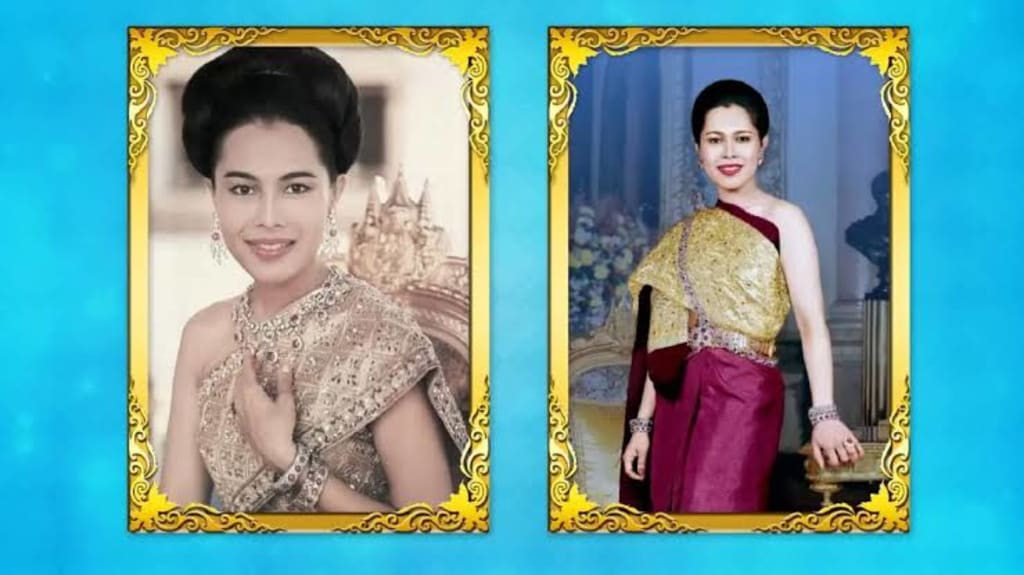
In the photograph, Sirikit wears Thai silk. A sash crosses her shoulder. A diamond brooch sits at her chest. Her earrings are teardrop-shaped. There is another strand at her wrist. The camera catches only this.
The camera does not catch how many documents she signs each day, how many officers she meets, how many names she remembers.
Switzerland, 1950s. Bhumibol meets her. She speaks French. She plays piano. Her family name is Kitiyakara. He needs someone to stand beside him and hold up the palace face. She needs a ticket in.
Before the wedding, he says in public that he will take only one wife. In the custom of Thai kings, that sentence is a contract. Her family hears it. She nods.
The wedding is written as love. Newspapers run the photographs. No one runs the negotiating table.
After the marriage, she walks out of the palace. Rice fields in the north. Fishing villages in the south. She bends to receive flower garlands. She designs eight national dresses, necklines, cuffs, patterns, from state banquets to daily wear. She takes a ruler. She has the tailors shrink the palace motif and place it at the collar. She tries the dress on. She turns. She looks at the hem. She tells the maids to remember which dress for a banquet, which for a funeral.
Thai silk becomes a national symbol. She accompanies the king abroad. She shakes hands. She smiles. She writes down the name of every envoy.
She pins ranks on officers. Army, navy, air force, one shoulder board at a time. One goes on crooked. She reaches out and straightens it. The general lowers his head. She remembers his name.
She stands beside the king. She also stands before piles of documents. She is the palace's project manager.
In 1956, Bhumibol is ordained as a monk. She serves as regent. Documents come to her desk. She signs. The royal seal sits to her left. For the first time, she does not have to speak through anyone else. She rises at seven every day and reads documents. She circles with a red pen. She calls ministers. Her voice is low.
Then the marriage turns cold.
Bhumibol speaks little, then less. He is depressed, withdrawn, shuts the door outside official business. She knocks. No answer. She sits at the far end of the long table. The soup in front of her goes untouched.
They divide the work: he manages law, she manages hearts. He manages the front, she manages the back. The king is water. The queen is forest. The water does not flow into her room.
They speak three sentences a week. One about official business, one about the children, one good night. Sometimes the good night does not come.
In middle age, she meets Narongdej. A bodyguard, a military officer, young. She talks with him. She smiles.
When Bhumibol finds out, he sends him abroad to the United States. In 1985, Narongdej dies in New York. He is thirty-eight. The official cause is heart disease. Rumors spread that the body had marks. The palace skips a full autopsy and buries him quickly.
At the funeral, Sirikit walks over and touches his forehead. She weeps. She tells Maha to bow. The crowd is silent. Maha bows. She stands. She does not explain.
Afterward, she is sent away to "recuperate." Half a year. The windows are closed. The person who brings meals does not look at her. Rumors of a curettage circulate in the palace. She counts the windowpanes. One, two, three, four. Up to a hundred. The meal tray has a lid. She lifts it. Porridge. She does not eat.
When she comes out, she is thin. She no longer knocks on Bhumibol's door.
She begins plastic surgery. Her face changes. She looks in the mirror and touches the corners of her eyes. She calls the doctor. The doctor comes. She points at her face. The doctor nods. She lies down.
She binges. Late at night, she eats sweets. The plate is empty. She tells the maid to bring more. The maid lowers her head. She wears brighter colors. Young men appear at her side. She no longer plays the perfect queen.
The succession question comes.
Bhumibol favors Sirindhorn. Sirindhorn is smart, capable, gets things done. The king considers changing the succession law. Maha's position is unstable.
Sirikit moves. She publicly opposes Sirindhorn. She suppresses her daughter. When Sirindhorn hands in reports, she sets them aside. When Maha gets into trouble, she covers for him. She paves the way for Maha, meets generals, nobles, the Supreme Patriarch. She puts her military contacts, her charity network, her Red Cross influence, all of it, on her son.
She summons Maha. Maha stands. She says, Sit down. Maha sits. She says, Listen carefully. She teaches him whom to see, what to say, what not to say. She writes Maha's name at the top of the list.
She looks at Maha as if he were a card held close. She has done the math. If her daughter takes the throne, power returns to the paternal line. The stage she spent half her life building will be dismantled. If her son takes the throne, she will be queen mother, mother, the one behind the curtain.
She chooses her son.
She is cold to Soamsawali too. Soamsawali is the niece she chose to be Maha's wife. Soamsawali bears children. Maha has affairs. Sirikit does not stop him. She tells Soamsawali to endure. Soamsawali later becomes paralyzed and sits in a wheelchair. Sirikit goes to see her, stands for a while, and leaves.
She is cold to Sirindhorn too. Sirindhorn does the work; she finds fault. Sirindhorn wears a uniform; she turns to look at Maha. Sirindhorn is a daughter. In the rules of the palace, a daughter is a piece. A son is the card held close.
In her later years, she is addicted to plastic surgery. Her face swells. Her eyes grow small. She binges. Her weight rises and falls. Scandals cling to her. The media photographs her. The jewels are still there. The person is tired.
The princess she pinned her hopes on, Bajrakitiyabha, collapses. Brain death. Soamsawali paralyzed. Maha takes the throne. News from the palace harem keeps coming.
She sits in a wheelchair. An old brooch lies beside her hand. Bhumibol gave it to her. She does not wear it. The crown is in the safe. The key is not in her hand.
The lights go out. The maid pushes her back to her room. The corridor is long. She says nothing.
About the Creator
Jin
Writer of reamstories
https://reamstories.com/jin
Enjoyed the story? Support the Creator.
Subscribe for free to receive all their stories in your feed. You could also become a paid subscriber, letting them know you appreciate their work.
Comments
There are no comments for this story
Be the first to respond and start the conversation.