
The Cord That Lets a Toyota Worker Stop the Production Line
At Toyota, spotting a problem can give a factory worker the power to interrupt production before the problem travels any farther.
This story was created with the help of ChatGPT (AI) and reviewed by a human editor for accuracy before publishing.
By Human Business Works
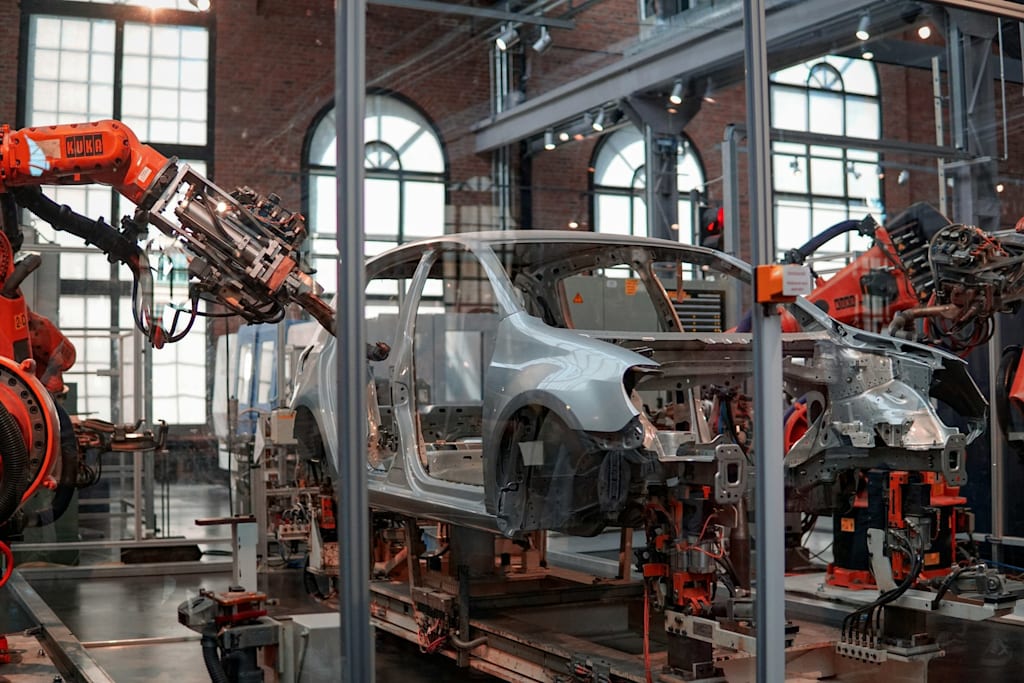
At Toyota’s car plant in Burnaston, Derbyshire, a cord runs along the production line.
A worker who notices something wrong can pull it.
A light comes on. A number on an overhead board identifies the workstation where help is needed. A team leader heads toward the problem while the vehicle continues through the worker’s allotted process time.
If the problem can be fixed quickly, production continues.
If it cannot, the line pauses.
For a factory built to produce cars efficiently, deliberately creating a way for one worker to interrupt production can seem like an expensive idea.
Every stopped minute means less movement down the line.
Toyota built the interruption into the system anyway.
The cord is part of an approach known as Andon, a signal used within the Toyota Production System to make problems visible while they are happening. At Burnaston, the cord is connected to lights, an audio system and a board showing exactly where assistance is required.
The purpose is straightforward.
A problem should not quietly continue down the line.
If something appears wrong with a part, a fitting or the work itself, the person closest to it has a way to call attention to it immediately.
The factory can lose a little time now rather than discover later that the same problem has travelled through multiple vehicles.
The worker does not have to stay silent to keep the line moving
Modern factories are built around movement.
Components arrive. Vehicles progress from one workstation to another. Each task has a certain amount of time attached to it.
That creates an obvious pressure.
Keep going.
A worker who falls behind can slow the process around them. A machine problem can interrupt other stations. Stopping an entire line can be costly.
A system concerned only with short-term output might therefore encourage people to keep production moving whenever possible and deal with smaller problems later.
Toyota took a different approach.
Its production system rests partly on the Japanese idea of jidoka, which Toyota translates as automation with a human touch.
The concept predates Toyota’s car factories.
Toyota traces it to Sakichi Toyoda, founder of the Toyota Group, who worked on improving weaving looms. One of his inventions could detect when a thread broke and stop instead of continuing to weave defective fabric.
The machine did not become more productive by continuing regardless of what happened.
It became more useful because it knew when continuing was the wrong thing to do.
That idea eventually became part of Toyota’s manufacturing philosophy.
A machine can stop when it detects an abnormality.
A person can do the same.
Toyota says its use of the Andon system dates back to 1950. Over time, the cord, button, warning lights and display board became practical ways of applying the principle on an assembly line.
The worker closest to the problem does not have to wait for somebody several levels above them to discover it.
The signal starts where the problem starts.
That changes the worker’s role.
The person assembling the vehicle is not there only to complete a task before the next car arrives.
They are also responsible for the quality of what they pass to the next person.
If something looks wrong, keeping quiet is not necessarily helping production.
It may simply be allowing the problem to move.
A stopped line can be doing useful work
There is a visible cost when a production line pauses.
Cars stop advancing.
People wait.
The interruption is easy to see.
The cost of allowing a defect to continue is less visible at first.
Imagine a fitting problem that appears on one vehicle and is ignored.
The vehicle progresses to the next workstation. Another vehicle arrives. The same problem appears again.
By the time somebody notices the pattern, several vehicles may have passed through.
Now the company has more work.
Someone has to find the affected vehicles.
The defect has to be repaired.
Completed work may need to be undone so another part can be reached.
If the problem survives long enough to leave the factory, the consequences become more serious still.
Toyota’s system tries to confront the issue closer to the moment it appears.
When the Andon signal is activated, the team leader comes to the workstation. If the problem can be corrected during the remaining process time, the line does not have to stop. If it cannot, production pauses while the issue is investigated.
That pause can look like lost productivity on a factory dashboard.
Inside the system, it can be the thing protecting productivity later.
There is also another effect.
The problem becomes visible.
Toyota does not treat each Andon signal only as an isolated interruption. The company studies the frequency and nature of the issues as part of its broader practice of continuous improvement, known as kaizen.
A recurring problem is therefore more than something to repair.
It is information.
Why does the same fitting keep causing trouble?
Why is one process taking longer than expected?
Why does a particular part arrive incorrectly?
Fixing the immediate problem gets the line moving again.
Understanding why it happened can prevent the cord from needing to be pulled for the same reason tomorrow.
That is a different relationship with mistakes.
The worker who reveals a problem has not necessarily damaged productivity.
They may have exposed something the business needed to know.
The idea travels surprisingly well outside a car factory.
In many workplaces, employees can see problems long before senior managers do.
A customer-service employee hears the same complaint twenty times.
A restaurant server notices that diners repeatedly send back the same dish.
A warehouse worker sees the same packaging fail.
A junior employee realizes that a process everyone follows is producing the wrong result.
Whether that information travels upward depends partly on what happens to the person who raises it.
If stopping to question something creates trouble for the employee, people learn to keep the work moving.
The problem stays hidden.
Toyota’s cord sends a different message.
The person doing the work has permission to interrupt it when quality is at risk.
That permission does not make stopping free.
A factory still needs to produce vehicles. Deadlines still exist. Efficiency still matters.
The system simply recognizes that speed measured over the next few minutes can be very different from efficiency measured over the entire process.
At Burnaston, the cord still runs alongside the workers and vehicles moving through the plant.
Most of the time, production moves forward.
Then someone sees something that should not.
A hand reaches for the cord.
A light comes on above the line.
And for a moment, stopping the work becomes part of doing the work properly.
About the Creator
Enjoyed the story? Support the Creator.
Subscribe for free to receive all their stories in your feed.
Comments
There are no comments for this story
Be the first to respond and start the conversation.