
The Contract Before the Kiss
Rupert Murdoch’s five marriages read like tabloid chaos. The real story is a family trust that decided, decades in advance, what every wife and child could touch.
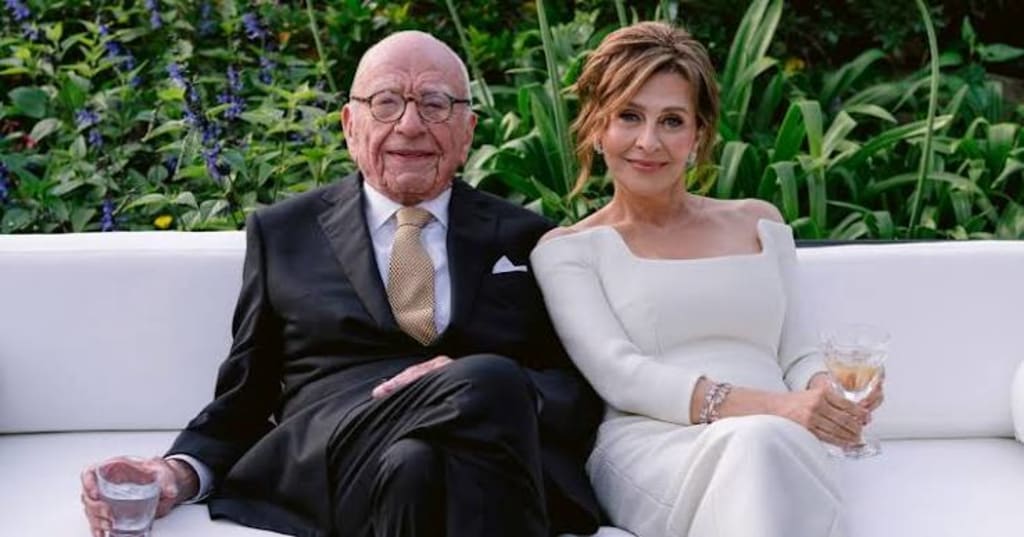
Rupert Murdoch has married five times and divorced four. That arithmetic invites the wrong story. What looks like romantic restlessness is something colder and more coherent: a man who learned early to treat marriage as a renewable service contract and divorce as a line item with a pre-negotiated ceiling.
The mechanism was a family trust drawn up in 1999, in the shadow of his divorce from Anna Torv, his second wife. That trust gave the Murdoch Family Trust eight voting shares: four controlled by Rupert himself, and one each to his four eldest children, Prudence, Elisabeth, Lachlan and James. Any children born later would be entitled to a financial share of the fortune but no voting power. That clause was written into the structure years before Wendi Deng would have children of her own. The trust held roughly 40 percent of the voting shares in News Corp and Fox, and it was designed to survive Rupert. On his death, his four votes would be distributed equally among the four eldest children. Nothing in the trust depended on who he married next.
Every wife after Anna walked into a structure that had already decided, in advance, what a wife could and could not touch. The marriages changed. The architecture did not.
The first one left almost no trace
Patricia Booker was a flight attendant when she married Murdoch in 1956, the year he inherited a small Adelaide newspaper and began the long campaign of acquisitions that would become an empire. She was not a co-founder in any formal sense. She kept the household running while he travelled. She provided the social surface a young man with sharp edges needed in provincial business circles. She gave him a daughter, Prudence, in 1958. When the marriage ended in 1967, the settlement was a cash payment whose exact size is not publicly established. Reports describe it only as a severance paid alongside Murdoch’s acquisition of custody of Prudence. There was no trust to fight over, no voting shares to divide, because there was no empire yet to divide. Patricia disappears from the record almost entirely after the divorce. She is the proof of concept: an early marriage can be dissolved without leaving a mark on the asset base, because the asset base is still small enough to be carried in one man’s name.
The second one wrote the rules that would bind everyone after her
Anna Torv was a journalist at the Sydney Daily Mirror when she met Murdoch, and she married him in 1967, the same year his divorce from Patricia was finalised. For thirty-one years she worked inside the business. She served on the board of News Corporation as a non-executive director from 1990 to 1999. She was inside the expansion into Britain and the United States, inside the negotiations and the image management that a man like Murdoch needed precisely because his instincts were combative. She also gave birth to three of the four children who would inherit voting control: Elisabeth, Lachlan and James.
When the marriage collapsed in 1999, over his relationship with Wendi Deng, whom he would marry seventeen days after the divorce was finalised, Anna had a choice that most people in her position never get. Under California law, after a marriage of that length, she could have claimed half of everything. She did not. She took a settlement reported in two competing figures: $200 million in some accounts and $1.7 billion in others. The discrepancy matters less than the condition attached to it. Anna insisted on a trust that would lock control of the empire into the four eldest children, with Rupert holding four votes and each child holding one. She gave up the possibility of a larger personal payout in exchange for a structural guarantee that her children, and only her children plus Prudence, would control the company after Rupert’s death.
She helped design the trust and then lived with its limits. She was not sentimental about it. The trust was “irrevocable” in name, but it was also a document that could be litigated, and Anna understood that a document is only as durable as the people who agree to be bound by it. What she bought was time: twenty-six years in which her children would hold equal voting rights, and in which any later wife would have to contend with a structure she had already signed into existence.
The third one entered a game whose rules had already been written
Wendi Deng married Murdoch in 1999, on a yacht in New York Harbour, seventeen days after the Anna divorce was finalised. She was thirty-one. He was sixty-eight. She was not naive about the trust. She had been inside the company’s Hong Kong operations, and she understood that the voting structure was closed to her. What she did next was a workaround.
Murdoch had been treated for prostate cancer. The radiation and surgery had left him with severely diminished fertility. Deng persuaded him to freeze sperm before the treatment. She then used IVF to have two daughters, Grace and Chloe, in 2001 and 2003. The trust allowed subsequent children to be financial beneficiaries, entitled to a share of the fortune, even if they had no voting rights. By producing children, Deng created two new beneficiaries inside a structure that otherwise excluded her entirely. She could not touch the votes. But she could attach two permanent claims to the cash flow.
She also discovered the limit of that strategy. In 2006, Murdoch inserted an amendment into the trust that allowed the sub-trusts of each child to be altered under certain conditions, a provision that would later become the legal hinge for the 2023 succession fight. Deng pushed for voting rights for Grace and Chloe. She was refused. The other adult children, whose own votes were at stake, made it clear that the answer was no. What Deng secured instead was a financial stake: Grace and Chloe would be equal beneficiaries in the economic sense, with no control. When the divorce came in 2013, Deng walked away with two properties, the Fifth Avenue penthouse and the Beijing house, and no News Corp stock. The daughters’ beneficial interest survived. The mother’s voting power had never existed.
Deng’s calculation was cold, and it was rational. She traded the reputational cost of being the third wife, the one who entered after the trust was sealed, for a position from which her children could never be expelled from the money, only from the power. It was a loss on the control ledger and a win on the inheritance ledger. Whether that counts as a victory depends on which ledger you are reading.
The fourth and fifth were not anomalies. They were the mature form of the system
Jerry Hall married Murdoch in 2016. She was a supermodel with a public identity that predated him, and that identity was the point. A man in his late eighties does not need a wife who can open markets or restructure a balance sheet. He needs a wife who can stand beside him at a gala without requiring an introduction. Hall signed a prenuptial agreement before the wedding. When the marriage ended in 2022, by email, while she was in the UK waiting for him to join her, the settlement was reported at more than £10 million a year for life, plus a share of properties worth around £250 million. The control of Fox and News Corp was explicitly unaffected. She received exactly what the system was designed to give a late-stage spouse: a generous income stream and a real-estate portfolio, structured so that no voting share ever moves.
Elena Zhukova married Murdoch in 2024. She was a retired molecular biologist, previously married to a Russian billionaire, with her own money and her own life. The Financial Times reported, in the plainest possible language, that the marriage was “not expected to impact” the family trust that controls roughly 40 percent of the voting shares in Fox and News Corp. She did not need the money. She did not receive the power. The system did not need to exclude her aggressively, because by 2024 it had become a background condition. A wife could now be a companion without being a variable in the control equation at all.
Then the trust did the thing it had always been capable of doing: it turned on the children
The 1999 structure gave each of the four eldest children one vote, and Rupert four. On his death, his votes would be split equally among them. For two decades that arrangement held because Rupert was alive to cast the deciding votes. But as he aged, the arithmetic became a problem. If Elisabeth, James and Prudence voted together, they could outvote Lachlan, three votes to one, and Lachlan’s position as successor would be decorative. Worse, from Rupert’s perspective, the three of them were more liberal than Lachlan. James had left the News Corp board in 2020 citing disagreements over editorial content. Elisabeth had told a journalist that sacrificing her relationship with James to please her father was “one of the greatest regrets of my life”.
In 2023, Rupert tried to change the trust. The plan, reportedly called “Project Harmony,” would have given Lachlan permanent, exclusive control. A probate court in Nevada rejected it in December 2024, finding that Rupert and Lachlan had acted in “bad faith” in attempting to amend an irrevocable trust. That ruling did not restore the old arrangement. It forced a settlement. In September 2025, Prudence, Elisabeth and James each agreed to sell their stakes for approximately $1.1 billion and to step away from any control of Fox or News Corp. A new trust was created, worth about $3.3 billion, holding roughly 36 percent of Fox’s Class B stock and 33 percent of News Corp’s Class B shares. Lachlan would have sole voting control. Grace and Chloe were included as beneficiaries. They still had no votes.
Prudence, the first child, the one who had been there before the empire, was bought out with the others. Elisabeth and James, who had spent their adult lives inside the business, were bought out. Lachlan received the control he had been groomed for. Grace and Chloe received a place at the table with a menu but no pen. The trust that Anna had built to protect her children from a future wife had, in the end, been used by their father to protect one child from the others. The mechanism was neutral. The hand on the mechanism was not.
What the five marriages actually show
The five marriages are usually told as a story about Rupert Murdoch’s appetite for reinvention. They are better read as a story about a structure that learned to absorb reinvention without changing shape. Patricia arrived before the structure existed. Anna wrote it. Deng found the one loophole that could not be closed, biology, and used it to attach her children to the money. Hall and Zhukova arrived after the loophole had been priced in, and they received exactly what the structure was willing to give: comfort, income, and no vote.
The women were not passive. Anna negotiated. Deng strategised. Hall signed a prenuptial agreement that gave her more than most people will earn in a lifetime, and she took it. They made choices inside a game whose rules had been written before they sat down. That is different from being fooled. It is more uncomfortable: being fully informed and still choosing the available seat.
Rupert Murdoch did not need to be romantic to win this game. He needed to be the person who owned the table. The trust was the table. And the trust outlasted every wife, every vow, and, for Prudence, Elisabeth and James, the family itself. What remains after the 2025 settlement is a contract with five signatures and one signature that counted.
About the Creator
Jin
Writer of reamstories
https://reamstories.com/jin
Enjoyed the story? Support the Creator.
Subscribe for free to receive all their stories in your feed. You could also become a paid subscriber, letting them know you appreciate their work.
Comments
There are no comments for this story
Be the first to respond and start the conversation.