
The Co-Branded Cup That Burst in Her Hand Was a Cost-Sheet Decision
The label cost less than a cent. The annealing step cost money. One of those costs got skipped.
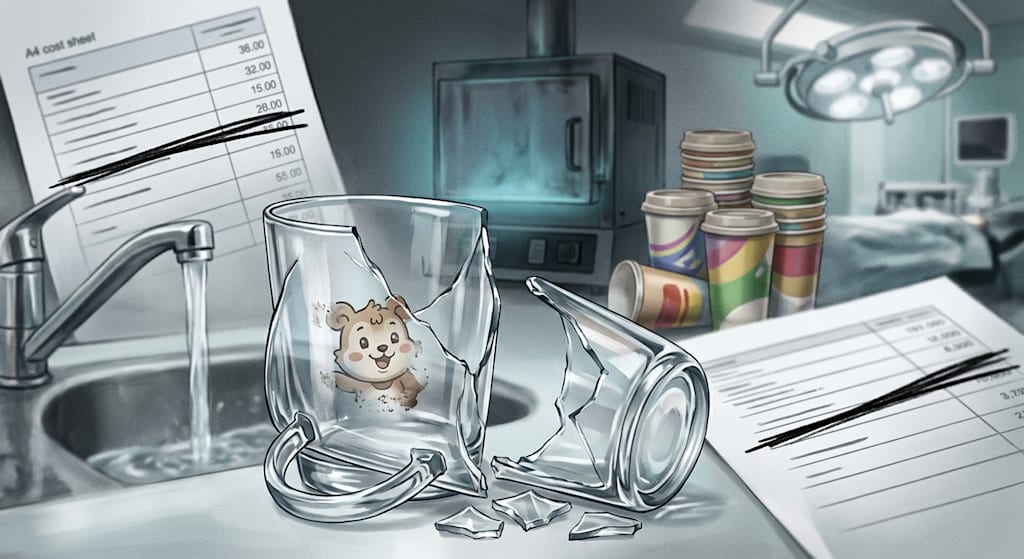
At the end of October in Guangdong, the tap water had no temperature difference. A glass cup printed with a cartoon figure burst in the user’s hand. The broken edge severed blood vessels and nerves, and that night the person was taken into surgery. Photos of broken cups posted across the internet afterward formed a pattern. From the same batch, some cups shattered as soon as they were taken out of the box and touched a tabletop. Some cracked when they touched a sink. Some arrived by delivery already broken to pieces. No temperature difference, no impact, still unopened. The cups were breaking by themselves.
This is not a defect-rate wobble. The same batch failing densely under no external force points to the production conditions themselves. Either the material did not match the label, or a key process was skipped.
Printing one line on the outer box, “high-borosilicate glass, suitable temperature 0°C to 100°C,” costs less than one cent in ink. Making the cup deserve that line costs money somewhere else. After forming, the glass must go into an annealing furnace at around 560°C and cool slowly to release internal stress. This step consumes electricity, takes time, and occupies furnace capacity. It is a line on a contract manufacturer’s cost sheet. Skip it, and the glass looks intact but retains stress inside. Under the slightest thermal or mechanical disturbance, such as the tap water in Guangdong at the end of October hitting it, the stress concentration point releases instantly. The cup bursts violently rather than merely cracking.
Qualified 3.3 high-borosilicate glass has a thermal expansion coefficient about one-third that of ordinary soda-lime glass and can withstand a sudden 150°C temperature difference without trouble. The beakers held directly over an alcohol lamp in a lab are made of this material. Soda-lime glass withstands only about 50°C. The cost of printing “high borosilicate” and the cost of achieving high-borosilicate performance sit two orders of magnitude apart on the contract manufacturer’s books. Printing a line only needs ink.
Molly Tea’s regular single cup averages 15 to 20 yuan. This time a cup of milk tea with a co-branded cup starts at 47 yuan. Subtract the milk tea, and the consumer paid about 30 yuan for the empty cup. But in a chain stocking more than 3,000 stores at once, that 30 yuan must first cover the IP licensing fee, then store gross margin, then the brand headquarters’ cut. The ex-factory budget left for the source glass factory is at most a few yuan. With both an extreme bare-bones price and full-color printing on a rushed delivery schedule, the annealing furnace becomes the easiest link to optimize away. It does not directly affect how the cup looks when it leaves the factory. It only affects whether it will burst in the user’s hand later.
The manufacturer involved, Hebei Xinshishang Glass Products Co., Ltd., has 8 employees. The advertised monthly salary for a quality supervisor is 5,000 to 8,000 yuan. A high-borosilicate glass line needs a steadily running annealing furnace and batch internal-stress sampling. The gap between that requirement and this scale is visible. After the incident, the production manager insisted the product “is high-borosilicate glass” and that “an instant temperature difference of over 100 degrees is no problem.” He attributed the breakage to “fear of impact” or “improper user operation.” In multiple consumers’ accounts, the cup did not experience impact. It touched a tabletop, or water.
There is another gap. Internal-stress testing for glass cups is not a mandatory inspection item for daily industrial products. It is only a recommended standard. Even if a cup’s internal stress seriously exceeds the standard, factory quality inspection may not stop it. Labeling “high borosilicate” is the brand’s commercial choice. Whether annealing is adequate is the contract manufacturer’s cost choice. Between the two there is no mandatory gate.
Molly Tea’s response after the incident was: delist across all channels, seal the same batch, refund all orders, and take “full responsibility” toward the injured. From a crisis-management view, this is the least bad choice. From a legal-structure view, the words had to be said because the law already places the brand in the position of first responsible party. Articles 1202 and 1203 of the Civil Code provide that where a product defect causes personal injury, the injured person may claim compensation from the producer or from the seller. After the seller compensates, it has the right to recover from the producer. Product tort applies no-fault liability. The victim need not prove that the brand or the contract manufacturer was at fault, only that the damage was caused by a product defect. The brand cannot cut itself off with “it was made by a contract manufacturer” or “the cup was just a free gift.” If third-party re-inspection confirms material mislabeling, it may also trigger Article 55 of the Consumer Protection Law, refund plus three times compensation, and the administrative penalties under Articles 49 and 50 of the Product Quality Law.
Legal accountability arrives after the harm. This deal exists because the annealing furnace’s electricity bill is paid immediately, while the risk of bursting is redeemed later. The contract manufacturer saves a certain cost. The brand gambles on certain sales during the co-branding window. The risk is packaged into a cup printed with a cute IP, waiting for an ordinary person to rinse it with cold water.
The new tea beverage track can no longer compete on tea leaves and fresh milk. It competes on charms and co-branded cups. IP licensing fees, headquarters gross margin, and store shares are deducted upfront, and the delivery window is locked by the schedule. In this structure, safety margin is not cut by one malicious actor. It slides to the end of the priority list under layer-by-layer squeeze. When a consumer pays 47 yuan for a cartoon figure, the default expectation of safety is not written into any contract manufacturer’s cost item.
Before that cup burst under the tap water in Guangdong at the end of October, the outer package clearly printed “high-borosilicate glass, suitable temperature 0°C to 100°C.” The ink cost less than one cent. The annealing furnace’s electricity bill was paid by the consumer, in the form of hand surgery.
About the Creator
Jin
Writer of reamstories
https://reamstories.com/jin
Enjoyed the story? Support the Creator.
Subscribe for free to receive all their stories in your feed. You could also become a paid subscriber, letting them know you appreciate their work.
Comments
There are no comments for this story
Be the first to respond and start the conversation.