
The Camera Was Rolling When She Fell
Inside a documentary that recorded a death, ended a marriage, and left a Sherpa guide with no second chances
I.
September 26, 2022. Manaslu. 8,163 meters.
Hilaree Nelson stood on the summit with skis on her feet. Her partner, Jim Morrison, had already descended and stopped on the slope below to wait for her. Director Jimmy Chin's action camera was running.
She jumped. Her skis touched the hard surface of the snow and she began to slide. Then the snowpack beneath her cracked open and started moving toward the valley. She drove her poles hard, trying to ski out of the slope that was breaking apart. A few seconds. She disappeared.
Morrison found her body two days later. He wrote on Instagram: "I did everything I could to locate her but was unable to go down the slope to find her alive and to continue living with her."
Nelson was 49. She left behind two sons and Morrison.
The fall was recorded. It was later cut into Everest: The Other Side, a documentary co-directed by Chin and Elizabeth Chai Vasarhelyi and released in 2026. The AP critic said the fall was captured "in agonizing IMAX clarity."
II.
Morrison knew this kind of loss. In 2011, his first wife, Katie, and their two children, Wyatt and Hannah, died in a plane crash. Eleven years later, on the slope of Manaslu, he watched another person disappear in front of him.
The AP critic noticed the sequence. He wrote that tragedy was not unfamiliar to Morrison, then added: within months of Nelson's death, Morrison, from his home by Lake Tahoe, decided to push forward with the Everest climb.
Months.
Nelson and Morrison's original plan was to ski down the Hornbein Couloir on Everest's north face. That route had not been repeated since 1991. No one had ever climbed the north face and skied down. Manaslu was training. Everest was the goal.
After Nelson died, Morrison continued.
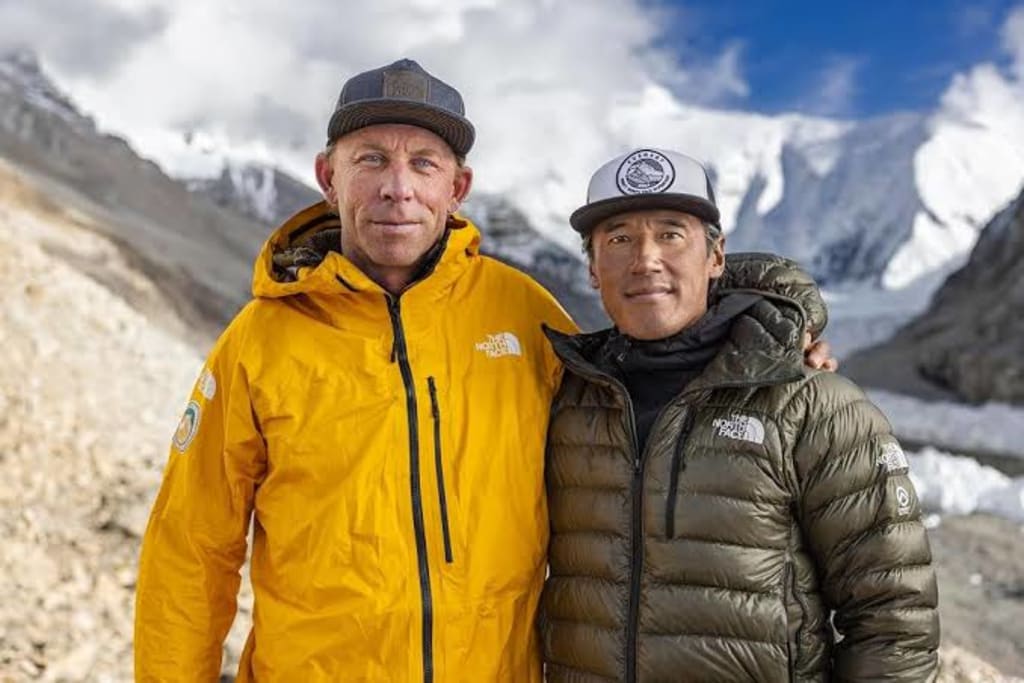
On October 15, 2025, he reached the summit via the north face and skied down. The slope was nearly 50 degrees at its steepest, with a vertical drop of 9,000 feet, about 2,743 meters. He took 4 hours and 5 minutes. He told National Geographic: "When I finally crossed the bergschrund, I cried. I had taken so much risk, but I was alive. It felt like a tribute to Hilaree—something she would be proud of. I really felt her with me, cheering me on."
He dedicated the ski to "his late partner," Hilaree. The word used was partner. Not wife. Nelson's former husband is Brian O'Neill. Morrison's wife was Katie, who died.
III.
The film's other line is not on the mountain.
Elizabeth Chai Vasarhelyi and Jimmy Chin co-directed Free Solo, The Rescue, Meru, and Return to Space. They won an Oscar. They were married. In April 2025, they announced they had filed for divorce after thirteen years of marriage. Their statement read: "After a great deal of care and consideration, we have made the difficult decision to end our marriage." Their production company, Little Monster Films, said the divorce would not affect projects in production.
Post-production on Everest: The Other Side was completed around the time the divorce filing became public. The AP review noted that their separation is not mentioned in the film. A Letterboxd review criticized it for that.
At the Venice Film Festival, Vasarhelyi told IndieWire the film "began as a love story between Jim and Hilaree… we never anticipated the tragedy that followed." In the film itself, she appears briefly and says: "This movie, the worst happened."
During promotion she also said: this was the hardest film of her career, possibly her last of this kind, but definitely the last she and Chin would co-direct.
The critics did not see the divorce in the film. But what sat on the editing table was this: a pair of directors who had decided to separate, jointly editing footage in which one of them had recorded the death of the other's partner.
IV.
Yukta Gurung was a Nepali guide. He had summited peaks above 8,000 meters twenty-eight times, including ten ascents of Everest. His reason for guiding was simple: he was born there, grew up there, and Everest was what he saw when he looked up. It was work. It was how he supported a family.
In 2024, while fixing route ropes at 7,790 meters, an avalanche caught him. His leg was broken. Sherpa companions took twenty-eight hours to carry him down the mountain. He survived.
On October 15, 2025, recovered from his injury, he left again with Morrison, Chin, and a team of twelve from Camp C on Everest's north face. The temperature was minus 27 degrees Celsius. The weather was clear. Morrison summited, skied down, and landed. Yukta was on the advance team.
On July 30, 2026, in the Karakoram range in Pakistan, on Broad Peak, 8,047 meters, an avalanche struck. The ten-member international team led by Nirmal Purja was killed entirely. Yukta was among them. He was 38.
In the same accident, the Chinese climber Wang Zhong was killed. The avalanche carried his body more than a kilometer down. The Paper reported that he was pursuing a "14 peaks" project and was two mountains short of the goal.
On September 27, 2026, in Nepal, on Himlung Himal, 7,126 meters, another avalanche struck. Nepali search and rescue teams eventually found fifteen bodies, with some people still missing. Agence France-Presse called it the worst mountaineering disaster in Nepal in more than a decade. All the dead were Nepali team members who had been preparing a base camp for future expeditions.
V.
The wager in Free Solo is that one person decides to face death alone. If Alex Honnold slips, he dies. The audience's sweaty palms and final release are built on that single, voluntary wager.
The wager in The Other Side is that a group of people are pulled into another person's dream. Hilaree died. Morrison had already lost a wife and two children. Yukta survived a broken leg in 2024, accompanied Morrison to the summit in 2025, and died on another mountain in 2026. Sherpas fix ropes at 8,000 meters, carry people down, and take on avalanche risk. The AP critic wrote that during the first attempt, "some Sherpas became wary of the risks involved. Their reasonable hesitation did not put Morrison in the best light." When Morrison finally achieved his dream, "it felt as if many people had moved on with their lives outside the frame. The families back home faded from the film."
In the film, Vasarhelyi asks: "How many people who have eaten at our dinner table are dead?"
That question has no answer.
VI.
After Morrison skied down to the bottom, he cried. He said he felt Hilaree with him.
Yukta did not get a second chance. He survived the 2024 avalanche by self-rescue and by being carried for twenty-eight hours by his companions. The 2026 avalanche on Broad Peak did not give him twenty-eight hours.
Vasarhelyi's line in the film: "This movie, the worst happened." She said it before the film was finished. Her marriage to Chin had not yet formally ended.
A few weeks before she died, Hilaree posted on Instagram: "These past weeks have tested my resilience in new ways." A doctor at base camp told the Kathmandu Post that before the accident, it had snowed there for fifteen consecutive days.
Months after Hilaree died, Morrison decided to return to Everest. He did. When he cried, the reports don't say whether the camera was running.
About the Creator
Jin
Writer of reamstories
https://reamstories.com/jin
Enjoyed the story? Support the Creator.
Subscribe for free to receive all their stories in your feed. You could also become a paid subscriber, letting them know you appreciate their work.
Comments
There are no comments for this story
Be the first to respond and start the conversation.