
The Cable-Free Internet Shift You Didn’t Notice
How fixed wireless is quietly redefining global connectivity
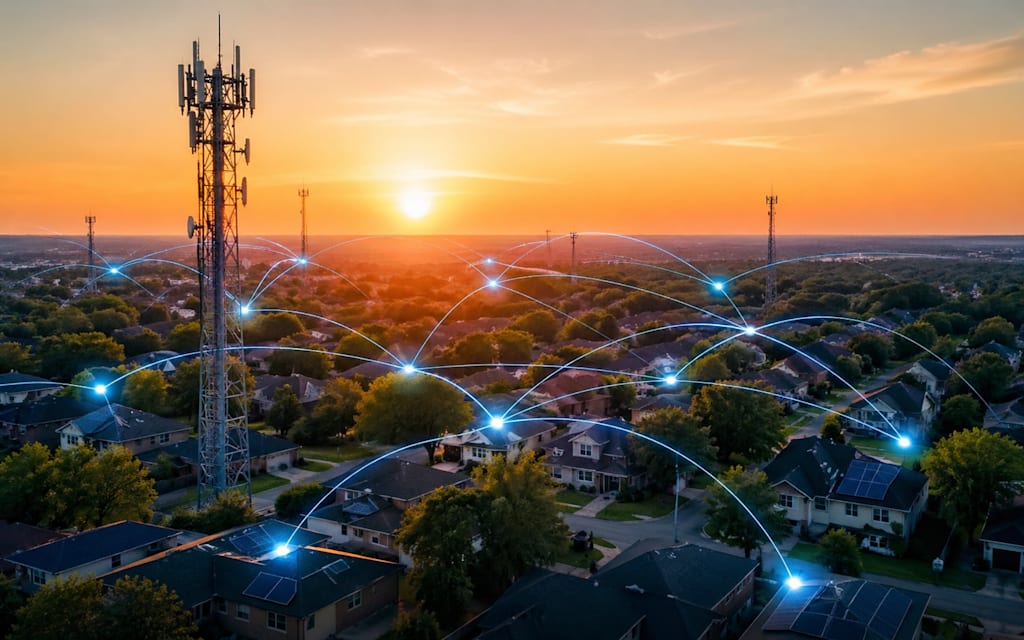
You don’t dig for it.
There’s no trench across your street, no cables threading through walls, no waiting days for installation. Yet, suddenly, the connection is there—fast, stable, and invisible.
It arrives quietly. A small receiver near a window. A signal traveling through air instead of wires. And just like that, a home is connected.
This is the subtle rise of fixed wireless—an innovation that’s reshaping how internet access is delivered. Behind this quiet shift is a rapidly expanding fixed wireless access Industry, redefining how people connect across cities, suburbs, and remote regions alike.
The momentum is deliberate. According to insights from the
The fixed wireless access market size is expected to grow from USD 37.30 billion in 2025 to USD 43.47 billion in 2026, reaching USD 84.37 billion by 2031, registering a CAGR of 14.18% during 2026–2031.
This growth reflects more than adoption—it signals a fundamental shift in how connectivity is delivered and experienced.
The Network Without Wires
Not long ago, internet access meant physical infrastructure—fiber lines, copper cables, and complex installations. Connectivity was something you could trace, touch, and see.
Today, that visibility is fading.
Fixed wireless access replaces cables with radio signals, transmitting data between towers and receivers. It’s a simple concept—but its implications are profound.
This evolution defines key fixed wireless access market trends, where speed, flexibility, and accessibility take priority over traditional infrastructure.
What makes this approach powerful is its efficiency:
No need for underground cabling
Faster deployment across regions
Reliable last-mile connectivity
Scalable for both dense and remote areas
The result is a network that feels almost effortless—yet delivers the performance modern users expect.
As adoption increases, service providers are expanding their reach, strengthening their fixed wireless access market share in both competitive urban markets and underserved regions.
From Connection to Opportunity
The real impact of fixed wireless isn’t just about getting online—it’s about what happens next.
A student in a remote town attends virtual classes without interruption. A small business runs cloud operations from a suburban home. A healthcare consultation happens in real time, regardless of location.
These moments are small—but together, they represent a larger transformation driving fixed wireless access market growth.
What’s changing is the nature of access itself. It’s no longer limited by geography or infrastructure delays.
Instead, connectivity becomes immediate.
This shift aligns with rising search queries like “alternative to fiber internet”, “wireless broadband for rural areas”, and “how fixed wireless access works.”
And the answers all point to the same idea: access is becoming more flexible, more inclusive, and more responsive to real-world needs.
Why the Industry Is Accelerating
The expansion of the fixed wireless access Industry is driven by a clear advantage—speed without complexity.
Deploying traditional broadband infrastructure takes time, investment, and physical disruption. Fixed wireless reduces all three.
This makes it especially valuable in:
Rural and underserved regions
Rapidly growing suburban areas
Temporary or emergency connectivity scenarios
High-demand urban environments
At the same time, advancements in wireless technologies are improving performance, making fixed wireless a competitive alternative rather than just a backup option.
These factors are shaping strong fixed wireless access market trends, reinforcing its role as a core connectivity solution.
Looking ahead, the fixed wireless access market forecast suggests sustained expansion—not as a replacement for fiber, but as a complementary force that broadens the reach of high-speed internet.
It’s no longer about choosing one technology over another. It’s about creating a hybrid ecosystem that adapts to different needs.
A Future Defined by Invisible Access
Imagine setting up high-speed internet in hours instead of days. Imagine entire communities coming online without large-scale infrastructure projects. Imagine connectivity that adapts as quickly as demand grows.
This is the direction the fixed wireless access market is heading.
And like many transformative technologies, it doesn’t announce itself loudly.
It works in the background—quietly enabling access, supporting systems, and expanding possibilities.
As the digital world grows more complex, the simplicity of wireless delivery becomes its greatest strength.
The fixed wireless access market forecast isn’t just about numbers—it’s about reach. About how far connectivity can extend when it’s no longer tied to the ground.
Final Thought
The next time your internet connects instantly—without delays, without installation hassles—pause for a moment.
There’s a chance it didn’t travel through a cable at all.
As the fixed wireless access Industry continues to evolve, one question remains:
If the future of connectivity doesn’t rely on wires… how much of your world is already running on air?
About the Creator
Enjoyed the story? Support the Creator.
Subscribe for free to receive all their stories in your feed.
Comments
There are no comments for this story
Be the first to respond and start the conversation.