
The Borrowed Ring: What Monaco Bought When It Married Grace Kelly
The wedding dress was real. The fairy tale was rented. Inside the palace, an Oscar winner was turned into a national symbol, a mother, and a drawer full of unread scripts.
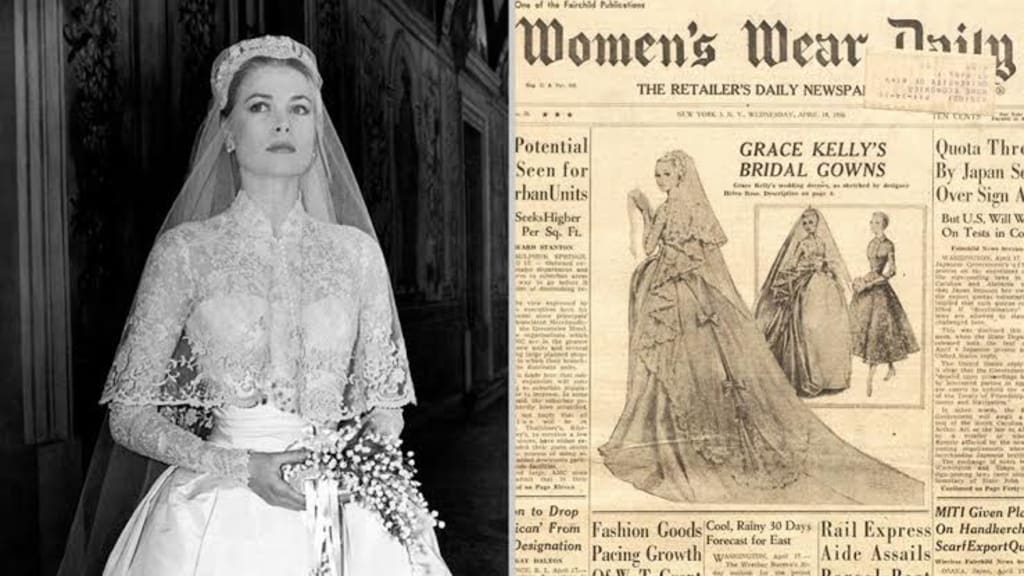
April 1956, Saint Nicholas Cathedral, Monaco.
Grace Kelly’s wedding dress used thirty yards of silk and twenty-five yards of tulle. Helen Rose of MGM designed it. Thirty-six seamstresses worked on it for six weeks. Sixteen hundred journalists crowded into the square outside the palace. Television broadcast a wedding live for the first time. Thirty million people sat in front of their sets and watched a Hollywood actress become a princess.
The ring on her hand was a 10.47-carat emerald-cut Cartier engagement ring. Rainier gave it to her when he proposed and said it was “my grandmother’s ring.” Biographers later checked. The prince had borrowed the ring from Cartier, and it went back after the wedding. Grace wore a different one. The ring was borrowed. The fairy tale was rented. No one thought anything was wrong, because everyone was looking at the wedding dress.
The day after the wedding, palace attendants took away her Hollywood address book. They said they would centralize the royal family’s external communications. She asked whether she could keep one. The attendant said, “Your Highness, all the princess’s private letters are archived by the secretariat.” She did not ask again. That afternoon she opened her suitcase and put the pocket Bible her mother had given her on the bedside table. Tucked inside the pages was an old MGM call sheet with her name and salary printed on it. She pulled out the call sheet and slipped it into another book. The book was called A History of the Principality of Monaco.
Retiring from films did not drop on her suddenly after the wedding. Before the marriage, Rainier had already sent word through an intermediary. The Princess of Monaco could not continue making films. Grace was filming The Swan at the time. She got the call during a break and sat facing the makeup mirror for a long time. The day’s call sheet was clipped to the mirror. Her next scene was at three in the afternoon. She told her agent. The agent asked what she planned to do. She said, “I’ll finish the wedding first and see.”
Several reasons overlapped, and she accepted the condition. Hollywood tired her out. The studios managed actresses like assets. Contracts specified weight limits, forbade changes to her hairstyle, and barred her private life from the newspapers. Her father, John Kelly, had never respected acting. The year she won the Oscar, her father said at a family gathering that “Grace was lucky.” Then he turned and praised her sister Peggy’s husband, the rowing champion at the University of Pennsylvania. Rainier wrote to her that the palace had a library, a garden, and the Mediterranean. She could do Red Cross charity. She could run an arts foundation. She would no longer have to get up at four in the morning to put on makeup. She believed him. She thought retiring meant not making films for now. She did not think it meant never making films again.
Before the wedding there was another thing she rarely mentioned afterward. The palace required her to undergo a fertility examination to confirm she could have children. The examination was done at a private hospital in New York, and the report went straight to Monaco. She once told a friend, “They looked at me like they were buying a horse.” Then she added, “Never mind. I like children anyway.”
For the first six months after the wedding, the palace was relatively loose with her. She could call old Hollywood friends. She could receive actors who came to Monaco. She could attend film festivals. The changes came one at a time. First an attendant said, “Your Highness, it would be best to keep your calls between three and four in the afternoon. At other times the prince is working.” Then her private letters began to be opened and inspected. Envelopes bore an extra stamp from the palace secretariat. Then she wanted to go to Paris to see a Chanel show. The request went up, and the reply came back: “A solo trip by the princess requires the prince’s approval. The prince has foreign engagements that week.”
She called Hitchcock once and talked for forty minutes. The next day at breakfast Rainier said, “You talked with Hitchcock for quite a while yesterday.” She asked, “How do you know?” Rainier said, “The switchboard has to log calls made by members of the royal family. That’s the rule.”
She learned from the newspapers that her old films had been banned. Local cinemas in Monaco received notice that they were no longer to screen any film starring Grace Kelly. She called the palace press officer. The press officer said, “Your Highness, you represent Monaco now. The roles in those old films could easily confuse the public.” She hung up, went to the kitchen, asked for a glass of hot milk, drank two sips, set it on the windowsill, and let it go cold.
In 1962, Hitchcock sent the script of Marnie to the palace. Grace read it and wrote Hitchcock a long letter. She said she wanted to act, that she wanted it badly, and that the role reminded her of how she felt while making Rear Window. She gave the letter to the secretariat to mail. Three days later Rainier called her into his office. The letter was on the desk, photocopied. Rainier said, “You can’t do it.” She said, “It’s only a few months.” Rainier said, “Not even a few months. The princess cannot fall in love with other men on the big screen. What would the people of Monaco think?”
She argued. According to a royal aide present at the time, she said, “This is my profession.” She said, “I trained for this my whole life.” She said, “You said I could continue doing something related to the arts.” Rainier replied, “Something related to the arts does not include acting.” She left the office and closed the door behind her. She did not slam it. That evening there was a state dinner. She wore white Givenchy and talked with the Italian ambassador for twenty minutes about Renaissance frescoes. She smiled the whole time. After the dinner, back in the bedroom, she told her personal maid, “Put that copy of Marnie away for me. In the bottom drawer.” The drawer already held a box of stomach medicine, a tube of hand cream, and a crooked sun drawn by her elder daughter.
The matter of children was put on the agenda in the first month after the wedding. The palace doctor came for regular checkups. At family dinners the elders would ask, “Any good news?” Outside the palace walls the media set up long lenses and waited for her belly to swell. She had a miscarriage the first time. She lay in the hospital for three days. Rainier came once, sat for fifteen minutes, and said, “It will be better next time.” After she returned to the palace, a parenting magazine was on the dining table, open to the page “How to Bear a Healthy Heir for the Royal Family.” She later had three children. Each postpartum recovery lasted no more than six weeks, because the princess needed to resume official duties as soon as possible. The day she gave birth to Prince Albert, Rainier told reporters outside the delivery room, “Monaco has an heir.” In her room she asked the nurse to draw the curtains. She said the light was too bright.
She learned about the prince’s affairs late. Then she was required to pretend she had not. Once she went alone to Paris for a UNICEF event. A reporter asked, “Why didn’t the prince come?” She said, “He is handling affairs of state.” The reporter asked again, “There are recent rumors that the prince often goes to Paris.” She looked down and adjusted her white gloves. It took her three tries to fasten the button. Then she looked up and said, “I haven’t heard.” That night back at the hotel, she wrote a letter to her best friend. The letter contained one sentence: “Today it took me a long time to fasten my gloves.” A biographer later obtained the letter. There were two small holes in the paper, as if something sharp had stabbed it.
She did try to do things inside the palace. She proposed child-welfare programs. She proposed opening part of the palace as a public art gallery. She proposed adding art classes to Monaco’s public schools. Some proposals were approved. Some were sat on. For the ones that were sat on, the palace secretary-general would tell her, “Your Highness, these need the prince’s signature.” She went to Rainier for signatures. Rainier said, “Let the secretary-general look first.” The secretary-general looked for three months and replied, “The budget is insufficient.”
Her correspondence with old Hollywood friends also broke off later. She wanted to write. The letters could not be sent. Once she wrote a thank-you letter to the Grace Kelly Fan Club. The secretariat intercepted it, on the grounds that it was not appropriate for the princess to correspond directly with a private organization. She slipped the unsent letter into a photo album. The first page of the album was a photograph of the night she won the Oscar. On the back, in faint pencil: “This is me.”
After 1965 she appeared in public less often. The palace said, “The princess is unwell.” Tabloids wrote, “The princess has depression.” The court did not respond. She was indeed taking medication: stomach medicine, sleeping pills, a small white pill. She told a visiting American journalist, “Sometimes I feel this palace is very big. Sometimes I feel it is only as big as the one floor tile I am standing on.” The journalist put the sentence into a draft. The palace demanded it be cut. The journalist cut it. The sentence later appeared in the journalist’s private diary.
She kept one habit. Every night she read scripts. She read the scripts she had already filmed: Rear Window, The Country Girl, To Catch a Thief. The title pages had notes she had written back then, in tiny pencil handwriting. Some places were rubbed fuzzy with an eraser. When she read, she would take a fresh pencil, write new marginal notes in the blank spaces, then erase them after. The maid once asked why she erased them. She said, “No use keeping them.”
In September 1982 she was driving with her younger daughter, Stephanie, from Roc Agel back to Monaco. On a bend in the mountain road the car went off the embankment. Before the car rolled down, the last thing she said to her daughter was “Don’t be afraid.” The hospital worked on her for a day. The next day she was declared brain-dead. The palace issued an obituary: “Her Highness the Princess died in a car accident.” At the funeral Rainier stood in the first row, wearing sunglasses. Hitchcock did not come. He sent a wreath. The card read: “For Grace, the one who never got to play Marnie.” The protocol officer took the card away and did not put it out.
After her death, the palace sorted her belongings. In the bottom drawer of the bedroom they found a stack of scripts. On top was Marnie. On the title page was a line in pencil, written lightly: “1962. They said no.” Underneath were a half-empty box of stomach medicine, a dried-out tube of hand cream, and a child’s drawing. At the very bottom of the drawer was an old MGM call sheet. Next to the salary figure someone had written a line in pen, not in Grace’s handwriting: “Archived.”
About the Creator
Jin
Writer of reamstories
https://reamstories.com/jin
Enjoyed the story? Support the Creator.
Subscribe for free to receive all their stories in your feed. You could also become a paid subscriber, letting them know you appreciate their work.
Comments
There are no comments for this story
Be the first to respond and start the conversation.