
The Bill Gates Harvard Story Is Not the Lesson You Think It Is
He didn’t leave because Harvard was too hard. He left because the market was moving faster than the classroom—and because genius without timing, capital, and nerve is just a clever person in a dorm room.
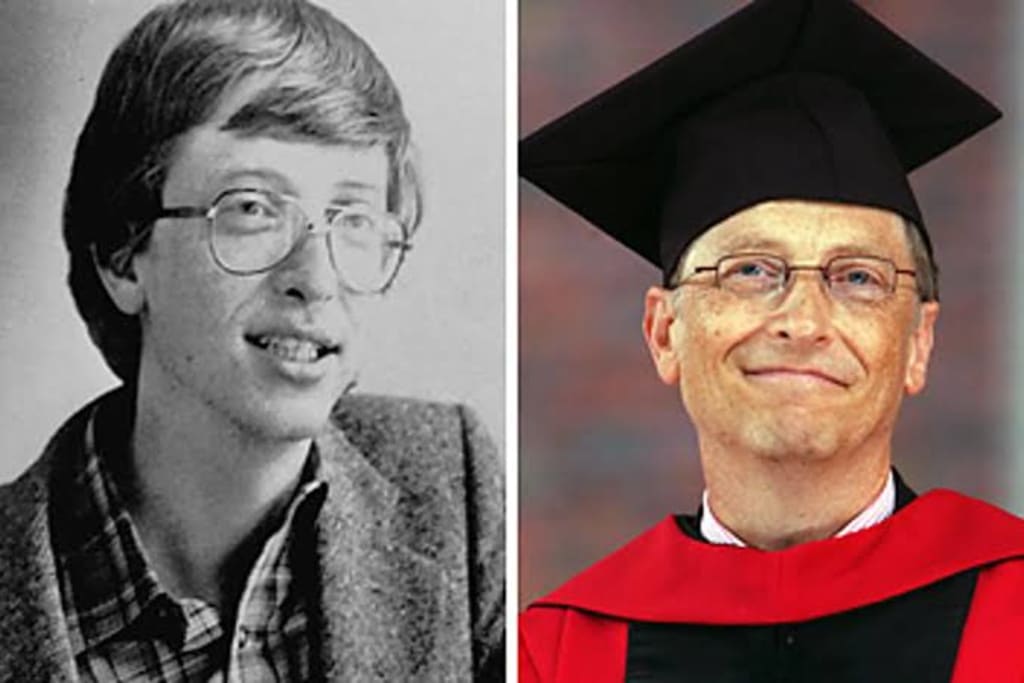
There is a stubborn myth about Bill Gates that refuses to die: the idea that he “dropped out” of Harvard because he could not handle it. The story is usually told as a kind of anti-institutional fairy tale. Harvard was too slow, too small, too conventional. Gates saw through it, walked away, and became the richest man in the world. The moral is supposed to be that real genius does not need school.
That version is satisfying, but it is also misleading.
The first correction is factual. Gates was not a Harvard law student. He entered Harvard College in the early 1970s and worked seriously in mathematics and computer science. He was not a confused humanities student who wandered into a lab. He had been programming since high school, had exceptional technical skill, and co-authored a paper in discrete mathematics as an undergraduate. That paper was not a campus newsletter piece; it was published in a respectable mathematical journal. In other words, the young Gates was not merely bright. He was unusually, almost freakishly capable in the exact areas that mattered for the coming personal-computer revolution.
So no, the standard story is not that Harvard was too difficult for him. Harvard was not failing him, and he was not failing Harvard in the ordinary sense. He took a leave of absence—not a dramatic permanent expulsion from the world of ideas—and left to start a company with Paul Allen. If Microsoft had collapsed, the safe assumption is that he could have returned to finish his degree. He had the academic ability, the family background, and the fallback options. That safety net matters enormously, and it is usually left out of the inspirational version.
What actually happened was more interesting than the myth. In the mid-1970s, the microcomputer was emerging as a real commercial possibility. The Altair 8800 had shown that hobbyists and small companies were hungry for software. Gates and Allen saw a narrow window: write a BASIC interpreter for the machine, move fast, and build a software business before the giants noticed. That window was not going to stay open forever. Harvard could teach him many things—mathematics, discipline, how to argue with brilliant peers—but it could not give him a market that was being created in real time outside its gates.
This is the defensible version of “Harvard could not teach him.” It is not that Harvard had nothing left to offer. It is that the specific education Gates wanted at that moment was not a course catalog. It was a race against other hobbyists, other companies, and other operating systems. He left because the opportunity cost of staying had become enormous. That is very different from leaving because classes are boring.
The distinction matters because the popular myth is a machine for producing bad advice. It encourages young people to confuse irritation with insight. It whispers that if you feel constrained by school, you might be the next Gates. But most people who leave school without a concrete plan are not stepping into a once-in-a-generation market window. They are stepping into uncertainty with fewer credentials, less leverage, and no co-founder who has already been thinking about the same technology for years. The Gates story is not evidence that school is unnecessary. It is evidence that timing, domain mastery, and a realistic escape route can sometimes make school the slower path.
There is also a quieter truth in the story: institutions are not all-powerful. A university can be excellent and still be the wrong place for a particular person at a particular moment. The mistake is turning that into a universal rule. Harvard was not “too shallow” for everyone. It was not even too shallow for Gates in every respect. He benefited from being around ambitious peers, from access to computers, and from the credibility of the institution. He did not burn it down. He left the door open.
The real lesson is not “drop out and change the world.” The real lesson is harder and less romantic: know the difference between a pond that is genuinely too small and a pond you are simply tired of swimming in. If you want to leave, do not leave because you are annoyed. Leave because you have evidence, a skill, a market, a team, a runway, or at least a serious experiment. Gates had all of those things in some form—plus a family safety net that most people do not have. That is not an argument for staying in school forever. It is an argument for telling the truth about why someone left.
Bill Gates did not flee Harvard because he was losing. He left because he had an unusually rare chance to win outside it. The myth turns that into a slogan for every restless student. The reality turns it into a more useful question: what exactly do you have that the world outside is waiting for?
About the Creator
Jin
Writer of reamstories
https://reamstories.com/jin
Enjoyed the story? Support the Creator.
Subscribe for free to receive all their stories in your feed. You could also become a paid subscriber, letting them know you appreciate their work.
Comments
There are no comments for this story
Be the first to respond and start the conversation.