
The AI Godfather Will Trust Jensen Huang. He Won’t Buy a Used Car From Musk, Altman, or Zuckerberg.
Geoffrey Hinton’s test for tech leaders is simple: does their power come with accountability?
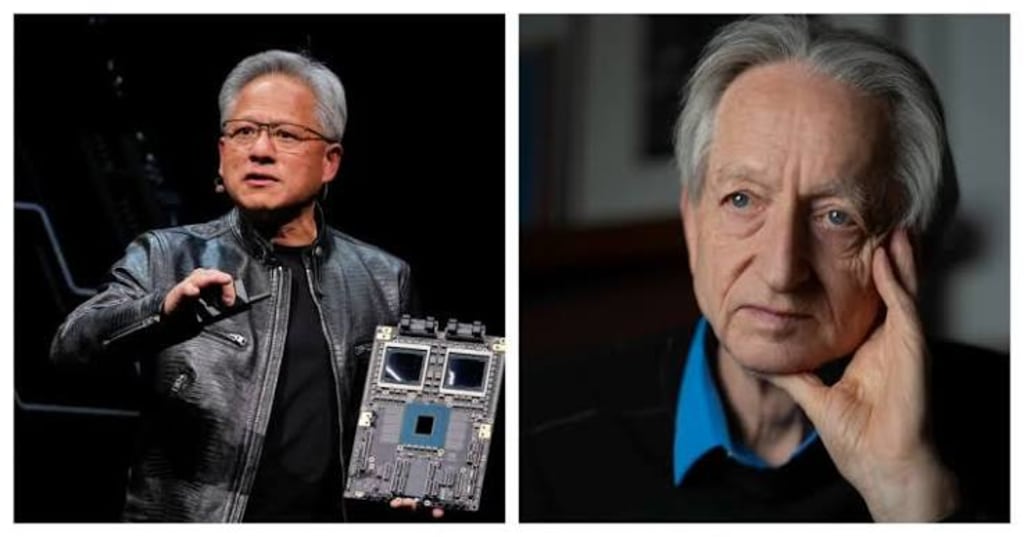
On November 13, 2026, PBS’s Firing Line asked Geoffrey Hinton about Jensen Huang. Hinton said he had met Huang and thought he was a decent guy. Huang had made a mistake, Hinton said, but he did not belong in the same category as Elon Musk and Mark Zuckerberg.
Then Hinton added a line that changed the interview’s center of gravity: the future of humanity should not be controlled by a handful of men.
That line matters more than the personal verdict. Hinton’s view of Huang as a person is one thing. His view of Nvidia’s commercial position is another. In an October 2026 CNN interview, he put it more directly: Huang downplays AI risk because he wants to sell more Nvidia chips.
Hinton is naming an incentive problem.
1. Jensen Huang: a decent guy and a business that has to sell chips
Hinton’s calibration on Huang deserves a closer look.
He did not say Huang is a good man, so Nvidia is fine. He said he met Huang, had a decent impression, but Huang made a mistake, and his commercial role shapes his public judgment about AI risk.
The CNN quote has two layers. First, Nvidia’s revenue is tied to demand for AI compute. Training large models requires GPUs. Inference requires GPUs. Data centers require GPUs. The hotter AI gets, the tighter the chip supply. Second, when a person in that position says publicly that AI risk is overblown, that statement deserves scrutiny.
Hinton did not accuse Huang of lying. He argued that a position shapes judgment. That is a structural problem, not a moral one.
His attitude toward Huang comes down to this: the person may not be bad, but the position does not allow neutrality. Character and commercial judgment are separate.
One detail is easy to miss. Hinton admits no one can precisely estimate the probability of superintelligent loss of control. His risk numbers are a warning, not a statistical conclusion. Huang’s claim that the probability lacks scientific basis is not unreasonable on technical grounds. Hinton’s response moves to another level. An inability to estimate probability does not make the risk ignorable. A person who profits from accelerating AI has the strongest incentive to say we cannot estimate it, so we need not worry.
The disagreement is about position and speech, not only about who is right.
2. Musk, Altman, and Zuckerberg: they know the risks but do not take them seriously
In a November 3, 2026 Guardian interview, Hinton did not hold back. He said the three know AI carries risks but do not really take them seriously. They are more willing to pursue money. He stressed that he does not trust Sam Altman at all. In a November 5 City A.M. interview, he added that he would not buy a used car from any of them.
The used-car metaphor is harsh. It points to a simple doubt: when enormous interests are at stake, will these people sacrifice what they claim to care about?
Each man sits at a different structural problem.
Musk’s problem is not commercial ambition. It is the concentration of power. He is involved in electric vehicles, spaceflight, social platforms, and artificial intelligence at the same time. In the October 2026 Guardian interview, Hinton also criticized Marc Andreessen, Peter Thiel, and Musk. He argued that some of them do not believe in democracy and want society controlled by a small group with technological and capital advantages.
Hinton is not worried that one Musk product will fail. He is worried about a model of governance. When a few private entrepreneurs control algorithms, compute, data, and distribution platforms, they become power actors. They can shape public policy, the information environment, and how society runs. That power is not elected. It has no matching accountability.
Altman’s problem is the tension between mission and commerce. OpenAI’s early positioning emphasized AI safety and long-term public interest. Once generative AI became one of the world’s most important technology industries, huge capital investment, commercialization pressure, and competitors pushed the company toward shipping first and worrying later.
Hinton’s judgment of Altman connects to the 2023 OpenAI board crisis. Ilya Sutskever helped push Altman out of the CEO role. The company fell into internal conflict. Altman returned. Hinton’s assessment is sharp: Sutskever has a strong moral compass and is an excellent scientist, but he is not good at political maneuvering. Altman is the opposite. Hinton said that if it were up to him, he would fire Altman too, though he joked that he might wait until the financing was complete.
That is Hinton’s personal judgment, not an investigation of Altman’s motives. It points to a question. A company that pushes frontier AI forward also evaluates its own technology. Does it have enough independence? The board crisis exposed the crack. Safety concerns, governance, and commercial power collided, and commercial power won.
Zuckerberg’s problem is platform scale. Meta’s AI strategy is not just a chatbot. It wants AI across the digital environment: recommendation systems, content generation, advertising, user interaction, and information distribution. AI capability improvements are tied to user engagement, advertising efficiency, and platform competitiveness.
Hinton’s concern is concrete. When limiting an AI capability would hurt revenue, does the platform have enough incentive to limit it? Meta may still act. Its incentive structure does not naturally point to safety first.
Three men, three structures. Musk is power concentration. Altman is the tear between mission and commerce. Zuckerberg is the mismatch between platform scale and public interest. Hinton distrusts the incentive bias that comes with the position.
3. Sutskever: scientific ability and a moral compass
To understand Hinton’s judgment, look at whom he places outside the opposing camp.
Ilya Sutskever was Hinton’s student. He helped build OpenAI’s early technical systems. He has long warned about losing control of superintelligence. In 2023, Hinton said Sutskever has a very strong moral compass and takes AI safety seriously. In the November 2026 City A.M. interview, he said something similar. Sutskever is outstanding in technical judgment and moral principle, but he is not good at political maneuvering.
This contrast raises a leadership question. Being good at pushing technology forward does not mean one should decide how fast it develops.
AI company leaders handle capital, talent, products, markets, and technical roadmaps. When a company develops models that may act with high autonomy, join scientific research, write software, and accelerate their own R&D, the manager’s job changes. They must answer: Which capabilities can be developed? Which should wait? Which risks need independent testing? When competition demands a fast launch and the safety team says risk is not controlled, who decides?
Sutskever earns Hinton’s praise because he ties scientific ability to responsibility for consequences. He should not be turned into a spotless safety hero. The 2023 board crisis was complicated. One scientist’s assessment cannot settle every question. The point is that technical safety needs binding force inside an organization. It cannot remain a mission statement in public relations.
4. What Hinton fears
Put Hinton’s recent statements together and three concerns appear.
First, technical capability is concentrating. Training and deploying the most advanced AI models requires capital, chips, data centers, energy, and high-level teams. Frontier AI development sits with a few large companies. They own the technology. They also decide the direction of model development, the pace of release, and the commercial use of the technology.
Second, the technology race can overwhelm safety work. Companies compare model capability, market share, and financing. Releasing a stronger model first is an advantage. Safety research needs tests, independent verification, and time. Companies gain from fast release. Society bears the costs of loss of control, privacy leaks, cyberattacks, and job shocks. This is an externality problem. Firms take the gains. Society carries the risks.
Hinton warned in the November 2026 Guardian interview that AI could cause a major social shock like Chernobyl in the short term. He gave examples: AI-assisted attacks could cause large power outages, or the financial system could fail to operate normally for a week. These events have not happened. He argues that the gap between development speed and safety governance can create systemic risks society has not prepared for.
Third, corporate self-regulation is not enough. Hinton argues that companies developing frontier AI cannot be the only judge of their own safety. They have technical knowledge. They also face market pressure and commercial interests. He wants an AI regulator modeled on the U.S. Food and Drug Administration. Before releasing the most advanced models, companies would submit statistical evidence to an independent agency showing that overall benefits outweigh potential harms.
The approach has four parts. Pre-release testing would evaluate frontier models before problems appear. Independent assessment would not rely only on company safety reports. Unified standards would make evaluations reproducible and comparable. Cross-border cooperation would create a common framework for risks with global impact. Hinton also says the United States and China share an interest in avoiding loss of control over superintelligence. AI safety cannot be reduced to technological competition between countries. If an uncontrollable superintelligent system emerges, its risks will not stop at a border.
5. The incentive behind the judgment
Back to the opening question. Why does Hinton assess these leaders so differently?
He is not judging private character. We cannot independently verify all his subjective views. He is asking harder questions.
Is this person willing to accept necessary constraints?
When commercial and social interests conflict, how will he choose?
When technological risk may affect all of humanity, will he let external institutions share decisions?
As power grows, does he still admit that he needs supervision?
These questions sit closer to AI-era leadership than whether a CEO is smart or visionary.
Huang shows that personal character and commercial interest can be separated. Altman shows that technological ideals, governance, and capital markets can tear against one another. Musk and Zuckerberg show the challenge to public governance when platforms, capital, and private power concentrate. Sutskever shows that scientific ability and moral responsibility belong together in frontier technology.
Hinton is not always right. His timing predictions have been off. His quantitative risk estimates carry uncertainty. A Nobel Prize does not turn every judgment into fact. His special position is this: he understands why the technology works and how neural networks differ from traditional software. He knows the technology he helped create is becoming more powerful. He knows existing institutions may not be ready.
His warnings are not simple pessimism. He does not believe AI must bring disaster. He accepts that AI could create a future with higher productivity and more social wealth. His fear is about speed. If technology develops much faster than safety governance, social adaptation, and checks on power, people may bear the costs before they share the benefits.
Conclusion
Hinton’s different assessments are not a good-and-bad list. They point to a harder question. As AI affects economic structures, political order, employment systems, and survival conditions, who should hold this power?
An excellent entrepreneur can build a great company. An excellent scientist can push a major breakthrough. Neither ability gives a person the right to decide humanity’s technological future without constraint.
The AI industry needs commercial judgment. It needs scientific breakthroughs. It also needs independent regulators, public governance, and institutions that answer for long-term consequences. A few people can create technology. A few people should not decide the future it shapes.
About the Creator
Jin
Writer of reamstories
https://reamstories.com/jin
Enjoyed the story? Support the Creator.
Subscribe for free to receive all their stories in your feed. You could also become a paid subscriber, letting them know you appreciate their work.
Comments
There are no comments for this story
Be the first to respond and start the conversation.