
The $92 Billion Automotive Software Revolution Is Already Underway
As connected cars, EVs, and self-driving technologies advance, software is rapidly becoming the automotive industry's most powerful growth engine.

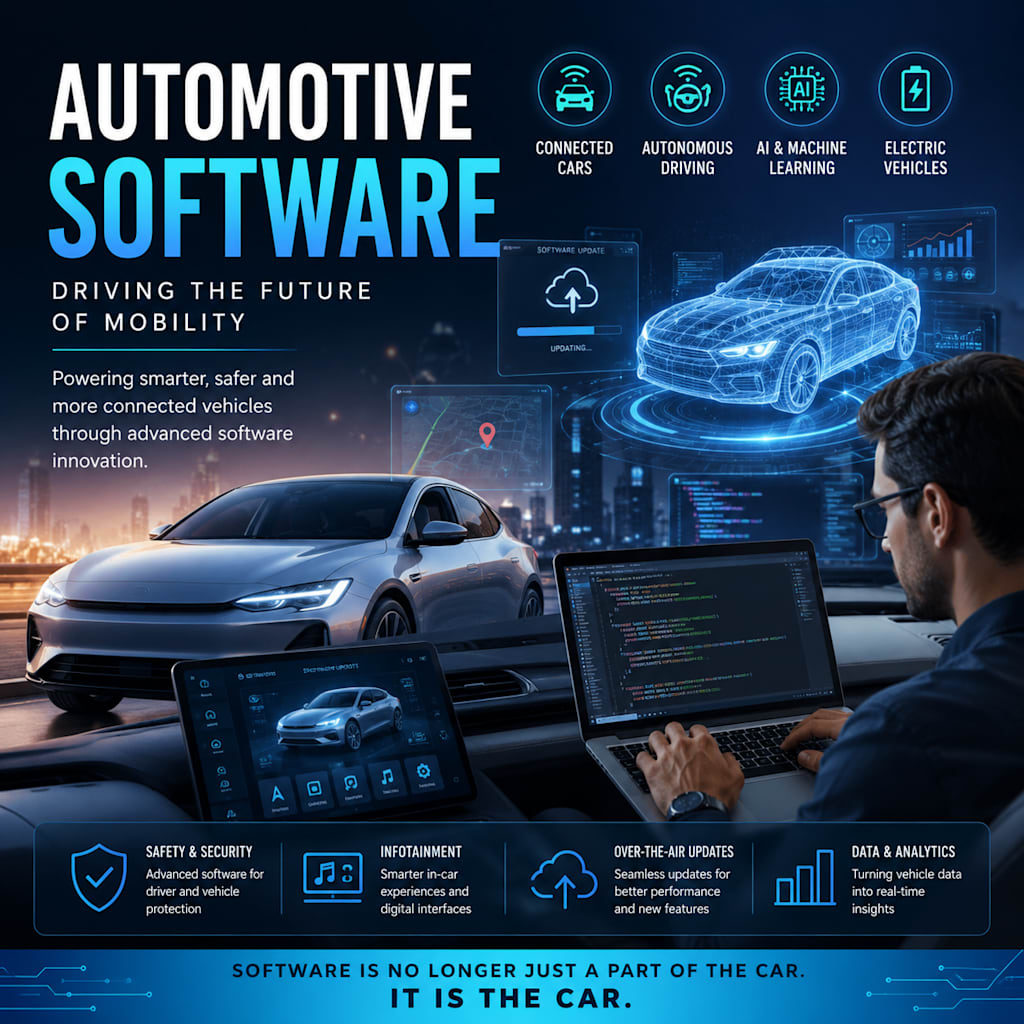
Why Software Is Becoming the Most Valuable Part of Modern Vehicles
For over fifty years, the Auto industry was ruled by Mechanical Engineering. Hp, engine performance, economy and quality of the build made it to the top.
Today, that is changing.
Unlike before, cars nowadays have a software component that runs the vehicle, along with the hardware and the engine. Everything is connected by means of networks and a variety of software that insulates all the innovation that is coming in the future.
With cars becoming smarter, more connected and more autonomous by the day software in automobiles is fast becoming one of the fastest growing areas of the worldwide automotive market.
A Market Experiencing Explosive Growth
Automotive software market is worldwide and had a worth of about USD 26.9 billion as of 2025. Industry experts have projected that the market could break USD 92 billion by the year 2034, which is a very high 14% annual growth rate.
This growth is indicative of a major transformation happening within the automotive industry.
Cars are not just means of transportation anymore. They are becoming smart digital platforms, able to analyze plenty of information, connect with outside world and optimize themselves over the time.
Because of it, software development is becoming equally critical as the manufacturer of vehicles.
The Rise of Software-Defined Vehicles
Perhaps one of the most revolutionary trends revolutionizing the auto industry is the rise of the software defined vehicle (SDV).
Historically, vehicles would leave the factory with a set of functions that have been predetermined. However, now the car manufacturer has the ability to add additional functions, refine existing ones and correct problems by means of remote software updates.
This means a vehicle bought today can be upgraded months or years down the line without needing any hardware modifications.
People have already understood this concept on their mobiles. The same principles are quickly becoming a norm in the car industry.
Software is being viewed by manufacturers more and more as a long-term platform than a purely transient product.
Autonomous Driving Is Accelerating Innovation
Speaking of the single piece of technology that showcases the significance of automotive software writing, it might very well be Autopilot.
Self-driving systems rely on a combination of:
- Artificial intelligence
- Machine learning
- Sensor fusion
- Computer vision
- Real-time data processing
For instance, every second, self-driven vehicles deliberates information captured from cameras, radar, LIDAR, and GPS Network.
This production level so involved deserves to be elaborated with, so it takes very high software architecture to process so much information so fast.
Automakers and technology companies now for emerging fully autonomous vehicle.
Electric Vehicles Depend on Software More Than Ever
The rise of EVs is a large factor for the growth of automotive software.
Unlike traditional vehicles, EVs rely heavily on software to manage critical functions such as:
- Battery performance
- Charging optimization
- Energy consumption
- Thermal management
- Range estimation
Drivers are growing demand for accurate battery data and optimized charging plans with smart energy management system.
This would not be able to be implemented without software of a more sophisticated quality.
However as governments all over the globe continue to push for greener means of transport, the EV penetration is likely to drive the software demand for years to come.
Connected Cars Are Transforming the Driving Experience
The cars we drive are more connected than ever.
Modern drivers demand that their cars and digital worlds work perfectly together.
Modern connected vehicles can provide:
- Real-time traffic information
- Navigation assistance
- Remote diagnostics
- Vehicle tracking
- Entertainment services
- Over-the-air software updates
Today, in many ways, vehicles are becoming mobile digital ecosystems.
In addition to the potential benefits of clients and contractors mentioned above, for companies operating large portfolios of vehicles the connected software services present considerable operational advantages in- planning routes more accurately, reducing maintenance costs, and saving overall efficiencies.
Artificial Intelligence Is Entering the Driver's Seat
Designing for the Future Appears to have arrived before us as the revolution that will take place in the automotive industry due to the proliferation of artificial intelligence, data tracking and artificial agents is already happening..
Software driven by AI is already contributing to increased security, fuel efficiency and performance in vehicles.
Some of the most important applications include:
Predictive Maintenance
Self-diagnosing-I.e. Allows AI systems to monitor vehicle data and detect impending mechanical failures.
Intelligent Driver Assistance
Modern vehicles use AI to support features such as:
- Lane-keeping assistance
- Adaptive cruise control
- Collision avoidance systems
- Driver monitoring technologies
- Personalized User Experiences
Intelligent infotainment systems with AI capabilities could learn driver preferences, provide more intelligent navigation routing and make the human interface more user friendly.
With the rapid advancement of AI technologies, the control of automotive software will be far more enhanced.
Safety Remains a Top Priority
Safety requirements are tightening all markets..
Governments and regulatory bodies are also insisting on more sophisticated safety systems in new cars.
Software now plays a critical role in enabling systems such as:
- Automatic emergency braking
- Electronic stability control
- Blind-spot monitoring
- Driver alert systems
- Collision detection technologies
Consumers are also now placing a higher emphasis on safety in their purchasing decisions, which is spurring significantly increased investment in software enabled safety systems by manufacturers.
This has created a booming market for automotive software products that are focused on safety.
Why Asia-Pacific Is Leading the Market
In all of the regions, Asia-Pacific is highest of all the automotive software market.
Several factors contribute to this leadership position:
- Strong vehicle production capabilities
- Rapid adoption of electric vehicles
- Significant investments in automotive technology
- Large consumer markets
(An increasing demand for connected and intelligent vehicles.)
Innovative developers such as China, Japan, South Korea and India countries will accelerate in the region also by another reason, because such countries still invest heavily.
Simultaneously, it is worth highlighting that North America and Europe still are significant centers for automotive software development, mainly with great importance on levels of automation and vehicle safety systems.
Challenges Facing the Industry
Automotive software developers, despite booming industry, face a number of issues.
Security we all know is one of the largest fears of the industry.
As cars become more connected, safeguarding them from cyber risks becomes crucial.
Manufacturers must also navigate:
- Complex regulatory requirements
- Rapid technological changes
- High software development costs
- Data privacy concerns
- System reliability expectations
These issues, inevitably, will have to be addressed in order to sustain long term growth.
Looking Ahead
Transportation is moving more and more towards software.
In the next ten years, vehicles will be smarter, safer, connected and more autonomous than they are today.
A significant part of this will be the continuous development of software that is the backbone that underpins innovations in electric mobility, automation, artificial intelligence and connected transportation systems.
Except for engines and hardware, everything else can been quickly differentiated by software.
The companies that are leading this transition won't just produce better cars-they'll produce smarter cars.
And in the not-too-distant future software may be the most valuable component within every vehicle on the road.
About the Creator
Robert
Senior Market Researcher at IMARC Group, specializing in global market analysis, industry trends, and data-driven insights across diverse sectors.
Enjoyed the story? Support the Creator.
Subscribe for free to receive all their stories in your feed.
Comments
There are no comments for this story
Be the first to respond and start the conversation.