
The $7.6 Billion Metabolomics Boom Nobody Is Talking About
How Precision Medicine, AI, and Biomedical Research Are Driving a Silent Healthcare Revolution

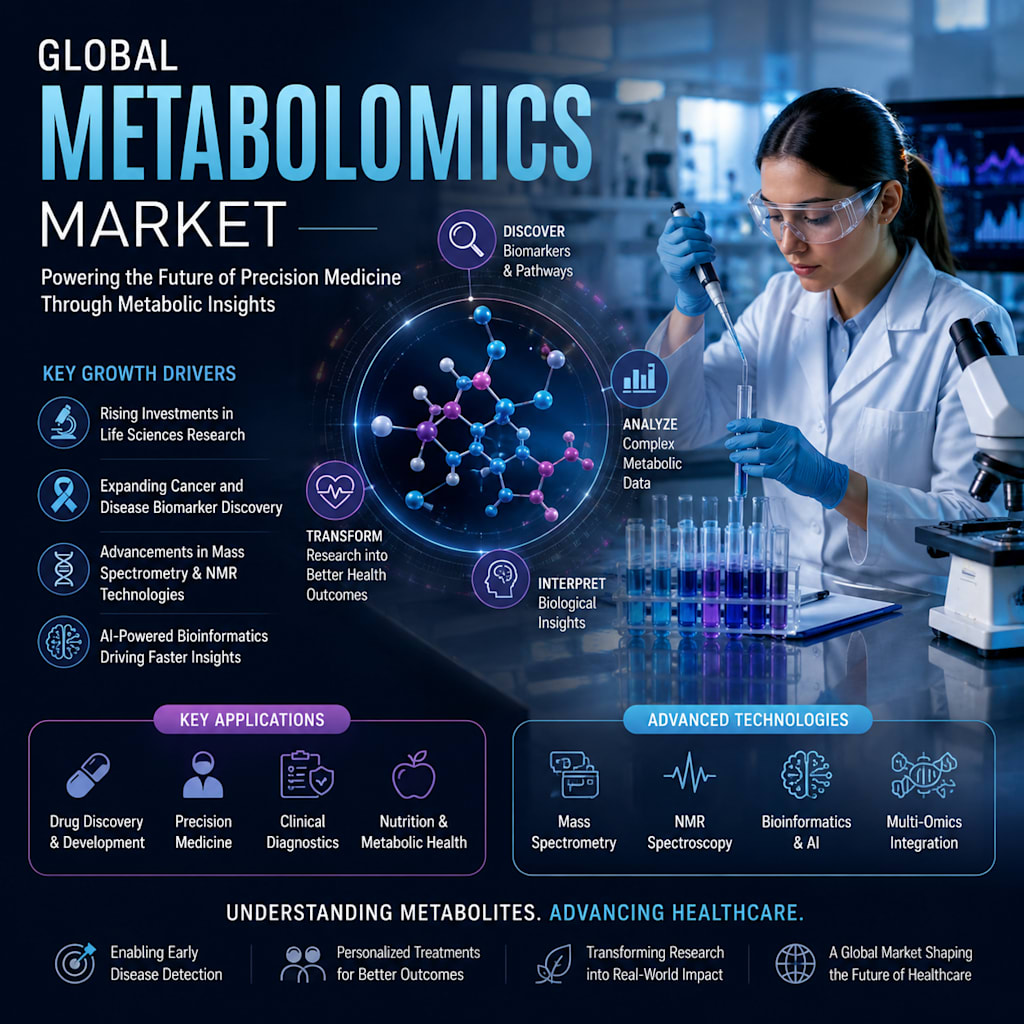
Medicine is entering a new era.
Scientists spent decades focusing primarily on the role genes play in disease. Then they turned their attention to proteomics, the microbiome and AI-driven diagnostics. Now, another field is rapidly gaining traction - metabolomics.
Although the term sounds highly technical, the underlying concept is quite simple: mapping the microscopic molecules within the body that tell a real-time story about what is truly happening in health.
According to industry estimates, the rest of the world is taking note.
The global metabolomics market size, valued at roughly $3.25 billion in 2025, is projected to reach nearly $7.64 billion by 2034. The forecast growth demonstrates that this trend is about far more than just scientific curiosity – it marks a significant shift in the way disease will be diagnosed, monitored and treated in the years to come.
So, What is Metabolomics?
There are millions of chemical reactions occurring within the body every second of the day.
These processes produce tiny molecules called metabolites that are critical to numerous physiological processes including energy production, immune response, digestion, cell repair, and more.
Metabolomics is the study of these metabolites.
Unlike genetic testing which measures potential while indicating what might happen, metabolomics offers a snapshot of what is happening within the body in real time.
This difference is immense.
It can allow for early disease detection, offer insights into the effectiveness of treatments and enable individualized therapies that are tailored to a patient's metabolic profile.
Why the Excitement Around it?
One of the major reasons for the significant interest in metabolomics is that many diseases can impact the body's metabolism long before clinical symptoms manifest.
Both cancerous cells and neurological disorders, for example, may alter metabolism years before noticeable changes are detected.
Scientists are hoping to utilize the profiling of these metabolic changes to aid in the faster and more accurate detection of illness. In turn, it could help to transform healthcare from a reactive treatment process to a proactive, preventative model.
Doctors could be able to make intervention decisions before disease has progressed too far.
Cancer Research Driving Investment
In terms of application area, cancer research remains the largest growth sector in metabolomics. It is increasingly being used for early cancer diagnosis, treatment monitoring, discovery of biomarkers, and improving precision oncology strategies.
Modern cancer treatment has increasingly turned towards a more personalized approach and metabolomics is directly aligned with this movement. Rather than administering the same treatments for all, efforts are underway to develop tailored therapies specific to the biological makeup of each individual patient.
This move towards personalized medicine is a driving factor behind the significant investment from pharmaceutical companies into the metabolomics market.
AI is Accelerating the Field
One of the primary difficulties of metabolomics is the massive amount of data it can generate. Thousands of metabolites can be found within a single sample and may interact in incredibly complex ways, making efficient analysis with traditional methods challenging.
AI technology is beginning to change the face of metabolomics by improving the speed of analysis and the ability to discover hidden trends in large data sets. AI is expected to create completely new opportunities in the fields of drug discovery, personalized medicine, biomarkers, and clinical diagnostics.
Machine learning integration has become a defining trend for the metabolomics market.
The Move Towards Personalized Medicine
Around the world, healthcare systems are gradually transitioning away from broad-brush approaches towards a more personalized one. In essence, precision medicine focuses on tailoring treatments based on individual genetics, environment, lifestyle and, increasingly, metabolism.
Metabolomics is one of the pieces to this puzzle, as it provides insight into what is happening within the body at the cellular level at any given moment. Billions are now being invested by governments, healthcare agencies and pharmaceutical companies into precision medicine, with significant opportunities for metabolomics technologies being created. This trend is particularly crucial for chronic illnesses such as diabetes, cardiovascular disease, neurological disorders, and autoimmune conditions.
As the move towards personalized healthcare gains traction, so too will the demand for metabolic profiling increase.
Neurological Disorders May Become Another Growth Sector
While oncology is currently the dominant field of application in metabolomics, neurological diseases may emerge as a rapidly growing sector over the next ten years. Alzheimer's disease, Parkinson's disease and other similar conditions often prove notoriously difficult to diagnose early. However, researchers are hoping to identify biomarkers within the body that can signal the presence of these illnesses prior to significant symptom presentation.
It is hoped that this capability may help physicians diagnose these diseases earlier, and these efforts have been met with significant investment by biotech companies and universities. If these advancements prove successful, the potential benefit to millions could be enormous.
The Technology Driving the Industry
Metabolomics depends on sophisticated analytical and scientific instruments. Essential for accurate metabolite identification and profiling are devices like mass spectrometers (MS), Nuclear Magnetic Resonance (NMR) spectroscopy, chromatograph systems and AI-powered bioinformatics software. Mass spectrometry is currently the dominant force due to its ability to detect minute molecules at trace levels. Bioinformatics software is becoming increasingly crucial as more biological data is being generated. In the future, the future of metabolomics may ultimately hinge more on the capabilities of software than on the accuracy of laboratory instrumentation.
Asia-Pacific as a Growth Engine
Whilst the market for metabolomics is currently dominated by North America, the Asia-Pacific region is predicted to see impressive growth in the coming years. China, Japan and India are investing heavily in pharmaceutical research, precision medicine programs, life sciences infrastructure and biotechnology innovation, while growing clinical trial activity and an increase in healthcare spending further bolster market prospects. Asia-Pacific is expected to play an increasingly significant role in the global metabolomics market over the next few years.
There Are Still Significant Obstacles to Overcome
Although metabolomics holds great promise, it faces considerable hurdles. High-end analytical equipment, for example, can be exceptionally expensive to purchase and operate, presenting a barrier to adoption for smaller labs. Standardization issues, the complexity of data interpretation, regulatory uncertainty and a lack of highly skilled professionals all contribute to the difficulty of large-scale clinical implementation.
The Future Could Extend Beyond Hospitals
Perhaps the most revolutionary potential for metabolomics lies in the ways it could one day move beyond hospitals. Portable metabolomics systems and wearables capable of analyzing metabolic data outside of the traditional lab environment are already being developed. The future may hold the promise of predicting disease even before the manifestation of symptoms, individualised nutrition plans based on real-time metabolic activity, and wearable devices that constantly monitor health. Though the idea sounds futuristic now, the reality is not that far away.
Final thoughts
Metabolomics has transformed from an experimental discipline into a critical element of modern health research. Its capability to analyze real-time biochemical changes has tremendous implications for diagnostics, oncology, neurology, drug development, and personalized medicine. In partnership with other advancing fields like artificial intelligence, biotechnology and precision healthcare, metabolomics is poised to be one of the most impactful technologies of the next decade. The market's projected growth to over $7.6 billion by 2034 is more than simply an indicator of economic expansion - it represents a significant change in the understanding of illness.
About the Creator
Robert
Senior Market Researcher at IMARC Group, specializing in global market analysis, industry trends, and data-driven insights across diverse sectors.
Enjoyed the story? Support the Creator.
Subscribe for free to receive all their stories in your feed.
Comments
There are no comments for this story
Be the first to respond and start the conversation.