
The 1999 Bet That Put Vladimir Putin on the Road to the Kremlin
Yeltsin did not need the strongest successor. He needed one he could trust, one the state could work with, and one voters might eventually accept. Then war changed the odds.
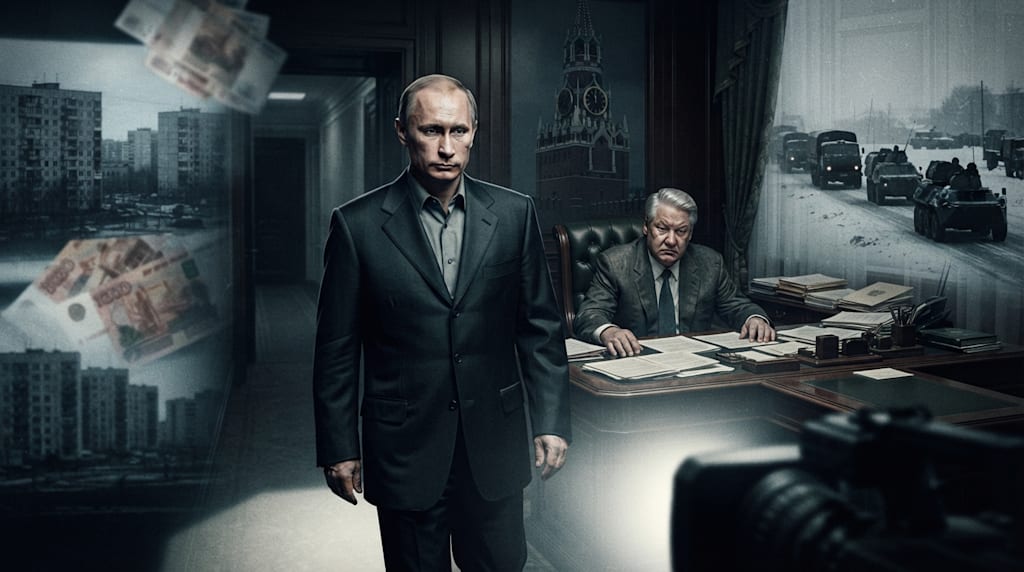
On August 9, 1999, Boris Yeltsin dismissed Russia's government.
The new prime minister was a 46-year-old former intelligence officer most Russians barely knew.
His name was Vladimir Putin.
At the time, Putin was not a political star. He had no national party, no established electoral machine, and almost no independent following. In one August 1999 survey, only about 2 percent of voters said they would vote for him for president.
Yeltsin, however, did more than appoint him prime minister.
In a televised address, he described Putin as the man who could lead Russia into the 21st century. Yeltsin had already gone through four prime ministers in the previous 17 months. Putin was the fifth.
That made the appointment look less like another cabinet reshuffle and more like an early signal about succession.
But there was an obvious problem.
Why Putin?
A man with roughly 2 percent support was being positioned for a presidential race against figures with far deeper political roots.
The answer has two parts.
First, why Yeltsin chose Putin.
Second, why Putin was able to turn that choice into an election victory.
Those are different questions.
And the distinction matters, because in August 1999 almost nothing about Putin's future was inevitable.
Russia was already running out of political room
To understand Yeltsin's choice, start with the crisis he was trying to leave behind.
On August 17, 1998, the Russian government announced a de facto ruble devaluation, restructured domestic government debt and imposed a 90-day moratorium on some foreign payments. The banking system was badly damaged. Over the final five months of 1998, consumer prices rose by more than 75 percent and the ruble lost roughly 70 percent of its value against the dollar.
The economic damage was not an abstract statistic.
Savings lost value. Banks failed. The payments system seized up. Businesses struggled to get paid. Government finances were under severe pressure.
Russia had already spent most of the 1990s living through political instability and a brutal economic transition. Now the state looked unable to guarantee either prosperity or basic order.
Chechnya was another unresolved problem.
The First Chechen War, fought from 1994 to 1996, ended with Russian forces withdrawing and Chechnya gaining broad de facto autonomy. Moscow had failed to impose a lasting settlement.
By 1999, Yeltsin was preparing to leave office with his political credibility badly weakened.
That changed the logic of succession.
The Kremlin did not simply need a candidate who could win an election.
It needed someone who could inherit the machinery of government without immediately threatening the people who had built their positions around Yeltsin.
That did not necessarily mean the most popular politician.
In fact, extreme popularity could be a liability.
A politician with his own party, regional machine, media allies and wealthy backers could enter the Kremlin owing Yeltsin very little.
That was the problem with some of the obvious alternatives.
The men who already had power had one disadvantage
Yevgeny Primakov was the clearest example.
He had been foreign minister and prime minister. He had experience, name recognition and a serious political base.
In August 1999, Primakov joined forces with Moscow mayor Yuri Luzhkov to build Fatherland-All Russia, an electoral bloc that immediately became one of the strongest challenges to the Kremlin. The two men were widely regarded as serious presidential contenders.
That made them formidable.
It also made them difficult to control.
Primakov did not need Yeltsin to invent his political identity. Luzhkov did not need Yeltsin to provide him with a power base. They already had their own.
The 1999 succession fight was therefore not a simple contest between individual politicians. It was a struggle between competing networks of oligarchs, regional leaders, state officials and political organizations. One side was coalescing around Primakov and Luzhkov. The other was built around the Kremlin and its eventual candidate, Putin.
Putin entered this fight from almost the opposite position.
He had very little of his own.
And that was precisely what made him useful.
Putin's political weakness was also his selling point
By August 1999, Putin had accumulated an unusual kind of résumé.
He had spent years in the KGB, including an assignment in East Germany. After returning to Russia, he worked in St. Petersburg politics under mayor Anatoly Sobchak. In 1996 he moved to Moscow and entered the presidential administration. In 1998 he became director of the Federal Security Service, the FSB. In March 1999 he was appointed secretary of the Security Council.
By the time Yeltsin made him prime minister, Putin had spent years moving through the administrative and security systems that actually made the Russian state work.
He knew the bureaucracy.
He knew the security services.
He knew how the presidential administration functioned.
What he did not have was an independent national political machine.
That distinction mattered.
The man coming out of the security system was not an outsider who needed to dismantle the state to gain power. He was a state insider without a large political base of his own.
For a president preparing to leave office, that combination had obvious advantages.
Putin's public profile was low enough to be built almost from scratch.
His institutional résumé was strong enough to make him credible inside the state.
And unlike Primakov or Luzhkov, he did not arrive with a powerful coalition of his own.
In normal electoral politics, that looked like a weakness.
From Yeltsin's perspective, it could also be insurance.
The loyalty question was more complicated than the legend
One part of Putin's biography became particularly important in how his political character was later described: his relationship with Anatoly Sobchak.
Putin had worked for Sobchak in St. Petersburg. After Sobchak lost the mayoral election in 1996, Putin left the city rather than quickly attaching himself to the new political order.
When Sobchak later came under investigation, Putin continued to help him.
That history has often been used to explain why members of Yeltsin's circle came to regard Putin as unusually loyal.
But it should not be turned into a neat causal story.
There is no clean evidence showing that Yeltsin looked at the Sobchak episode and simply concluded, "He saved his old boss, so he will save me."
What the episode did provide was a political signal.
Putin had demonstrated that he could maintain a relationship with a fallen patron even when doing so was not obviously useful to his own career.
In a political system built around personal networks, that kind of behavior carried weight.
It did not prove what Putin would do once he held presidential power.
It did tell the people choosing him something about how he treated the people who had helped him get there.
Then the country gave Putin something he did not have: a public reason to matter
At the beginning of August, Putin had a succession problem.
He had almost no electoral support.
Then events moved faster than any campaign could have.
In August 1999, Chechen Islamist fighters entered neighboring Dagestan. In September, a series of apartment bombings in Russian cities killed hundreds of people.
Putin responded with extraordinary aggression.
The Russian government launched a new military campaign in Chechnya. Putin's public language was blunt, and the contrast with the hesitations of the previous war was obvious.
The political effect was immediate.
Putin's name stopped meaning "the obscure former security official chosen by Yeltsin."
It started meaning "the man who says the state will fight back."
His poll numbers changed accordingly.
A 1999 congressional research report records the shift in voting intention with unusual clarity: about 2 percent in August, 21 percent in October, around 40 percent in November and roughly 55 percent in December.
The Levada Center's historical approval data shows the same basic movement from another angle. Putin's approval stood at 31 percent in August 1999, then rose to 53 percent in September, 65 percent in October and 80 percent in November.
The distinction between those measures matters, but the direction does not.
Putin had entered August as a little-known prime minister.
By the end of the year, he was the most powerful figure in the presidential race.
Yeltsin had created the candidate.
The war gave the candidate a public identity.
The apartment bombings remain the darkest part of the story
This is where the history becomes much harder to write cleanly.
Russian authorities blamed the September 1999 bombings on Chechen militants and their allies.
But the attacks generated persistent questions about whether elements of the Russian security services had played a role.
The most notorious episode came in Ryazan on September 22.
Residents discovered what appeared to be explosives in the basement of an apartment building. Local police treated the incident as a genuine bombing attempt. Two days later, FSB chief Nikolai Patrushev said the operation had actually been a training exercise and that the apparent explosives were harmless material. Contemporary reporting described the explanation as an effort to test public vigilance.
The episode became one of the foundations of later allegations that the bombings had been orchestrated by the security services to create support for a new war in Chechnya.
That claim remains disputed.
The responsible historical conclusion is narrower.
The bombings happened.
The Russian government responded with a new war.
Putin's popularity rose rapidly during the same period.
The Ryazan incident generated a lasting credibility problem around the official account.
Those facts can be established without pretending that the entire conspiracy question has been solved.
That restraint matters.
A political story becomes less convincing, not more, when every uncertainty is converted into a secret plan.
December 31 changed the calculation
By December, Putin had gone from political unknown to overwhelming favorite.
Then Yeltsin resigned.
On December 31, 1999, Yeltsin announced on national television that he was stepping down. Under the constitution, Prime Minister Putin became acting president, and a presidential election had to be held within 90 days.
The timing was politically powerful.
The presidential election that had been expected later in 2000 was suddenly pulled forward.
Putin was no longer campaigning as an ordinary challenger.
He was acting president.
That gave him the symbolic advantage of incumbency, access to the machinery of the federal government and a much larger public platform.
A previously internal Kremlin calculation had now become visible to the entire country.
Putin was not merely Yeltsin's preferred successor.
He was already sitting in the presidency.
The significance of that decision is visible in Yeltsin's own conversation with Bill Clinton that evening.
Yeltsin explained that Putin would have three months as acting president, during which the public would get used to him, and said he was sure Putin would be elected.
That is perhaps the clearest statement of the strategy.
Yeltsin was not waiting for the election to determine who would succeed him.
He was using the constitutional succession process to give his chosen successor the best possible position before the election took place.
And then came the document that made the succession concrete
Within hours of taking office as acting president, Putin signed a decree granting extensive guarantees to former presidents.
The decree gave an outgoing president immunity from prosecution, arrest and detention, as well as protection for his home and family. It also provided security and financial guarantees. Contemporary reporting described the move as a broad protection package for Yeltsin.
The timing was hard to miss.
Yeltsin resigned.
Putin inherited the presidency.
Putin immediately signed legal protections for Yeltsin.
That does not prove that there was a secret written bargain covering every detail of the transfer of power.
It does establish that the two parts of the succession sat next to each other in time.
Yeltsin needed protection after leaving office.
Putin needed the political support of the system that had elevated him.
The arrangement gave both sides something they wanted.
That is more convincing than the cleaner legend that Yeltsin simply "saw greatness" in a little-known security official.
By March, the gamble had become an election victory
Russia voted on March 26, 2000.
Putin won 53.44 percent of the vote in the first round, with Communist Party leader Gennady Zyuganov finishing second at 29.49 percent.
The result matters because Putin's rise was not simply an appointment from above.
Yeltsin had given him an opening.
The Kremlin had given him institutional support.
The war had given him a national issue.
The December resignation had given him incumbency.
But millions of Russians still voted for him.
That is why describing the 2000 election as nothing more than a Kremlin installation misses part of the story.
Putin had acquired something he did not possess in August 1999: a large constituency that associated him with order, force and the restoration of state authority.
The political machinery helped him.
It did not manufacture every vote.
What Yeltsin got right, and what he got wrong
Seen from the summer of 1999, Yeltsin's choice was not irrational.
He needed a successor with access to the security services.
He needed someone who was not already the leader of an independent political empire.
He needed someone who could be introduced to the public quickly.
And he needed someone whom the existing political establishment was willing to support.
Putin fit those requirements unusually well.
The mistake was assuming that those same qualities would make him easy to control.
They did not.
Once Putin became president, he began building an independent political system around himself. The regional political structures of the 1990s were brought into tighter alignment with Moscow. Oligarchs who had enjoyed substantial political autonomy lost room to operate independently. The security services became more central to the presidential system.
Some of the people who helped create Putin's rise eventually fell out with him.
The clearest example was Boris Berezovsky, one of the most influential members of the Yeltsin-era elite and an early supporter of Putin's ascent.
The successor became his own political center.
That is the part of the 1999 story that is easiest to miss when looking backward.
Yeltsin did not choose a future strongman because he knew what Putin would become.
He chose a relatively unknown state insider because, in the summer of 1999, that looked like a manageable solution to an extremely dangerous succession problem.
Then three things happened very quickly.
The war changed Putin's public standing.
The Kremlin turned his candidacy into an organized political project.
Yeltsin's resignation put him in the presidency before the election had even taken place.
Seven months after his appointment as prime minister, Putin was president-elect of Russia.
That is the real story of 1999.
Not a forgotten bureaucrat suddenly revealing his destiny.
Not a single master plan with every move predetermined.
A weak president chose a successor who looked safe.
A collapsing political system gave that successor a chance to become popular.
And once he had both institutional power and public support, the logic of the succession changed.
The man chosen to inherit Yeltsin's system no longer needed to remain inside it.
That summer, most Russians had to ask who Vladimir Putin was.
By the end of the year, the more consequential question was already different:
What happens when the person chosen to succeed a political system becomes strong enough to replace it?
About the Creator
Jin
Writer of reamstories
https://reamstories.com/jin
Enjoyed the story? Support the Creator.
Subscribe for free to receive all their stories in your feed. You could also become a paid subscriber, letting them know you appreciate their work.
Comments
There are no comments for this story
Be the first to respond and start the conversation.