
The $122 Billion Automotive Industry Most People Never Talk About
As electric vehicles and smart cars rise, the automotive wiring harness market is quietly becoming one of the most important sectors in mobility.

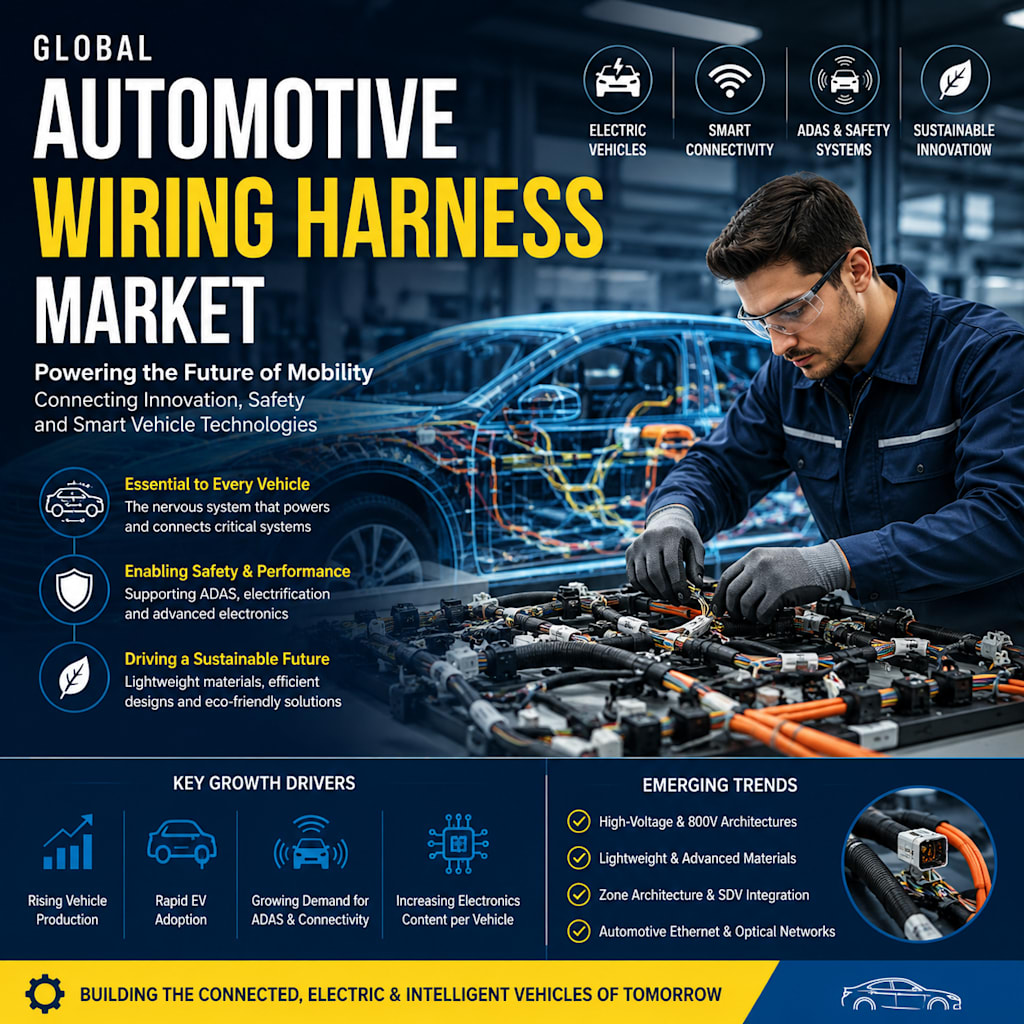
Modern vehicles are moving from a primarily mechanical-based technology to increasingly sophisticated, software-driven platforms that incorporate numerous sensors, connectivity features, advanced safety components and electric powertrains. Behind all of these innovative features lies one indispensable component which is virtually unheard of outside of the automotive industry - the wiring harness.
Also referred to as the 'nervous system' of the car, an automotive wiring harness connects together every electrical and electronic component throughout a vehicle. These essential systems allow information, power, and commands to be communicated between all electrical and electronic components of the vehicle architecture in real time. As the automotive sector witnesses significant expansion in the growth of electric vehicles (EVs), automated and connected car systems globally, the market for the automotive wiring harness sector is entering an accelerated and exciting transformation period.
A Market Which Grew with the Electrification of Vehicles.
The automotive wiring harness market size globally was valued at close to USD 89.4 billion in 2025 and was forecast to be worth close to USD 122 billion by 2034, representing a compound annual growth rate (CAGR) of 3.4% for the period 2026 to 2034. Although this is not a particularly significant growth rate in comparison to some other emerging automotive technologies, the worth of wiring harnesses on a per-vehicle basis has risen considerably especially in electric and software-driven cars. Modern vehicles simply require significantly more wiring than older models ever did.
Why Wiring Harnesses Are More Important Than Ever Before.
The expansion in the adoption of electric vehicles is arguably the most important factor influencing market growth. Unlike conventional internal combustion engine (ICE) vehicles, electric cars utilize sophisticated high voltage wiring which must accommodate a minimum of 400V and increasingly 800V electrical architecture to manage the power from the battery, fast charging, thermal systems, power electronics and electric drivetrains. As global EV penetration continues to climb, the demand for these complex wiring harnesses also rises along with it, with recent records showing sales have breached previous milestones which created a direct demand for greater in-vehicle electrical system complexity.
Advanced Driver Assistance Systems Are Contributing to the Complexity of Systems.
Today's modern vehicles are being engineered to be more intelligent and safer than ever before. Applications like adaptive cruise control, lane keeping assistance, automatic emergency braking, park assist, and driver monitoring systems, are driven by a myriad of sensors, cameras, radar and ECUs which all require efficient, reliable, and high-speed wiring to communicate. These ADAS applications are a primary driving force behind increasing the complexity and value of wiring harnesses in vehicles today. Simple electrical circuits are being replaced by intricate communication architectures with which vast amounts of data must be transmitted instantly across the entire vehicle.
The High Voltage EV Wiring Harness Segment Is Driving Growth.
One of the most significant areas of rapid market growth has been the high voltage EV wiring harness market. These wiring harnesses are far more sophisticated than those that were manufactured for conventional vehicles and require high voltage insulation, thermal resistant and highly rated insulation, electrical and magnetic shielding, heavy gauge cables and robust safety features. Actually, even in the high voltage EV sector, 800V electric vehicle platforms are beginning to emerge, providing entirely new classes of high value wiring harnesses. Premium automakers such as Porsche, Hyundai, and Kia have already implemented 800V vehicle architectures and other manufacturers will soon follow.
The Demand For Lighter Weight Vehicles.
Vehicle lightweighting has emerged as a high-priority for automakers. For EV vehicles, even the slightest reduction in weight has an impact on the vehicle's driving range and battery efficiency. Manufacturers are beginning to replace copper with lightweight Aluminum for wiring harnesses as a result of this drive to increase vehicle efficiency. Aluminum is much lighter than copper, although Copper continues to be used for automotive wiring systems due to its superior electrical conductivity and reliability.
Asia Pacific Continues to Lead the Market.
Asia-Pacific remains the largest and most quickly developing market for automotive wiring harnesses, capturing more than half of the market value worldwide due to large scale automotive manufacturing in China, advanced manufacturing capabilities and EV adoption in Japan and South Korea, and rising car production in the Indian and Southeast Asian markets. It must also be noted that the Japanese automotive sector has also led global automotive wiring harness manufacturing by companies like Yazaki and Sumitomo Electric.
Software-Defined Vehicles are Shifting Vehicle Architecture.
One of the most prominent long term trend influencing the automotive wiring harness sector is the emergence of the software-defined vehicle (SDV). Previously, vehicles had numerous ECUs and complex electrical distribution networks which required significantly more wiring. However, a growing number of automakers are developing centralized vehicle architectures. This change will influence the future design and construction of wiring harnesses. With the shift toward zonal architectures with reduced wiring lengths, future wiring harness systems may still be complex, but they will not involve nearly as much cabling as current systems do. In fact, Tesla has already displayed how centralized architectures have dramatically reduced its total vehicle wiring requirements and this shift is expected to dramatically alter the entire wiring harness ecosystem over the next decade.
Smart Connectivity Continues to Emerge in vehicles.
The modern car is increasingly functioning like a connected computer, requiring many of the same technologies found in our mobile devices. The demand for integrated connectivity solutions has grown rapidly. The addition of new technologies such as automotive Ethernet, high speed data transmission via optical fiber, advanced communication protocols and more will require the adoption of advanced intelligent vehicle networking systems by manufacturers. The ability for a car to have over-the-air updates and be connected to cloud systems is revolutionizing the automotive wiring harness.
Sustainability Has become A Key Driver for the Wiring Harness Sector.
Sustainability is one area which will increasingly drive automotive wiring harness development. Automakers are beginning to invest in the use of recycled copper for their wiring harnesses and are looking to utilize new bio-based insulations. They are also shifting toward halogen-free flame retardants, and more sustainable manufacturing processes. Global efforts to reduce the automotive sector's carbon footprint will continue to put pressure on harness manufacturers to develop more sustainable products and processes.
The Industry is Highly Competitive.
The market for automotive wiring harnesses is highly competitive and is led by a few major global players. The leading suppliers are continuously investing heavily in technology that supports 800V electric vehicles and high voltage wiring systems, smart vehicle architectures, lightweight materials, AI, and automation. In this increasingly competitive market, strategic partnerships between automakers and Tier 1 suppliers are paramount to successful development.
The Wiring Harness Industry Is Facing Obstacles.
The automotive wiring harness industry continues to face some key challenges. The volatility of copper prices is a significant hurdle to overcome, due to copper making up a considerable proportion of a wiring harness's material costs. Furthermore, increasing labor costs continue to plague wiring harness manufacturers in key locations where a large portion of their assembly lines still rely heavily on human labor. There is also the challenge of reducing the sheer volume of wiring in vehicles with the development of future zonal architectures which may potentially decrease the demand for the total volume of wiring harnesses produced in a vehicle.
Looking Forward
The future of the automotive wiring harness market is intimately tied to the evolution of vehicles themselves. With vehicles ever-increasingly heading down a path towards electric, connected, automated, and software-driven designs, in-vehicle electrical system complexity is set to grow even further. From higher voltage EV architectures to sophisticated sensor networks, the automotive wiring harness remains one of the single most critical components of the modern automobile.
About the Creator
Robert
Senior Market Researcher at IMARC Group, specializing in global market analysis, industry trends, and data-driven insights across diverse sectors.
Enjoyed the story? Support the Creator.
Subscribe for free to receive all their stories in your feed.
Comments
There are no comments for this story
Be the first to respond and start the conversation.