
Tapered Roller Bearings Explained for Industrial Applications
Learn how tapered roller bearings handle combined loads, where they are used, and what factors matter most for sizing, preload, and long-term performance.

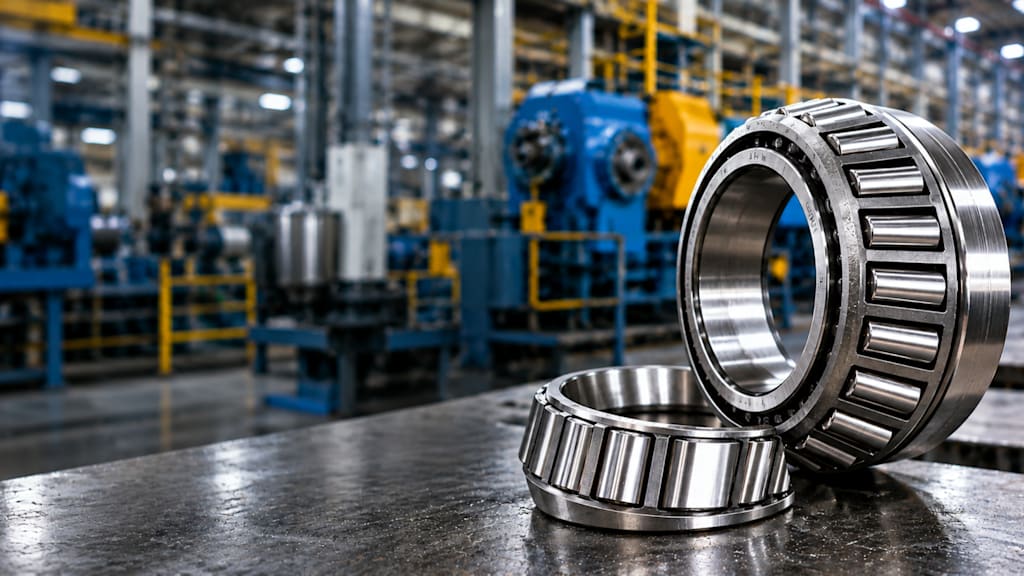
Most of the time, high-load machinery doesn't just break down without some warning. In most cases, the first symptoms appear in moving parts where load, pressure, friction, and heat slowly accumulate. That’s why industries that handle such equipment prefer tapered roller bearings over the conventional bearing types.
A reliable bearing manufacturing company knows that selecting the right tapered roller bearing assembly requires considering several factors beyond installation. These include load direction, shaft stability, operating temperatures, lubrication methods, etc.
Applications of Tapered Roller Bearings
Among other applications, tapered roller bearings can handle combined loads in agriculture, the automotive industry, construction, and mining. Unlike plain bearings, the tapered assemblies are designed to operate in complex environmental conditions and under considerable stress. In addition, unlike ball bearings, tapered bearings have a special geometry that allows them to operate under axial loads.
Principles of Operation of Tapered Roller Bearings
Unlike conventional ball bearings, which use spherical rolling elements, tapered roller bearings feature conically shaped rollers that roll between two raceways of corresponding geometry. As a result, the way loads pass through the bearing differs considerably from the way conventional bearings behave.
The angled raceway geometry causes all load contacts to converge to a single point on the shaft axis. The unique conical alignment of the bearing is ideal for handling combined axial and radial forces simultaneously.
One of the best examples is a car turning a sharp corner, where the wheel experiences a weight pushing straight down (radial load) while simultaneously experiencing centrifugal force pushing it sideways (axial load). That's exactly how tapered rollers change the force's behavior depending on its direction.
Therefore, tapered rollers prove to be an important solution in industries where:
- Wheel hubs are applied.
- Industrial transmissions operate.
- Conveyors move material.
- Farm machines are used.
- Construction and mining equipment work.
- Other rotating assemblies are involved.
Importance of Loading Conditions
One of the most frequent errors in engineering is ignoring load direction when selecting bearings. Most people pay attention only to the bearing's load rating or the shaft diameter.
In real-life situations, axial loads are combined with radial ones. That's why standard ball bearings cannot properly withstand certain types of stress. That's why engineers use tapered roller bearings for such purposes.
Unlike standard ball or cylindrical bearings, tapered roller bearings distribute loads more evenly across the bearing surface.
As a result, bearings can withstand additional external pressure. It's also worth mentioning that some industrial systems use bearings mounted in the opposite direction.
The aim is to compensate for the axial loads coming from different sides.
Dimensions of the Tapered Roller Bearings Assembly
Dimension is the primary criterion for selecting tapered roller bearings. However, the choice should be made depending on three main factors:
- Shaft diameter
- External bore diameter
- Bearing width
However, other criteria should also be considered. Operating speeds, lubrication systems, temperature range, loading directions, etc., also affect the choice.
One of the most common misconceptions about bearings is that oversizing improves performance. In reality, larger than necessary bearings increase:
- Friction
- Generation of heat
- Potential lubrication issues
- Risk of misalignment
- Preload problems, etc.
In most situations, the problem is excessive preload. Internal preloads create excessive internal pressure, leading to higher temperatures. Increased temperature is the cause of the failure of many mechanical components.
Improper lubrication ranks third among the common causes of rolling bearing failure. Lubricants ensure a uniform layer on contacting surfaces, reducing metal-to-metal friction.
That's why experienced engineers estimate operational conditions before selecting bearings according to their dimensions.
Common Applications of Tapered Roller Bearings
Nowadays, tapered roller bearings are applied in multiple industries because they can handle complex loading conditions.
Automotive Sector
Tapered roller bearings are often installed in wheel hubs and differentials as vehicles experience constant radial and axial loads.
Construction Sector
Earthmovers, excavators, and other construction machines are exposed to considerable shock loads and operate on difficult terrain.
Agriculture
Harvesters, tractors, etc., are subject to vibrations, fluctuations in torque and loads, and dirt.
Industrial Gearboxes
Stable shafts and optimal load distribution reduce wear in industrial transmissions.
Mining and Material Handling
Conveyor rollers are subjected to constant radial loads throughout the entire working period.
Difference Between Tapered and Needle Roller Bearings
Many users compare these two types of bearings because both use rolling elements rather than balls. But they are solving very different problems.
Needle roller bearings represent the smallest bearings among all varieties used in practice. They are intended for installation in locations where high radial loads occur, but space is limited.
In contrast to needle bearings, tapered rollers are suitable for combined loads.
While tapered rollers excel at handling combined forces, applications with predominantly high radial loads and severe spatial constraints are better suited to compact needle roller bearings.
The right choice ultimately depends on factors such as
- Direction of load;
- Available space
- Operating speeds
- Environmental conditions
- Lubrication system used
- Other factors
There is no universal solution for every bearing.
Why Proper Installation Is Important
Even if a bearing design is chosen correctly, improper handling during installation can still lead to premature bearing failure. Here are common reasons for failure caused by the installation procedure:
- Inappropriate preload settings
- Shaft misalignment
- Presence of contaminants
- Improper mounting forces
- Rapid temperature rise during installation.
In industrial workshops, one of the most widespread installation techniques is hammer installation, performed in emergencies.
Impact loads lead to damage to the races before the assembly goes into service. The first symptoms of damage are:
- Vibrations
- Noise
- Unnatural temperature increases
- Irregular wear patterns.
Use of proper mounting and alignment tools reduces the risk considerably.
Choosing the Right Tapered Roller Bearings for Industrial Use
Tapered roller bearings are highly efficient bearing solutions for handling radial and axial loads and are used in many industries, including agriculture, construction, and the automotive industry.
When selecting tapered roller bearings, many engineers focus on dimensional characteristics and load capacities. However, the quality standards applied in bearing production are equally important.
The professional, experienced bearing manufacturers focus first and foremost on consistent quality in materials, finishing processes, heat treatment techniques, and dimensional accuracy, understanding that the real-world operating conditions are just as important as the technical specifications on paper.
About the Creator
Enjoyed the story? Support the Creator.
Subscribe for free to receive all their stories in your feed.
Comments
There are no comments for this story
Be the first to respond and start the conversation.