Product reviews and how-to's about the best workplace products for the office.
The final weekend of November 2025 delivers a tech news cycle dominated by the ongoing friction between proprietary ecosystems and the inexorable advance of AI-driven hardware. We are seeing major strategic moves across the industry, from Googleās aggressive push for file-sharing freedom to Appleās quiet hardware upgrades, and a crucial reality check in the world of industrial robotics.
By Mary Diu11 months ago in Journal
The tablet market is witnessing a renaissance, driven by demands for better productivity and superior entertainment devices. While Apple and Samsung continue to dominate the high-end with their Pro and Ultra models, Xiaomi has historically positioned itself as a potent disruptor, offering near-flagship specifications at a fraction of the cost. The latest leaks regarding Xiaomiās upcoming tabletārumored to feature the powerful Snapdragon 7+ Gen 3 processor and a stunning 3.2K display at a mid-range priceāsuggest the company is preparing to launch a device that fundamentally redefines the concept of "value."
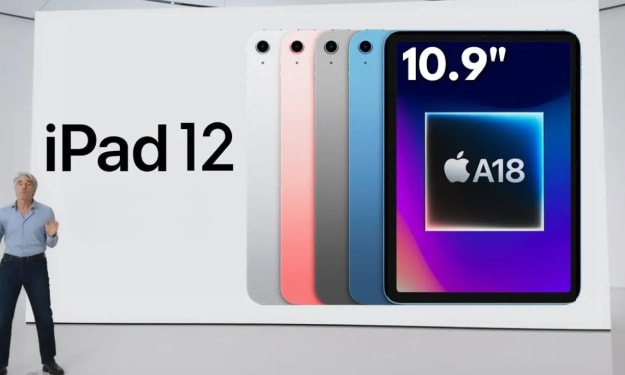
Appleās product cycle has historically been predictable, centered around flagship events in September and October. However, mounting market pressure, particularly in developing economies and the education sector, appears to be driving a significant strategic shift. New leaks and industry reports suggest that early 2026 could see Apple launch an unprecedented wave of affordable, yet technologically sophisticated, devices aimed squarely at the entry-level and mid-range markets.
For years, the seamless, proprietary file sharing protocol AirDrop has stood as one of the most effective and frustrating barriers to leaving the Apple ecosystem. The instantaneous nature of sharing large photos and videos between iPhones is a defining "it just works" feature that Android could never perfectly replicate across the platform divide.
The technology industry has always been a battleground between open standards and proprietary ecosystems. For years, the ability for users to share files seamlessly between devices has been a point of friction, and Appleās AirDrop has been the gold standard for efficiency within its walled garden. However, the recent emergence of cross-platform sharing solutionsāspecifically initiatives that allow Android users to utilize protocols similar to AirDrop to share files with iPhonesāpresents a fascinating dilemma for Apple.
The development of humanoid robots often captures the public imagination with demonstrations of dexterity and complex manipulation. However, the true bottleneck for real-world deploymentāwhether in factories, disaster zones, or everyday lifeāis often something far more mundane: endurance and power efficiency.
The typical smartwatch market is dominated by competition over fitness tracking, battery life, and operating system integration.
š The Billionaire's Phone Booth: Ranking the Top 5 Most Expensive Phones in the World Beyond the flagship: A look at the ultra-exclusive, diamond-encrusted devices where technology meets high-end luxury, art, and staggering price tags.
The year 2025 has cemented a powerful truth: the Windows laptop ecosystem is no longer playing catch-up. Fueled by specialized silicon designed for AI, vastly improved display technology, and a renewed focus on battery efficiency, the competition among PC manufacturers has never been fiercer. The modern "best" laptop must seamlessly blend power for intensive work, portability for the mobile professional, and, increasingly, dedicated hardware for the new era of generative AI applications.

The skies just got a lot more interesting. The recent maiden flight of Volodya, a humanoid robot widely believed to be the advanced Unitree G1 model, serving as a cabin crew assistant on a Pobeda Airlines flight from Ulyanovsk to Moscow, marks a pivotal moment in both commercial aviation and service robotics. While the initial role was scripted and limited, this is far more than a public relations stunt; it is a critical proof-of-concept for integrating complex bipedal systems into the most constrained and heavily regulated consumer environments imaginable: the aircraft cabin.
n the relentless march towards fully autonomous factories, the announcement this week that Figure 02, the humanoid robot from Figure AI, has been officially "retired" after an 11-month deployment at the BMW manufacturing facility in Spartanburg, USA, is far more significant than a simple press release. This isn't a failure; it is a monumental success story in data collection, marking a crucial inflection point in the development cycle of real-world humanoid robotics.
Let's start with a confession: my purchase of the Samsung Galaxy A56 5G was an act of necessity, not desire. I am typically a flagship userāaccustomed to the latest chips, aerospace-grade materials, and the steepest price tags. I needed a reliable global backup phone for an extended trip, something robust and, crucially, unlocked. When the Latin Version SM-A566E/DS landed on my desk, I approached it with a predictable skepticism: "Itās a mid-range phone. Where are the compromises?"