politics
Political figures, histories, and current events in the whole scope of modern and past politics. Work place politics.
I’m the One Who Never Falls Apart—Until I Did
By Nadeem Shah They always say I’m the strong one. The dependable one. The listener. The problem-solver. The one who doesn’t cry, who doesn’t break, who always has a calm answer and a reassuring smile. My friends, family, coworkers — they leaned on me like I was some unshakable monument.
By Nadeem Shah about a year ago in Journal
There Is No Kingdom Called Agbarha-Warri
The name may echo with some familiarity, particularly among the Urhobo people living in parts of Warri, Delta State. However, when examined within the frameworks of traditional governance, historical records, and cultural legitimacy, the claim to a so-called "Agbarha-Warri Kingdom" begins to unravel.
By Omasanjuwa Ogharandukunabout a year ago in Journal
Trump Extends Tariff Implementation Date to August 7
Trump Extends Tariff Implementation Date to August 7 President Donald Trump had previously announced that the implementation of his new tariffs on August 1 would bring significant change to the global economy. Administration officials had assured the public that this was a firm, non-negotiable deadline. However, when Trump signed the executive order on the night of July 31—imposing new tariffs on 68 countries and the European Union—the start date of the import taxes was delayed by seven days to allow updates to the tariff schedule. This change may be welcomed by countries that have not yet reached agreements with the U.S.—but it has also introduced a new layer of uncertainty for consumers and businesses still trying to understand what is coming and when. Trump has hinted that the increase in taxes on roughly $3 trillion worth of imported goods will generate new revenue, pave the way for factory jobs, reduce the budget deficit, and compel other nations to deal with the U.S. more respectfully. However, these sweeping tariffs could undermine America’s global standing, as allies may feel coerced into unfavorable agreements. Taxes on raw materials and essential goods used in U.S. factories could fuel new inflationary pressures and potentially stall economic growth—concerns the White House has dismissed. Despite Trump’s eagerness, many questions about the tariffs remain. As the self-imposed deadline approached, it seemed that nothing was set in stone except the President’s determination to impose the taxes. The legal legitimacy of the tariffs is also under question. On Thursday, a U.S. appeals court heard arguments on whether Trump had overstepped his authority by declaring a "national emergency" under the 1977 law to impose tariffs—thereby bypassing Congressional approval. Trump appeared pleased as the world waited to see what he would do. On Thursday morning, he posted on Truth Social: "Tariffs are making America great and rich again. Hastily Crafted Tariff Policy Countries have viewed President Trump’s policy as carelessly designed—one that could slowly impose long-term damage to America’s strength and prosperity. Scott Lincicome, Vice President at the Cato Institute, said: "By Friday morning, we’ll only know that U.S. import taxes will be historically high and complex, and because the agreements are so vague and incomplete, the uncertainty of this policy will remain very high." Everything else, he added, remains undecided. The new tariffs are based on measures announced in the spring. Trump initially set the Friday deadline following market unrest in April caused by his previous "Independence Day" tariffs. Failing to secure enough trade agreements with other countries, Trump extended the timeline and sent letters to world leaders, leading to a rush of negotiations. Swiss imports will now face a 39% tax rate—higher than the 31% rate Trump had threatened in April.while Liechtenstein’s rate was reduced from 37% to 15%. Countries not listed in Thursday night’s executive order will be subject to a default 10% tariff. Trade Deals Stir Anxiety Among Allies Over the past few weeks, Trump held talks with the European Union, Japan, South Korea, Indonesia, and the Philippines on a trade framework, giving him the opportunity to claim that other nations were caving under his threats. On Thursday, he claimed there were deals with other countries but declined to name them. The day began with palpable tension. The EU was awaiting a written agreement on a 15% tariff deal. Switzerland and Norway were among dozens of countries unaware of their tariff rates, while Mexico’s tariffs were frozen at 25% for a 90-day negotiation period following a phone call with Trump that morning. European leaders faced criticism over the perception of bowing to Trump, though they emphasized this was only the start of talks and stressed the importance of maintaining U.S. support for Ukraine in its war against Russia. Canadian Prime Minister Mark Carney had already suggested that Canada could no longer trust the U.S. as an ally, and Trump refused to speak with him on Thursday. Facing Legal Challenges With a 25% tariff announced by Trump on Wednesday, India is now less likely to benefit from the shift in manufacturing away from China. While the Trump administration has tried to challenge China’s manufacturing dominance, it remains locked in lengthy trade talks with the country, which is subject to a 30% U.S. tariff and is retaliating with a 10% rate on American imports. Major corporations had begun issuing warnings earlier in the week that the tariffs were beginning to strain them financially. Ford Motor Company estimated it could lose $2 billion this year due to the tariffs. French skincare company Yon-Ka warned of hiring freezes, reduced investments, and increased prices. Will Trump’s New Tariffs Survive Legal Scrutiny? Federal judges expressed skepticism on Thursday about Trump’s use of the 1977 law to declare America’s long-standing trade deficit a "national emergency," thereby justifying tariffs on nearly every country. Judge Todd Hughes of the U.S. Court of Appeals for the Federal Circuit told the Justice Department attorney representing the administration: "You're asking for unlimited authority." The judges did not issue an immediate ruling, and the case is expected to eventually reach the Supreme Court. The Trump White House has portrayed the increase in federal revenue from the tariffs as a sign of success in reducing the budget deficit. So far this year, $127 billion has been collected in customs duties—almost $70 billion more than last year.
By Real contentabout a year ago in Journal
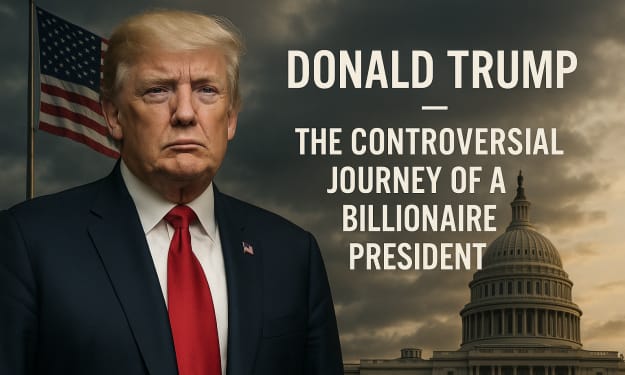
Donald Trump – The Controversial Journey of a Billionaire President
Introduction: Donald John Trump, the 45th President of the United States, is one of the most talked-about and polarizing figures in modern political history. Before entering politics, he was a billionaire businessman and television personality. His rise from a real estate mogul to the White House marks one of the most unconventional political journeys in American history. --- Early Life and Education Donald Trump was born on June 14, 1946, in Queens, New York City. He was the fourth of five children in the family of Fred and Mary Trump. His father was a successful real estate developer who specialized in middle-class housing in New York. Due to behavioral issues, Donald was sent to the New York Military Academy at age 13. The discipline and structure of military school helped shape his competitive spirit. After high school, he attended Fordham University for two years and then transferred to the Wharton School at the University of Pennsylvania, where he graduated in 1968 with a degree in economics. --- Business Career and Real Estate Empire After graduation, Trump joined his father's business, “Elizabeth Trump & Son.” In 1971, he took control and renamed it “The Trump Organization.” He expanded the business from residential real estate in outer boroughs to high-profile projects in Manhattan. His signature project was Trump Tower, a 58-story skyscraper on Fifth Avenue in New York City, completed in 1983. Over the years, he developed and branded numerous properties, including hotels, casinos, golf courses, and resorts. His name “TRUMP” became a brand associated with luxury, success, and wealth. However, his business ventures weren't always smooth. In the 1990s and 2000s, several of his casinos and hotels filed for bankruptcy protection. Despite financial setbacks, Trump maintained a high media profile and managed to rebuild his brand. --- Television Stardom In 2004, Trump became a household name with the reality TV show “The Apprentice” on NBC, where he played the role of a tough business leader evaluating contestants. His catchphrase “You’re fired!” became iconic. The success of the show boosted his popularity across the U.S. and allowed him to present himself as a decisive, successful businessman — an image that later helped launch his political career. --- Entry into Politics Trump had hinted at political ambitions for decades but made a serious move in 2015 when he announced his candidacy for the presidency as a Republican. His campaign focused on a nationalist agenda: strict immigration control, renegotiation of trade deals, job creation, and "America First" foreign policy. Despite being considered an outsider and initially facing criticism from both political parties and the media, Trump won the Republican nomination. In November 2016, he shocked the world by defeating Democratic candidate Hillary Clinton, winning the electoral college while losing the popular vote. --- Presidency (2017–2021) Trump's presidency was marked by bold and often divisive decisions: Immigration: He enforced strict immigration policies, including the controversial travel ban on several Muslim-majority countries and attempts to build a wall along the U.S.-Mexico border. Economy: Trump pushed for tax cuts, deregulation, and renegotiated trade deals like NAFTA (replaced with USMCA). The economy saw growth during his first three years, though the COVID-19 pandemic severely impacted it in 2020. Foreign Policy: He withdrew the U.S. from the Paris Climate Agreement, the Iran nuclear deal, and emphasized strong relations with Israel. He also met North Korean leader Kim Jong-un in an unprecedented diplomatic move. Impeachments: Trump was impeached twice by the House of Representatives—first in 2019 over his dealings with Ukraine, and second in 2021 for inciting the January 6 Capitol riot. He was acquitted both times by the Senate. --- Post-Presidency and Legacy Trump lost the 2020 election to Joe Biden but refused to concede immediately, claiming widespread voter fraud without credible evidence. His role in encouraging the January 6 attack on the Capitol tarnished his presidency and led to widespread criticism. After leaving office, Trump remained active in politics, hinting at a potential 2024 run and continuing to hold rallies and maintain a strong influence over the Republican Party. He also launched his own social media platform, Truth Social, after being banned from Twitter and Facebook. --- Conclusion Donald Trump’s life is a unique blend of success, controversy, and influence. From building skyscrapers to shaping national policy, he has left a deep imprint on American society. Loved by millions and criticized by many, Trump represents a new era of celebrity-politics where fame and boldness can redefine leadership. Whether history views him favorably or not, there is no doubt that Donald Trump will remain a major figure in American political and cultural history for generations to come.
By Nimatullahabout a year ago in Journal