humanity
The real lives of businessmen, professionals, the everyday man, stay at home parent, healthy lifestyle influencers, and general feel good human stories.
Why Being the "Good Girl" Can Hold You Back
Why Being the "Good Girl" Can Hold You Back This is me (well, it was me, and perhaps it still is at times)! How about you? The Good Girl. I vividly recall my younger days when my parents frequently urged me to remain the "good girl." I was terrified of speaking up or taking risks, fearing that I wouldn't live up to the "good girl" image. Today, I proudly embrace the courageous and kind person I have become. I am stronger and braver than ever, while still maintaining kindness.
By Hridya Sharma2 years ago in Journal
The Reason Why I Capture Everything on Film (And Why You Should Be Doing It To)
Nobody ever knows what'll happen in our lives. Nobody. Of course, for some, there are psychic mediums who certain people may believe can predict what'll happen... But life is and has always been unpredictable for most, if not all people. Nobody has an idea about who could enter into their life... Or why they were sent to us in the first place. Lessons are made every single day, and we just have to let it flow in and out- like a tide. We don't even have a clue about what people in our lives are meant to be with us forever, or who'll just up and go... without any possible warning. Sometimes, we have to experience things that'll hurt in the moment but teach us something valuable in the long run. Capturing every bit of those precious memories you've made in life, whether it's short or long, through either video capture or a series of pictures, can help your memory of that one specific day... or person... or even animals... never fade.
By 'Lissa Stufflestreet2 years ago in Journal
Why Leaders Are Failing To Fix Their #1 Problem
If there was a Problem that Impacted 80% of the Workforce that also: Decreased Productivity to "at least" 1/20th Of People's Productivity Potential Directly Prevented Innovation and Creative Problem Solving Made Flow States (Where We Feel and Perform Our Best) Impossible To Achieve Significantly Increased Sick Days and Health Costs Made Learning Significantly More Difficult Dramatically Dropped Emotional Intelligence and IQ And More
By H.E. Dr. Cody Dakota Wooten, COIE, DFM, DHM2 years ago in Journal
Pave the Path
Millennials are at the forefront of a transformative wave in the business world, embracing digital social entrepreneurship as an essential aspect of change. Unlike previous generations, millennials are deeply driven by a desire to make a positive impact on society and the environment. They are leveraging digital technology in innovative ways to address pressing social issues, demonstrating that business can be both profitable and purpose-driven.
By Bob Nelson Oil and Gas2 years ago in Journal
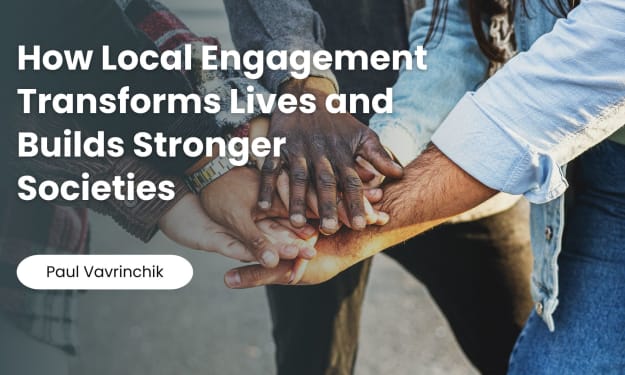
The Power of Community Involvement: How Local Engagement Transforms Lives and Builds Stronger Societies
Participation is essential in building strong and active communities. When people engage themselves in society at different levels, they help to shape the common goal and human development and ultimately promote the welfare of all. In this article, we discuss the effectiveness of community participation and how it can change the lives of the participants and society at large.
By Paul Vavrinchik2 years ago in Journal
Which foundation is best for my skin type?
In a world obsessed with perfection, where every blemish and flaw is scrutinized under the unforgiving lens of society, finding the right foundation is more than just a beauty task—it becomes an intimate journey of self-discovery and acceptance. This is especially true for those who, like Samantha, have spent years battling with their skin, only to find that the real struggle lies within. Samantha’s skin was her greatest insecurity. As a teenager, acne was a constant companion, leaving behind scars and a rough texture that seemed impossible to smooth over. Each glance in the mirror was a painful reminder of the insecurity she tried so hard to conceal. Layer upon layer of foundation and concealer only made her feel like she was hiding beneath a mask, never quite achieving the flawless skin she so desperately desired. Her journey toward self-acceptance began on a rainy afternoon when she entered a makeup store, her spirits dampened by yet another breakout. The beauty consultant welcomed her with a warm smile, but Samantha could sense the consultant’s silent judgment as her eyes scanned Samantha’s skin. It was a look she had grown used to over the years—one that made her feel self-conscious and exposed. As they discussed her concerns, the consultant asked Samantha a question that caught her off guard: “What’s your skin type?” It was a simple question, yet Samantha realized she didn’t have an answer. She had always focused on the problems—acne, redness, scars—without truly understanding the nature of her skin. The consultant explained that before choosing a foundation, it was essential to understand her skin’s needs. Skeptical but eager for a change, Samantha took this advice to heart. She began researching her skin, discovering that she had combination skin with an oily T-zone and dry cheeks. This revelation was a turning point. Instead of blindly applying products, she started to tailor her skincare routine to address her specific needs. Slowly, she began to see changes. Her skin became less oily in some areas, the dryness improved, and her breakouts lessened. But while the condition of her skin improved, the scars and uneven texture remained—a stubborn reminder of the battles she had fought. With renewed confidence, Samantha returned to the makeup store, armed with knowledge about her skin. The consultant introduced her to foundations designed for combination skin—lightweight, non-comedogenic, and natural in finish. As she tried different shades, Samantha felt a mix of hope and fear. Would this foundation be the one to finally make her feel beautiful? When she found her perfect shade, it was more than just a match for her skin tone; it felt like a match for her soul. The foundation glided on smoothly, evening out her complexion without feeling heavy or mask-like. For the first time in years, Samantha felt like she could look in the mirror and see herself—not just her flaws. Over time, as Samantha’s relationship with her skin evolved, she began to embrace her imperfections. She saw beauty in her skin’s unique texture, in the way it glowed when she smiled. Makeup became less about covering up and more about enhancing what was already there. She experimented with blush, highlighter, and eyeshadow, not to hide but to celebrate her features. The most profound change was in how Samantha viewed herself. She no longer felt the need to apologize for her skin or to hide behind layers of makeup. She grew comfortable going out with minimal makeup or even bare-faced, secure in the knowledge that her worth wasn’t tied to how flawless her skin appeared. The foundation had become a symbol of her journey—a journey from shame to self-love. Samantha’s story is a testament to the power of understanding your skin and finding products that work with it, not against it. It’s a reminder that beauty isn’t about perfection; it’s about embracing who you are, flaws and all. In the end, the best foundation is the one that makes you feel confident and beautiful, not because it hides your flaws, but because it enhances the natural beauty that has been there all along. Samantha’s journey teaches us that the search for the perfect foundation is, at its core, a journey toward self-love and acceptance.
By Angel Mlambo2 years ago in Journal
Do you want to know how I am feeling?
I’m delighted to see your interest in knowing how I am. Well, the answer is yes—I’m doing great, and I hope the same for you. Life has its ups and downs, but overall, I believe we are all doing well in our own spaces, don’t you think? Some of you might be fully aware that you’re doing just fine, but for others, there might be a cloud of doubt. If you’re among those who are unsure of how they are doing, I’m here to tell you that you don’t need to worry so much.
By Bhawarth S. Saraswat2 years ago in Journal