fact or fiction
Is it a fact or is it merely fiction? Fact or Fiction explores the lesser known truths in the corporate culture of Journal.
"Don’t Miss the Pink Micro-moon: April’s Full Moon Will Be the Year’s Smallest". AI-Generated.
Attention sky watchers: the full moon this weekend promises a one-of-a-kind lunar event. On the evening of Saturday, April 12, and into the early hours of Sunday, April 13, 2025, April’s Full Pink Moon will rise — but unlike some of the dramatic “supermoons” of recent years, this one will be a micromoon, the smallest full moon of the year. While it won’t dazzle with unusual size or brightness, it offers a subtle and serene celestial show, well worth a look — and a moment to marvel at the quiet rhythms of the universe. What Is a Micromoon? A micromoon occurs when a full moon aligns with the moon’s apogee, the farthest point in its elliptical orbit around Earth. The moon is approximately 252,000 miles (405,000 kilometers) away from Earth at this point, compared to approximately 226,000 miles (363,000 kilometers) during its closest approach, or perigee. A micromoon appears around 14% smaller in diameter and 30% darker than a supermoon due to this distance. The difference may not be obvious to the naked eye unless you’re comparing side-by-side images, but it does lend the moon a more delicate appearance in the sky — a kind of quiet beauty in contrast to its more flamboyant supermoon siblings. When and How to Watch The Full Pink Micromoon will reach peak illumination at 3:21 a.m. EDT on April 13, but the best viewing will take place on Saturday night, shortly after moonrise. The moon slowly rises into the night sky, glowing a warm amber color as it approaches the eastern horizon shortly after sunset. You will be treated to a tranquil lunar display that will last all night if the skies are clear. While binoculars or a long-zoom camera will provide more information about the moon's cratered surface, no telescope is required. Why Is It Called the "Pink" Moon? Despite its name, the Pink Moon won’t actually appear pink in color. The customs of Native Americans and colonists that gave each full moon a seasonal name that was related to nature are the source of the term. In honor of phlox, a type of early-blooming wildflower with vibrant pink petals that signifies the beginning of spring in North America, the full moon in April is referred to as the "Pink Moon." Other traditional names for this moon include the Sprouting Grass Moon, the Egg Moon, and the Fish Moon, each pointing to the natural cycles of renewal and growth that mark this time of year. Why This Micromoon Matters Micromoons possess their own charm as well as their significance in astronomy, whereas supermoons frequently take center stage due to their size and brightness. They remind us of the moon’s elliptical orbit, the variability of its distance from Earth, and the subtle differences in its appearance. This micromoon is also a great teaching moment for anyone interested in astronomy. It’s a chance to observe how small changes in distance affect the way we perceive objects in the sky — and to better understand our moon’s relationship with Earth. Tips for Viewing Want to make the most of your micromoon experience? Here are a few simple tips: Use astronomy apps or websites to determine when the moon will rise above the horizon in your area. Check your local moonrise time. Head away from city lights: A dark, open area will give you the best view of the moon’s soft glow. Bring binoculars or a telescope: Even basic gear will enhance your view and let you spot surface details like craters and lunar seas. Make use of the moon illusion by observing the moon as it rises, when it is at its largest near the horizon due to a visual effect brought about by the atmosphere of the Earth. A Moment of Celestial Stillness In a world that moves fast, the Pink Micromoon is a gentle reminder to slow down, look up, and reconnect with the sky. Despite not being the most spectacular full moon of the year, its magic lies in its subtlety. The smallest full moon of 2025 invites us to take in the beauty of the night sky from any location, including a mountain trail, balcony, or backyard—all we need is a little time and a little wonder.
By Susmita Zaman2 years ago in Journal
Supreme Court Orders Trump-Era Officials to ‘Facilitate’ Return of Wrongly Deported Man
In a decision that would have broad implications for U.S. immigration enforcement and government accountability, the Supreme Court has held that Trump administration officials are required to "facilitate" the return of a man wrongly deported. The decision underscores the role of the judiciary to ensure justice to individuals who are harmed by administrative actions, most specifically in the highly politicized and generally contentious arena of immigration policy.
By Robert Kroos2 years ago in Journal
Virtual Side Hustles: Navigating the Freelance Revolution of 2025
In 2025, the freelance revolution is reshaping the way we work and earn money. The digital landscape has evolved beyond traditional employment, opening up a realm where remote work and gig platforms empower individuals to pursue multiple income streams simultaneously. This article explores how emerging freelance opportunities are setting the stage for a modern work-life balance, highlights success stories, spotlights the skills in demand, and offers practical tips for navigating this rapidly evolving landscape.
By Mysteries with Professor Jahani2 years ago in Journal
Liberation Day Tariffs Miss the Real Target: China
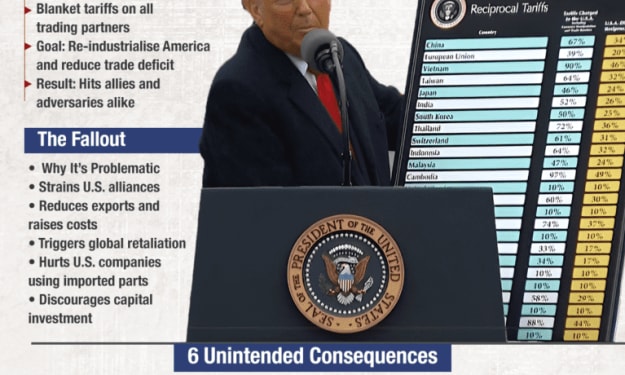
⏩The Trump administration’s announcement of blanket tariffs misses the mark. Instead of using a tariff threat to address trade irritants with our allies in order to form an alliance to jointly confront China’s mercantilist practices—the real threat to American economic and technological dominance—these tariffs indiscriminately hit allies and competitors alike. While they are sure to result in some increases in domestic manufacturing, foreign retaliation, as well as US tariffs on intermediate goods, will also mean fewer US exports. And the result will be strained, if not broken, partnerships at a time when America and the West should be laser-focused on countering predatory China’s trade offensive. ▶️With these tariffs, the Trump administration is arguably implementing the worst possible solution to address a problem they have rightly identified. Despite, or perhaps because of America’s leadership in the global trade system (until the day before “liberation day”), the result was a massive trade deficit and deindustrialization. ▶️Yet, U.S. globalists blithely denied that trade deficits matter and that globalization played a key role in hollowing out U.S manufacturing. At the same time, U.S. policymakers gave short shrift to foreign trade barriers as even long-standing allies adopted policies that disadvantaged American firms. Most of our Allies indeed took advantage of the United States by imposing their own trade barriers, and challenging us to adjudicate them at the WTO, which did not work for various reasons. And, of course, at the end of the day, it is China that will ultimately be responsible for breaking the global trading system, given its massive trade and economic distortions that have done so much to harm allied manufacturing economies. ▶️For at least a decade, the writing was on the wall for all to see. Yet, no serious and systematic efforts were made to reform the global trade system to address these systemic imbalances and distortions. Indeed, most in the Washington trade community insulted and mocked anyone who dared say there might be problems, if they even bothered to pay attention to them. ▶️So why are we surprised that Trumpian extremism to break globalization is the response? The reality is that “liberation day” is a natural, albeit likely fatally flawed, result of that self-righteousness, combined with an ill-informed nativism and protectionism from the Trump trade community. Now, the United States has declared a trade war with the rest of the world, treating allies and adversaries as equals. And like a partner who cheats and gets caught, these bonds with allies will likely never be fully restored, even if Trump wrangles deals. ▶️It would be one thing if the Trump tariff wall were effective. At least the United States would benefit from more manufacturing and a lower trade deficit. The reality is that “liberation day” will do little to make the United States more globally competitive and restore manufacturing, especially high-value-added advanced production. ▶️To be sure, “liberation day” measures will mean that some U.S. manufacturers will sell more, and some multinationals might move some production to the United States. But at least six factors are working in the opposite direction. ⏩First, tariffs on intermediate goods will hurt U.S. companies competing in global markets. Higher steel prices mean U.S. auto exports will be less competitive. ⛔Advertisement⛔ Subscribe to our notifications for the latest news and updates. You can disable anytime. pital goods (e.g., computers, machine tools, etc.) will raise these costs and lead to diminished US capital investment, not just in manufacturing but throughout the economy. That will slow the growth of vitally needed productivity. ⏩Third, most, if not all, other countries will retaliate. Even as the President has said he is open to negotiation (although other top Trump officials have said there will be no negotiations) and will punish retaliators. As this happens, some companies in America will move U.S. operations to other nations to serve non-US markets, as Harley-Davidson and Caterpillar did in 2018. ⏩Fourth, for intermediate goods that pass back and forth across the US border for additional value-added stages, the cumulative tariff stacking will likely lead companies to do all of this work outside of the United States. ⏩Fifth, even if the tariffs do restore some manufacturing, much of that could very well be low value-added products that have no real strategic interest for America, something those in the Trump trade community don’t care about. But the reality is that producing computer chips is vastly more important than producing potato chips. And other nations, who do understand this key difference, could very well respond by reducing exports to the United States of low-value added products, as well as vastly increasing imports of them, along with minerals and agricultural products. All with the objective of getting off Trump’s naughty list by reducing their trade deficit with the United States (the so-called reciprocal tariffs are a simple formula that reflects our trade deficit in goods with these nations). The result would be balanced trade, but the United States would be “winning” by being largely a “hewer of wood and drawer of water.” ⏩Sixth, the tariffs are a gift to Xi Jinping. By placing high tariffs on countries like India, Indonesia, and Vietnam, the incentive for multinationals to move production out of China goes down significantly. More importantly, besides arguably violating many trade agreements the United States has legally agreed to, the tariffs destroy any movement toward a Western alliance to counter China’s goal of setting the rules of the global economy. Just as America’s response to the Russian invasion of Ukraine cemented the alliance between Russia and China, Trump’s tariffs will go a long way toward building economic agreements between China and other nations. Already, Korea, Japan, and China have announced joint actions to respond, while the EU has discussed establishing closer ties with China. Free-market globalists screwed this up and enabled American losses, and as such, their “solutions” to do nothing other than remove the tariffs are unviable. Hopefully, they will realize this soon. In the vacuum of failed “free trade,” Liberation Day has been the answer. There is a better solution. First, the United States should establish a national innovation strategy focused on advanced manufacturing that includes implementing incentives for technology development and diffusion, establishing a National Competitiveness Council to formulate and coordinate advanced-industry competitiveness policies, or providing financial support—for example, creating a Super Chips Tax Credit. Killing the CHIPS Act, the National Institute of Standards and Technology’s (NIST) Manufacturing Extension Partnership, and cutting federal research spending is just digging the hole deeper. ⛔Advertisement⛔ Subscribe to our notifications for the latest news and updates. You can disable anytime. Subscribe to push notifications ▶️Second, Trump should approach our allies, one at a time, and confront them with a bill of particulars on the most important trade barriers they have related to US advanced industry development. He should state clearly that his additional tariffs go immediately to zero when these nations have made significant progress in rolling them back. For too long, the United States was too reticent to confront these practices, such as the systematic attacks on U.S. technology companies overseas. It’s not too late for this. ▶️At the same time, rather than tariffs which rightly anger our allies and inevitably lead to tit-for-tat retaliation, the administration should immediately push for a weaker dollar (which has the exact same effect as tariffs) and the implementation of a border-adjustable value-added tax (VAT) that would raise the price of imports and if used to partially lower business taxes, reduce the cost of exports. Allies might squawk but would not retaliate, partly because most have VATs, and many already manipulate their currencies. ▶️Third, the United States will lose the race for advanced industry competitiveness without serious partnerships with our allies. And that means China rules the world. In reality, we are close to having already lost this techno-economic war that China launched almost two decades ago. If Trump forces our allies to be against us and for China, the battle is definitely lost. ▶️Toward that end, Trump needs to adopt an Allied “Huawei” strategy. Absent Trump’s action in his first term to convince allies not to buy Huawei telecom equipment, it is likely that either Ericsson or Nokia would now be out of business, Huawei much stronger, and its future complete dominance likely. However, Trump’s efforts to limit their access to allied markets allowed us to gain a valuable commercial line of defense. The United States and allies need to do this again, but on a vastly broader array of Chinese goods and services, including Chinese company airplanes, drugs, semiconductors, heavy equipment, EVs, and other advanced and strategic industries that China has “cheated” in. ▶️If most of the allies, especially in Europe, had more cohesion and courage, they would be the ones to lead such a system, even as Trump tries to undermine it. But as it stands, they are more than happy to have America be the “bad cop” while they play “good cop” and take the U.S. market share. So, at the end of the day, it probably still comes down to US global leadership. Alas, with Trump’s nationalist protectionism, which is unlikely to come. The end of globalization as we know it, along with the end of America’s techno-economic leadership, is the likely result. ▶️There is a path out of the destruction and defeat that the Trump approach will bring. It’s not too late for the President to implement it. If he did, creating a new type of globalization to address critical current geopolitical challenges, he could go down as one of America’s greatest presidents. As things stand now, he will likely be seen as worse than Herbert Hoover when confronting the Great DepressionStart writing...
By CryptoCurrency News 2 years ago in Journal
The Farmer’s Promise
The wheat fields of rural Punjab shimmered under the relentless sun, their golden stalks swaying like a restless sea. Rohan Singh, a weathered farmer in his late 30s, wiped sweat from his brow, his eyes fixed on the horizon. His hands, cracked and calloused, clutched a rusty sickle. Beside him, under the gnarled branches of an ancient banyan tree, slept his three-year-old son, Arjun, swaddled in a faded cloth. The tree’s shadow was Arjun’s cradle—the only relic of Rohan’s late wife, Priya, who had planted it years ago.
By Aftab Alam2 years ago in Journal
The View of Life This Way
Life is perceived as a calm journey that continues to transform and change constantly. It is hard to predict, often difficult, and yet there are various layers of meaning that are revealed over time. Life is not a straight line—it is a mix of contradictions, surprises, and small changes. It weighs emotion and logic, choice and responsibility, and aspirations and sacrifices. In many ways, life is more about learning to let go—calmly, wisely, and at the right moments—than it is about trying to control everything.
By Ink & Echoes2 years ago in Journal
Chapter XVIII: The Ice Bear’s Solitude,
The Arctic is a land of paradoxes. A place where the sun never rises in winter and never sets in summer; a place where ice glitters turquoise in the moonlight and cracks like glass; a place where the loudest sound is silence itself. It is here where the polar bear; Ursus maritimus, "sea bear" is both king and captive of this frozen throne. To know the ice bear is to learn the language of isolation so profound it becomes a means of survival and an elegy for a world that so desperately strives to remain.
By LUCCIAN LAYTH2 years ago in Journal
Supreme Court Greenlights Trump’s Termination of 16,000 Probationary Federal Workers. AI-Generated.
In a landmark decision that has sent ripples across the federal workforce, the U.S. Supreme Court recently upheld former President Donald Trump's authority to terminate 16,000 probationary federal employees. This ruling highlights the contentious nature of employment policies within the federal government and raises questions about job security, governance, and the future of federal employment practices. Still, what does this mean for the federal workforce and away? In this report, we'll prospect the implications of this decision, the background leading up to it, and what it signals for the upcoming government. And its repercussions for upcoming administrations will all be covered in this article.
By Muhammad Alislam2 years ago in Journal
"Titanic 3D Scan 2025: The Most Detailed Look Ever at History’s Most Famous Shipwreck"
The RMS Titanic has captivated the world for over a century, symbolizing both human ambition and tragedy. Since its discovery in 1985 by Robert Ballard, the wreck has been the subject of numerous expeditions, documentaries, and scientific studies. However, in 2025, a groundbreaking high-resolution 3D scan of the Titanic has provided the most detailed and immersive view of the shipwreck ever seen. This monumental project not only preserves the Titanic’s legacy but also unlocks new secrets about its final moments.
By Bint E Ruqqyyah2 years ago in Journal
7 Major Differences Between iOS and Android App Development
Choosing an iOS or Android platform is a critical decision impacting an application significantly throughout the development, user experience, and ultimate success. The platforms are similar in their objective of providing a seamless user experience; however, they differ in several unforeseen ways. This article elaborates on seven astonishingly surprising different aspects of iOS and Android development that you may never have expected.
By Appvin Technologies2 years ago in Journal
Light Curves — Colors of the Universe
About Stellar Light Curves What are light curves, and why study them? And why should ordinary people care? Now that we’ve set the questions, let’s quickly grasp the concepts, and I’ll help you develop not only a deep understanding but also a bold interest in the topic. After all, that’s the main goal of a popular science article. So, let’s begin…
By Ilya V. Ganpantsura2 years ago in Journal