economy
Economy and the area of production, distribution, trade, and consumption of goods and services.
What Makes Ratul Puri Different? The Leadership Philosophy That’s Turning Heads in Corporate India
In India’s fast-evolving corporate world, leadership is no longer just about managing profits and portfolios—it’s about vision, agility, and responsibility. At the center of this change is Ratul Puri, Executive Chairman of Hindustan Powerprojects, whose distinctive leadership philosophy is reshaping how corporate India views success, innovation, and impact.
By Chinmaya Singhabout a year ago in Journal
Ratul Puri’s Vision 2030: The Ambitious Plan That Could Make India a Global Clean Energy Leader
India stands at a critical juncture in its energy journey. With growing electricity demands, climate commitments under the Paris Agreement, and rising energy prices, the country must find a path that balances growth with sustainability. One name that’s emerging as a driving force behind India’s green energy transition is Ratul Puri, Executive Chairman of Hindustan Powerprojects.
By Chinmaya Singhabout a year ago in Journal
SpaceX Launches 26 Starlink Satellites on Falcon 9 Rocket from Vandenberg
**Date: May 13, 2025** In another milestone for private space exploration, SpaceX successfully launched 26 Starlink satellites aboard its reliable Falcon 9 rocket from Vandenberg Space Force Base in California on Monday. The mission, which took place under clear skies and optimal weather conditions, further expands the Starlink broadband network, SpaceX’s ambitious initiative to provide high-speed internet access across the globe—including remote and underserved regions.
By Syeda Raniabout a year ago in Journal
How South Asia is blowing against the wind of regional cooperation Panorama
As US-inflicted tariff wars mount, the region remains disintegrated with barely 5% of its global trade among members No other region has been hit as hard as Asia by American President Donald Trump's tariff policies targeting countries having a trade surplus with the US. The overall outlook of Asia does not seem bright after the trade war triggered by what Trump termed "reciprocal tariffs". Though paused for 90 days, a baseline 10% remains in force while China faces up to 145% duties prompting it to impose retaliatory steps. The Asian Development Bank (ADB) has lowered its growth forecast for Asia further. The multilateral institution said the tariff issues will shave growth in the region by a third of a percentage point in 2025 and a full percentage point in 2026. What are the immediate steps needed to weather the storm? All multilateral institutions such as the World Bank, IMF and ADB have been calling Asian leaders to prioritise regional cooperation and intra-region trades to navigate economic turbulence and achieve sustainable growth. The Business Standard Google News Keep updated, follow The Business Standard's Google news channel The call fell flat for South Asia, but not for the rest of Asia. Leaders of ASEAN (Association of Southeast Asian Nations), a block of 10 countries of Southeast Asia, are already in action. In the first week of April, the ministers of the bloc at a meeting in Malaysia agreed to establish an ASEAN Geo-economics Task Force to discuss and formulate "a coherent forward-looking regional policy response to emerging economic and geopolitical challenges". The 46th ASEAN Summit, scheduled for May 26, will convene leaders from all ASEAN member states — Indonesia, Malaysia, Philippines, Singapore, Thailand, Brunei Darussalam, Vietnam, Lao PDR, Myanmar, and Cambodia. The next day, they will hold talks with their counterparts from the Gulf Cooperation Council (GCC) to boost regional cooperation. The summit would bring ASEAN closer to six Gulf nations — Bahrain, Oman, Kuwait, Qatar, the United Arab Emirates, and Saudi Arabia. China has also been invited to attend, with Chinese Premier Li Qiang expected to visit Malaysia in conjunction with the summit. "God willing, by the end of next month, Malaysia will mark another historic milestone by hosting the Asean-GCC summit," said Malaysian Prime Minister Datuk Seri Anwar Ibrahim on 12 April. Malaysian Foreign Minister Mohammad Hasan, in mid-March, also announced that in October, ASEAN nations will engage with their 10 dialogue partners, including China, South Korea, Japan, Australia, and the US. Emerging economies in Asia are moving in the direction of enhanced cooperation. But South Asia is blowing against the wind at the time of crisis. The World Bank in its latest update on South Asian economies said while the sub-continent continues to grow faster than any other region, its growth prospects are dimming. Growth outcomes in 2024 were disappointing and the outlook for 2025 has been downgraded for most countries in the region. "After an unexpectedly weak outturn of 6% in 2024, growth in South Asia is expected to soften further to 5.8% in 2025 — 0.4 percentage points below October forecasts — before ticking up to 6.1% in 2026," it said. This outlook, the World Bank said, is subject to heightened risks, including from a highly uncertain global landscape, combined with domestic vulnerabilities including constrained fiscal space. After a decade of shocks, South Asian economies' ability to cushion new shocks is limited, it warns. "Tackling some of its greatest inefficiencies and vulnerabilities could help South Asia navigate this unusually uncertain outlook. These include poor tax collection, unproductive agricultural sectors, households and firms that lack mobility and access to finance to mitigate climate shocks, and a growing labour force with insufficient jobs," said the World Bank. The global lender has been urging South Asia to prioritise regional cooperation to navigate economic turbulence. But South Asian leaders seem to be ignoring the writing on the wall. The region is now under the shadow of an escalation of India and Pakistan tensions after a deadly Kashmir attack which claimed 26 lives. Escalation of the armed conflict will jeopardise intra-regional trade again in times of global economic turbulence. The World Bank has earlier recognised the potential and progress of SAARC (South Asian Association for Regional Cooperation) in areas like regional integration, trade and climate resilience. The reality portrays nothing but a gloomy picture. The last time South Asian leaders joined together in a video conference was more than five years ago after the Covid-19 pandemic broke out worldwide. In response to an offer by India's Prime Minister Narendra Modi, SAARC leaders joined the video conference on 15 March 2020 and pledged to unite and fight together against the deadly virus to keep the people in the region safe. The last SAARC summit was held in Kathmandu, Nepal, in 2014, more than 10 years ago. The 19th summit was scheduled to be held in Pakistan in November 2016, but got cancelled after an attack on an Indian army camp in Kashmir, killing 18 soldiers. According to the charter, SAARC is supposed to hold its summit annually bringing together heads of state to discuss in person how to cooperate more in trade and development. The 39-year old bloc, in fact, has remained as a dysfunctional body for long due to mainly growing enmity between India and Pakistan. The bilateral relation among SAARC countries is also not healthy enough to revive the bloc any time soon, though Bangladesh interim government head Muhammad Yunus has moved for its revival as he believes resuscitating the SAARC spirit can solve many regional problems. After the Kashmir attack, India and Pakistan retaliated by downgrading their relations, suspending bilateral trade and landmark treaties such as Indus Waters and Simla agreements. The relation between Bangladesh and India has reached its lowest ebb after the fall of the India-backed Sheikh Hasina regime. After the political changeover in Bangladesh, Dhaka and Islamabad moved to mend their ties. But the Kashmir attack put a break on the move. Bangladesh's move, however, angered India that scrapped the transshipment facility for Bangladeshi exporters. Even a ruling BJP MP recently demanded that India should stop water flow to Bangladesh by not renewing the Ganges water sharing treaty signed in 1996 for 25 years. India, the major player in the region, does not have good ties with other South Asian countries such as Sri Lanka, Nepal and Maldives either due to what experts allege is its interference in the internal affairs of neighbours. The other regional bloc BIMSTEC was intended to integrate seven South Asian and Southeast Asian nations — Bangladesh, Bhutan, India, Myanmar, Nepal, Sri Lanka, and Thailand. It was established in 1997 following Indian efforts to shift focus away from SAARC to sideline Pakistan. But it could not make much of a splash. The only positive thing is it held its latest summit in early April where top leaders pledged economic integration amid global economic turbulence. Intraregional trade accounts for barely 5% of South Asia's total trade, compared to the ASEAN region where intra-regional trade makes up 25%, according to the World Bank. South Asia is home to a quarter of the world's population. Despite a significant poverty decline in recent years, the region still has 7.6% of its population living in extreme poverty. When the rest of Asia is making moves for regional cooperation to weather the US tariff war, the South Asian region not only remains the world's most disintegrated area, but also faces a dangerous moment after a deadly militant attack in Kashmir ramped up tensions between two nuclear armed neighbours — India and Pakistan — having a bitter history of conflicts.
By Riham Rahman about a year ago in Journal
Madison Zhao’s Net Worth Revealed: What Is Her Financial Status?
Madison Zhao has become a name synonymous with ambition, innovation, and entrepreneurial success. At a remarkably young age, she has carved out a reputation as a trailblazing businesswoman, captivating audiences with her story of grit and determination. From humble beginnings to leading a thriving enterprise, her journey has sparked curiosity about her financial standing. In this blog, we delve into Madison Zhao’s net worth, exploring the sources of her wealth, her business ventures, and the factors that have shaped her financial status.
By Madison Zhao Fan Pageabout a year ago in Journal
🚀 How I Save 10+ Hours Every Week Using ChatGPT: The Ultimate Productivity Hack (2024 Guide)
Meta Description: Discover how I leverage ChatGPT to save 10+ hours weekly with this step-by-step guide. Learn AI-powered email drafting, research automation, meeting summaries, and smart workflow optimizations for professionals.
By shoaib khanabout a year ago in Journal
Is the political duopoly in the UK coming to an end?
The leader of Reform UK, a populist right-wing party that opposes immigration and has seen a sharp increase in support in recent months, was rejoicing over his candidate's close win in a by-election in the northwest English constituency of Runcorn and Helsby.
By Francis Damiabout a year ago in Journal
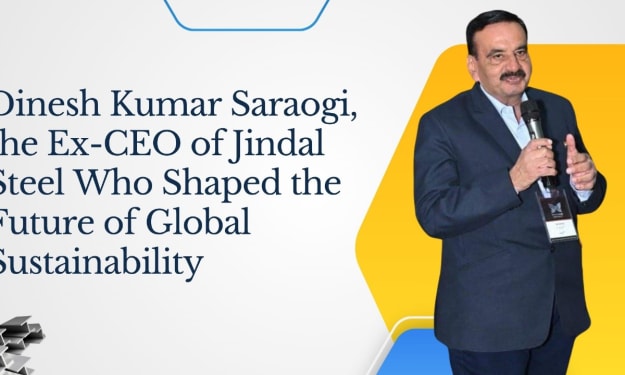
Dinesh Kumar Saraogi, the Ex-CEO of Jindal Steel Who Shaped the Future of Global Sustainability
With over 43 years of unparalleled experience in the steel industry, Dinesh Kumar Saraogi has left an indelible mark on the global stage. From leading transformative projects at Jindal Steel and Power Ltd. (JSPL) to spearhead innovative greenfield and brownfield projects in India as well as abroad, his career is a story of vision, resilience and groundbreaking success.
By Random Blogabout a year ago in Journal
6 Ideas on How to Make Money on Instagram Without Being an Influencer
Since social media platforms first appeared, businesses have been trying to figure out how to make money on them. Profitability started with advertising and continued to snowball until an entirely new profession emerged from within cyberspace: influencer marketing. An influencer is a person who has a massive online following. They market products and services for businesses in exchange for complimentary products, a commission on all products sold using a promo code, or an upfront fee. But it’s not easy to become an influencer. You need to put a lot of time and effort into growing your Instagram audience using a social media strategy. So does that mean you can’t make money on Instagram? Not at all! You can still make money on Instagram without being a major influencer with loads of followers. This guide will show you how non-influencers like you can monetize their Instagram presence. Here are the steps we’ll cover: Contents 1. Sell products directly 2. Build awareness for your brand 3. Implement affiliate marketing 4. Sell intellectual property 5. Engage customers directly 6. Sell dropship products
By ELIA MWAPINGAabout a year ago in Journal