economy
Economy and the area of production, distribution, trade, and consumption of goods and services.
Hot Topics - Real Estate
To start off a new week, let’s talk about a couple of hot topics in real estate right now! Many of you ask me frequently what is happening in the market, and depending on the week, it might be grimmer than others! Understanding more about what’s happening with the moving pieces of real estate helps break it down and make the reality of home ownership more tangible, and achievable!
By Kylie Martinabout a year ago in Journal
Trump Deploys 2,000 National Guard Members After Los Angeles Immigration Protests
After widespread demonstrations against federal immigration laws, former President Donald Trump took a bold step in the face of rising tensions over immigration enforcement by approving the deployment of 2,000 National Guard troops to Los Angeles. Disputable raids and detentions by Immigration and Customs Enforcement (ICE) in primarily Latino areas served as the impetus for the protests, which attracted hundreds of people. The Trump administration's tough immigration policies and readiness to employ military action to uphold law and order were highlighted by the National Guard's deployment.
By Tanvir Shahariarabout a year ago in Journal
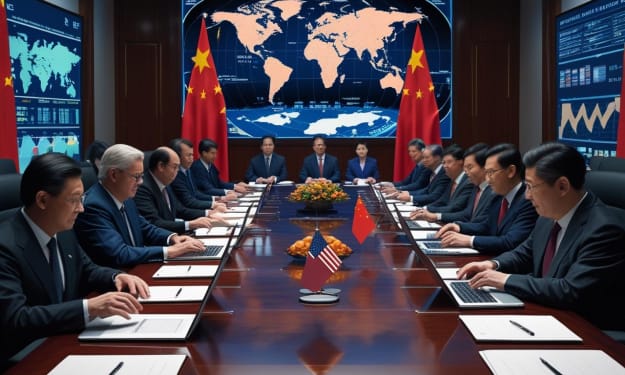
The London Showdown: U.S.–China Trade Talks on June 9 Could Reorder the Global Economy
1. 🇺🇸🇨🇳 Why London? Why Now? After months of escalating tension—from “Liberation Day” tariffs to rare-earth chokeholds—the U.S. and China are taking their latest gamble in London on June 9, 2025
By MILTON CHANDRA ADIKARYabout a year ago in Journal
Montréal, Strikes and Me
Here we go again... On June 2nd, the STM voted to go on strike for nine days, running from June 9th to the 17th. It will not be a total shutdown of the public transit system of my adopted hometown of Montréal, Quebec. Only certain hours of the day will see the buses and metro closed to the public, but still does not make it easier for the average commuter to plan their day-to-day activities...
By Kendall Defoe about a year ago in Journal
Sara Yahia: “Being compliant doesn’t mean slowing down innovation”
Human Resources leaders are facing new technologies, laws, and expectations. In this conversation, let's ask Sara Yahia, HR expert and author, for her take on it, sharing the lessons she’s learned and the challenges she’s seen firsthand on how to move forward with both confidence and care.
By Sara Yahiaabout a year ago in Journal
The Ripple Effects of U.S. Tariff Increases: What’s at Stake?
U.S. tariff policy holds immense sway over international trade dynamics, domestic industries, and consumer well-being. Recent tariff increases by the United States—most notably under the Biden and Trump administrations—have reignited debates on protectionism, trade fairness, and economic resilience. These measures, often aimed at protecting domestic industries or retaliating against perceived unfair practices by trade partners like China, may seem like short-term solutions but carry far-reaching consequences. Understanding the ripple effects of these tariff hikes is crucial to grasp what’s truly at stake for the global and domestic economy. Protectionist Goals vs. Global Interdependence Tariffs are essentially taxes imposed on imported goods, intended to make foreign products more expensive and thereby boost demand for domestic alternatives. In theory, this promotes local manufacturing, preserves jobs, and corrects trade imbalances. However, the U.S. is deeply enmeshed in global supply chains. From semiconductors to solar panels, many goods consumed or assembled domestically rely heavily on imported components. Increasing tariffs on Chinese goods, for example, is intended to encourage reshoring and reduce reliance on a geopolitical rival. But this often disrupts supply chains, raises costs for U.S. manufacturers, and provokes retaliatory tariffs from affected nations, compounding the economic strain. Instead of achieving strategic autonomy, tariffs may result in strategic isolation—where U.S. businesses are less competitive on the global stage. Economic Impact on U.S. Consumers and Businesses One of the most immediate ripple effects of tariff increases is rising consumer prices. When tariffs make imported goods more expensive, U.S. retailers and manufacturers often pass on the additional costs to consumers. This phenomenon has been particularly visible in industries such as electronics, automobiles, and household appliances. Small and medium-sized enterprises (SMEs), which typically lack the scale and financial buffer to absorb these costs, are hit especially hard. Many rely on global suppliers for affordable components. Tariffs squeeze their profit margins or force them to raise prices, potentially reducing their competitiveness. Meanwhile, large multinational corporations may be better positioned to relocate supply chains or negotiate more favorable terms—but at significant cost and complexity. In the long run, this could slow innovation and economic growth, particularly in technology sectors that depend on agile, cost-effective international partnerships. Retaliation and the Risk of Trade Wars Tariff increases rarely go unanswered. History shows that one nation’s tariffs often provoke retaliation, leading to escalating trade wars. The U.S.–China trade conflict that began in 2018 led to successive rounds of tariffs on hundreds of billions of dollars in goods from both sides. While some U.S. farmers and manufacturers saw temporary relief from subsidies or redirected trade, others suffered major losses as access to key export markets was blocked or diminished. Beyond bilateral disputes, higher tariffs can damage multilateral trade relationships and weaken institutions like the World Trade Organization (WTO), which plays a crucial role in mediating disputes and maintaining a rules-based global trading system. As the U.S. increases tariffs, it risks undermining the very frameworks that help resolve unfair trade practices peacefully and systematically. Strategic Competition and National Security Some proponents of tariffs argue they are necessary to protect national security interests, especially in critical sectors like semiconductors, rare earth elements, and green energy technologies. The concern is that overdependence on foreign—especially Chinese—suppliers in these areas could compromise national security and economic sovereignty. In this context, tariffs may be part of a broader strategy that includes industrial policy, subsidies, and domestic investment. However, without coordinated planning, such measures can misfire. Overreliance on tariffs without accompanying infrastructure and workforce investment may yield little more than higher costs and political tensions. Looking Ahead: Finding a Balance The challenge for U.S. policymakers is to strike a balance between legitimate national security concerns and the risks of overplaying protectionist tools. While some tariffs may be justified to address specific issues—such as intellectual property theft or forced technology transfers—broad, sweeping tariff increases risk backfiring. A forward-looking strategy might include targeted tariffs, coupled with robust investment in domestic innovation, supply chain diversification, and multilateral diplomacy. In today’s multipolar world, the cost of going it alone is high. As the U.S. recalibrates its trade relationships, the stakes are not just economic—they are geopolitical, structural, and deeply human. The ripple effects of tariff increases will be felt far beyond customs warehouses and trade balance sheets. They will shape the future of global commerce, the livelihoods of millions, and America’s role in a rapidly evolving world order.
By Naveed Younisabout a year ago in Journal