criminals
Notorious corporate criminals throughout the history of business.
Plagiarism and Copyright
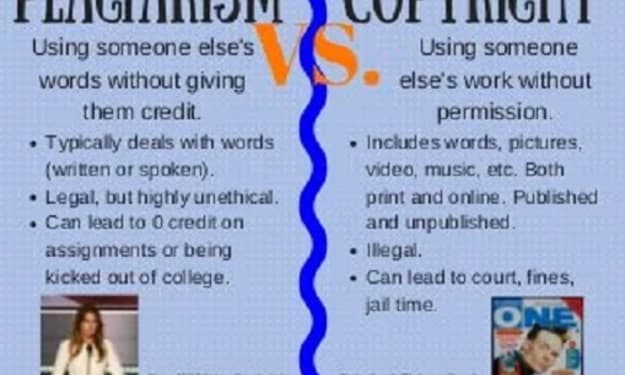
An Introduction The image above is from Slideshare Here There has been a lot posted about plagiarism recently and it is quite right that it is brought to the forefront and action taken where it occurs. The thing is that it has made me feel like the world’s biggest plagiarist because of the nature of my writing and has made me feel like I should drop out of the various Facebook Vocal groups because I am an effective writing criminal, though I will not leave unless asked to go or am actually removed. So here are a couple of definitions that I will work within this article which hopefully doesn’t get reported for plagiarism itself
By Mike Singleton 💜 Mikeydred 4 months ago in Journal
Authorship vs Refinement
Much of the confusion surrounding artificial intelligence and writing comes from a failure to distinguish between two fundamentally different acts: originating ideas and refining their expression. These acts are often treated as interchangeable, as though whoever touches the final form must also be the source of the thought itself. That assumption does not reflect how writing has ever worked, nor does it reflect how human thinking actually unfolds.
By Peter Thwing - Host of the FST Podcast4 months ago in Journal
Institutions Fear Inference More Than Lies
Institutions are often willing to tolerate isolated falsehoods, minor inaccuracies, selective framing, and even outright contradictions. A single lie can be corrected, buried, explained away, or isolated from the larger structure. What institutions consistently resist is not merely factual disagreement. They resist inference. They resist the moment when separate observations are connected into a pattern, and the pattern begins to imply responsibility.
By Peter Thwing - Host of the FST Podcast4 months ago in Journal
Immunity and Practical Unaccountability
In theory, no one is above the law. This phrase is repeated often enough that it functions as a civic mantra, a reassurance that power is ultimately constrained and that authority remains accountable to the same moral and legal standards imposed on everyone else. On paper, police officers, prosecutors, and government agents are subject to the law just like any citizen. They can be investigated, disciplined, sued, or prosecuted when misconduct occurs.
By Peter Thwing - Host of the FST Podcast4 months ago in Journal
Writing as Journal, Not Just Product
Not everything that matters begins as something meant for an audience. Much of what shapes a person most deeply starts as private wrestling, unfinished realization, unresolved tension, or a question that has not yet settled into a firm position. Treating writing only as a product meant for consumption misunderstands one of its most essential functions. Before writing becomes communication, it is often orientation.
By Peter Thwing - Host of the FST Podcast4 months ago in Journal
The Canvas Hack Explained: How a Massive Cyberattack Disrupted Thousands of Schools Across America
Imagine preparing for your final exams. Your lecture notes are online. Your assignments are online. Your quizzes, grades, deadlines, professor announcements—everything lives in one digital classroom.
By Omasanjuwa Ogharandukun4 months ago in Journal
Every Alternative Is an Admission
The Current System Should Not Be Treated as the Neutral Baseline The current redistricting system is often treated as the normal starting point, while every alternative is treated as an experiment that must justify itself. That framing is backwards. The current system is already an experiment in political assignment. It already decides which voters belong together before they vote. It already gives enormous power to whoever controls the boundaries. It already allows voters to be packed, cracked, attached, diluted, concentrated, divided, or rearranged while still maintaining the appearance of legal process. The familiar system should not receive moral credit merely because people are used to it.
By Peter Thwing - Host of the FST Podcast4 months ago in Journal
Why This Conversation Has to Happen Now
This Is Not an Abstract Exercise Brainstorming alternatives to redistricting can sound theoretical until the country enters a moment when the map itself becomes one of the main weapons of national power. At that point, the question stops being academic. It becomes immediate. If congressional control can be altered not mainly by persuading voters, but by changing the containers those voters are placed into, then redistricting is not a procedural side issue. It is one of the most consequential political powers in the country.
By Peter Thwing - Host of the FST Podcast4 months ago in Journal
Power Prefers Ambiguity to Truth
Ambiguity Is Safer Than a Lie Power rarely announces itself through outright lies. Lies are risky. They can be disproven. They can be exposed. They can be traced back to the person or institution that made them. What power often prefers instead is ambiguity. Ambiguity is safer than falsehood because it cannot be cleanly falsified. It blurs edges, stretches timelines, multiplies interpretations, and turns clarity into controversy.
By Peter Thwing - Host of the FST Podcast4 months ago in Journal
Why Communication Is About Meaning, Not Skill Display
When Language Becomes a Status Signal Communication is often treated as a performance of intelligence rather than a transfer of meaning. Fluency, vocabulary, wit, rhythm, rhetorical flair, and stylistic confidence are taken as evidence of insight, while quieter or less polished expression is often assumed to signal weaker thought. This framing subtly shifts the goal of communication away from understanding and toward display. When that happens, language stops serving meaning and starts serving status, even when the speaker or writer has no intention of performing.
By Peter Thwing - Host of the FST Podcast4 months ago in Journal
Editing as Protection, Not Substitution, of Meaning
Meaning Does Not Transfer Itself The assumption that editing weakens authorship rests on a fragile understanding of meaning itself. It treats ideas as though they exist independently of how they are communicated, as though the act of expression is merely decorative rather than structural. Under this assumption, any intervention that improves phrasing, organization, clarity, sequence, or emphasis is seen as interference rather than preservation. This framing misunderstands the reality that meaning is not transferred intact by default.
By Peter Thwing - Host of the FST Podcast4 months ago in Journal