criminals
Notorious corporate criminals throughout the history of business.
Understanding Valley Fair Mall — From Shopping Hub to Black Friday Tragedy
What is Valley Fair Mall Westfield Valley Fair is one of Northern California’s largest and most prestigious shopping destinations. With a floor area of over 2.2 million square feet and roughly 236 stores including luxury boutiques, high-end department stores, and a wide variety of dining options, it stands out as a major retail — and social — hub in the Bay Area.
By KAMRAN AHMAD12 months ago in Journal
When Fear Meets Duty: The Story Behind a National Guard Shooting in DC
Moments of crisis have a way of etching themselves into the memory of a city. Washington DC has seen its share of tension, but whenever the phrase national guard shot in DC appears in the news, it stirs a deeper feeling. It reminds people of uncertainty, of neighborhoods holding their breath, of soldiers pulled between two roles. On one side they are protectors. On the other they are young people who never expected to find themselves facing life changing decisions in the heart of their own capital. This article explores the layers behind such an event. It looks at fear, training, responsibility, and the quiet struggles that do not fit neatly into headlines.
By Muqadas khan12 months ago in Journal
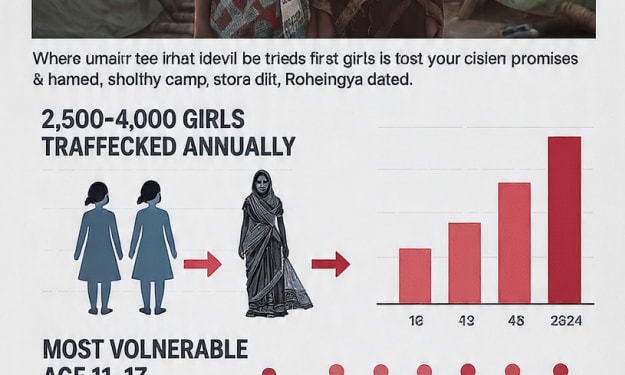
Rohingya Girls Trafficked Inside Cox’s Bazar Refugee Camps
By Tuhin Sarwar : Cox’s Bazar & Dhaka Investigative report exposes transnational exploitation of Rohingya girls and women through false job offers, hotel-based sexual labor, forged documents, and maritime smuggling.
By Tuhin Sarwar12 months ago in Journal
The Journal Keeper
M Mehran The first time I saw the journal, it wasn’t because I was looking for it. I was looking for something far less poetic—my phone charger. But life is strange that way. It rarely gives you what you ask for, only what you need. It was tucked beneath a loose floorboard in my grandmother’s attic, wrapped in a faded blue scarf. The leather was cracked, the edges feathered like pages that had been turned too often. There was no title on the cover. Just a small silver key hanging from a fraying ribbon. I should have put it back. I should have respected the privacy of someone who no longer had the choice to defend it. But grief makes us curious and loneliness makes us brave. So I opened it. The first page stopped me cold. “If someone I love is reading this, it means the world has already taken more than it should.” I sat down slowly on the dusty wooden floor. Sunlight spilled through the attic window in thin gold lines, the kind that make everything feel suspended—air, dust, time, and your heartbeat. My grandmother, who I always knew as calm, proper, and impossibly patient, had written a journal that didn’t sound like her at all. --- Most people think journals are quiet things—kept between pages and never meant to be spoken aloud. But hers was a storm. She wrote about dreams she never chased because she was too busy raising children. About music she wanted to learn but never had the time for. About being seventeen and standing on a train platform with a suitcase she never got to use. And then I reached the line that made my throat tighten. “I hope someone in our family learns to live before life becomes something they remember instead of something they’re inside of.” I closed the journal for a moment. Not because I wanted to—but because suddenly, I couldn’t breathe. I had been living the exact opposite of what she was asking. My own life was a checklist: Wake up. Work. Scroll. Sleep. Repeat. My childhood sketchbooks were empty. My passport unstamped. My dreams postponed because “maybe next year” felt safer than “right now.” I didn’t expect a journal written thirty years before I was born to feel like it was written for me. --- The second time I opened it, I wasn’t alone. My mother had come into the attic looking for her old photo albums. Instead, she found me—cross-legged, tear-stained, and holding the last words of a woman she missed more than she admitted. She sat beside me, and for a long time we didn’t say anything. Finally, she whispered, “I didn’t know she wrote.” “She didn’t,” I said softly. “Not like this.” I handed her the journal, and she held it the way people hold fragile things—not because they might break, but because they already have. We spent the whole afternoon reading it together. Sometimes we laughed—my grandmother complaining about my grandfather’s habit of talking to the television. Sometimes my mother wiped tears before they fell, pretending she had dust in her eyes. But there was one entry none of us were prepared for. --- “If you ever feel lost, start keeping your own journal. Not the kind that records what you did, but the kind that reveals who you are.” She wrote that every person has two lives: The one they live publicly, and the one they write privately. And the second one—the written one—was the truer of the two. My grandmother had never said anything that bold out loud. She spoke softly, lived quietly, and left the room before anyone noticed she had been there. But here, in ink, she was loud and certain and awakened. I realized then that journals aren’t meant to store memories. They’re meant to release them. --- That night, after we finally came down from the attic, I did something I hadn’t done since I was twelve. I bought a journal. Not a digital one, not a notes app—an actual notebook with rough-cut pages and a spine that cracked when it opened for the first time. The page stared at me like a mirror. Blank. Honest. Patient. I didn’t write what I did that day. I wrote what I felt: That I was afraid of wasting my life. That I wanted to travel without waiting for permission. That I missed people I never said goodbye to properly. The pen moved slowly at first. Then faster. It felt like someone unclenched a fist inside my chest. I didn’t know that writing could feel like breathing. --- Weeks passed. My journal began filling with things I didn’t even know I believed—ideas, fears, tiny victories. I noticed small details again: the way rain sounds different on a Monday than on a Saturday. The taste of coffee when you aren’t drinking it in a hurry. My life didn’t suddenly become extraordinary—but it became mine. One evening, my mother knocked on my door. She was holding a journal of her own. “I thought,” she said awkwardly, “maybe it’s my turn.” And just like that, three generations were connected—not through blood, but through ink. --- Yesterday, I returned to my grandmother’s attic, the journal still wrapped in its blue scarf. I didn’t take it with me this time. Some stories aren’t meant to be carried. Some are meant to stay where they can keep teaching. But before I closed the floorboard, I added something inside the scarf: A letter. “I found your words. And I’m finally writing my own. Thank you for giving me a life I hadn’t started living yet.” I don’t know if anyone will ever find it. Maybe years from now, someone else will be searching for a phone charger and instead find a map back to themselves. Because that’s what journals are— Not a record of the past, but a doorway to the person we are still becoming.
By Muhammad Mehran12 months ago in Journal
Social Engineering: What Is It and How to Defeat It
Social engineering is a method of mental manipulation used by cyber criminals to deceive people, pretending to be someone else or a company, with the intention that they share sensitive data or make decisions that endanger the security of their information. Instead of exploiting technical flaws, this type of fraud is based on human errors.
By Ninfa Galeano12 months ago in Journal
Why Hiring a Self-Assessment Accountant Can Save You Money
Navigating personal tax obligations is rarely straightforward. For many individuals, the self-assessment process can feel labyrinthine, laden with unfamiliar terminology, shifting legislation, and deadlines that creep up faster than expected. Missteps can lead to penalties, missed reliefs, or inaccurate filings—all of which translate into unnecessary financial loss. Engaging professional self assessment accountants is one of the most effective strategies for reducing this risk while simultaneously enhancing long-term financial efficiency.
By Self Assessment Tax Return12 months ago in Journal
Apple Delays Vision Pro 2 After Weak Sales of the First Model
Apple has decided to delay the development of the Vision Pro 2, the next version of its mixed-reality headset. The company planned to release future models quickly, but recent sales numbers changed that plan. The first Vision Pro, released earlier this year, did not sell as well as Apple expected. This slow demand is now affecting Apple’s long-term strategy for the device.
By Shakil Sorkarabout a year ago in Journal
Saudi Arabia’s Bangladeshi Domestic Workers: Violence, Exploitation and the Fight for Dignity
By Tuhin Sarwar | Bangladesh । 16-November । 2025 । Introduction: A Crisis Hidden Behind Closed Doors When 38-year-old Shamina returned to Dhaka from Saudi Arabia in early 2024, she could barely speak. Her left arm was fractured; burn marks lined her back; and she carried medical certificates documenting “severe physical assault.” Her story is not an anomaly it is part of a pattern.
By Tuhin Sarwarabout a year ago in Journal
Anthropic Will Spend $50 Billion to Build AI Data Centers in the U.S.
Anthropic, an AI company best known for its Claude models, is making a huge investment. The company will spend $50 billion to build new data centers in the United States. These centers will help run and grow its artificial intelligence work.
By Shakil Sorkarabout a year ago in Journal