criminals
Notorious corporate criminals throughout the history of business.
Vasco da Gama: The Founder of Barbarity and Colonial Terrorism in the Garb of Discovery . AI-Generated.
Vasco da Gama is often presented in the pages of history as a great adventurer and conqueror of the seas, but the reality is quite the opposite because his arrival was no less than a human disaster for the Indian subcontinent that changed the destiny of the region. He was actually a fanatical religious plunderer and colonialist whose heart was filled with the ancient hatred of the Crusades for Muslims and immense colonial arrogance for Indians. When he left Lisbon in 1497 on the orders of King Manuel I of Portugal, the red cross symbols on his ships reflected his intentions that this journey was not just for trade but to end the dominance of Christianity and the maritime trade monopoly of Muslims by force. He left traces of his brutality in the coastal cities of Mombasa and Malindi in Africa. After leaving, when he reached Calicut in May 1498, his behavior towards the local ruler, Raja Zamorin, was contrary to any diplomatic etiquette. His most shocking incident occurred during his second voyage in October 1502, when he stopped the ship 'Miri' in the Arabian Sea, which was returning from the Hajj pilgrimage from Mecca, with more than four hundred innocent passengers on board. In addition to respectable merchants, these passengers also included women and innocent children. When the Portuguese ships surrounded them, the captain and passengers of the ship handed over twenty-two thousand gold coins and valuable goods to Gama in exchange for their lives, but this savage man refused to spare their lives even after looting all the property and belongings. British historian R.S. Whiteway writes in his book "The Rise of Portuguese Power in India" that Gama ordered the ship's ammunition depot to be set on fire, during which The scenes were heartbreaking because mothers were holding their little children in their arms and showing them to the Portuguese soldiers that perhaps they would take pity on these innocents and save them. But Gama strictly ordered his gunners to shoot and kill any passenger who jumped into the sea. In this way, the ship continued to burn in the middle of the sea for four days, including the suffering people, until all 400 people were burned alive. Gama's brutality was not limited to Muslims, but he adopted inhumane tactics to intimidate the Hindu Raja of Calicut. When Raja Zamoran sent a respected and elderly Brahmin priest as an ambassador to Gama for negotiations, the brutal Portuguese arrested the old priest and cut off his lips and ears. Then he slaughtered a dog and sewed its ears on the priest's head and returned it with an insulting letter. Sent to the Raja, this incident is mentioned with pride by the Portuguese historian Gaspar Correa himself in his work "Lendas da Índia" which exposes the Portuguese mentality of that time. During the same voyage, Gama captured about eight hundred unarmed fishermen and small local traders on the coast of Calicut and cut off their hands, noses and ears and loaded them into a large boat and put dry leaves on top of it and set it on fire and pushed this burning boat towards the shore so that the people of the city would be terrified to see the severed limbs of their loved ones. He sent a message to the Raja to cook curry for himself from these severed human limbs. These are the gruesome historical facts that the Western narrative has always hidden in the beautiful words of "transition of civilization". Gama introduced a forced permit system called "Cartaz" for the first time in the peaceful trade of the Indian Ocean using cannons and guns, under which every ship was required to be given to the Portuguese. They had to pay extortion, otherwise they would be declared pirates and drowned. In this way, he strangled the independent economy of the subcontinent and laid the foundation for centuries of colonial plunder here. Renowned modern historians like Sanjay Subramaniam make it clear in his book "The Career and Legend of Vasco da Gama" that Gama was not just an adventurer but a violent person to the point of a psychopath who enjoyed playing Holi with the blood of innocents. The stories of his atrocities are also found in the writings of French historian Geneviève Bouchon and Indian researcher K.M. Panicker, which prove that Vasco da Gama's discovery actually brought a message of slavery, religious prejudice and economic destruction to South Asia. Unfortunately, the imprint of the colonial era still remains in our educational curriculum and Pakistan studies books, where Vasco da Gama is taught as a hero and a great man who discovered the way, while a criminal silence is maintained on the massacres committed by him. Due to this curricular gap, our The new generation is unable to recognize its real enemies and friends. It is time to make these historical truths part of the curriculum and force the international community to remove the statues of war criminals like Vasco da Gama from their squares, because these statues are a humiliation to humanity and a source of suffering to the souls of millions of innocent Indians and Muslims whose blood was shed by this brutal man just to obtain gold and spices. The story of Vasco da Gama is the story of a plunderer who stained the seas with blood and history will never forgive him until his true face is fully revealed to the world. And we, as independent journalists, pledge to continue to unmask the distorted faces of history so that future generations can distinguish between truth and falsehood and recognize our true national heroes. Research and writing: Journalist Malik Sarfaraz Hussain Awan
By Malik Sarfraz Hussain Awan7 months ago in Journal
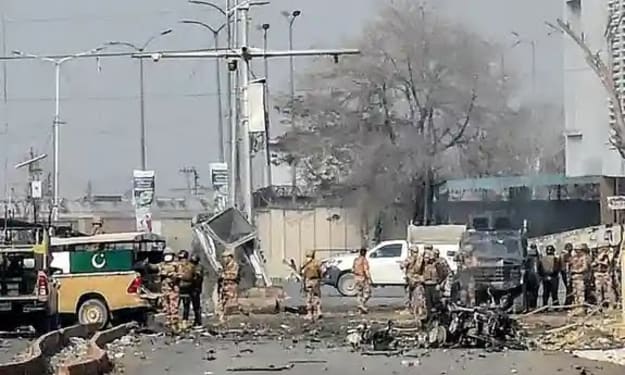
Attacks at 12 Locations in Pakistan’s Balochistan: What Does the Expansion of Militants’ Organized Operations to Quetta Mean?
Attacks at 12 Locations in Pakistan’s Balochistan: What Does the Expansion of Militants’ Organized Operations to Quetta Mean? The Government of Pakistan has confirmed that at least 37 militants and 10 security personnel have been killed so far in attacks carried out in 12 cities of Balochistan, including Quetta. However, security sources claim that 67 militants were killed in retaliatory operations on Saturday. According to security sources, 41 militants were killed yesterday during various operations in Panjgur and Shaban, after which the number of militants killed over two days has reached 108. A local police official stated that in Kharaan, an attack on the residence of Mir Shahid Gul Malazai, Chairman of the Malazai National Alliance, resulted in the deaths of seven people including Shahid Gul. Police said that his house and vehicle were also set on fire. Security sources say that in the attack in Gwadar, 11 members of a family from Khuzdar were killed, including three women and three children. The government claims that terrorist attacks in various cities, including the provincial capital Quetta, were thwarted. Besides Quetta, terrorists carried out attacks in Mastung, Pasni, Gwadar, Kharaan, Noshki, and Mach, though official details of these incidents have not been provided. Reports were also received of an attack on the Maritime Security Agency office in Pasni by a female suicide bomber, but authorities have not provided details of the losses there. The banned separatist group Balochistan Liberation Army (BLA) claimed responsibility for these attacks in a statement, calling them the second phase of “Operation Herof.” Similar organized attacks were witnessed in August 2024. The BLA had also claimed responsibility for those attacks and named the operation “Herof.” Attacks Inside Quetta Are a Message That We Can Come Anywhere It is not the first time that armed groups have entered multiple cities of Balochistan simultaneously, targeting police, government and security buildings, and carrying out suicide attacks. However, in the recent attacks, it was seen for the first time that such operations also took place inside Quetta, the provincial capital. A powerful explosion was heard in one area of Quetta early in the morning, after which the city’s Red Zone was sealed and emergency declared in hospitals. Quetta has been considered relatively secure, and security check posts and a protective cordon have been established around the city. Numerous checkpoints also exist inside the city. Do the recent attacks inside Quetta indicate a security or intelligence failure? Muhammad Shoaib, associated with the Department of International Relations at Quaid-e-Azam University, Islamabad, says that Pakistani cities have expanded so much that such a “failure” could occur anywhere—even in Islamabad. In his view, the fact that the attackers were killed quickly shows that security institutions were better prepared. “The speed with which videos and images emerged suggests that security forces managed to control the fallout. It seems they learned lessons from previous attacks and were somewhat prepared for such situations.” However, Shoaib says it is indeed the first time that such attacks reached the provincial capital, which is a major development. “Their arrival in Quetta is a big statement. It is a message from them that we can come wherever we want. People outside Quetta did not expect this, as the city’s security is considered relatively strong.” Shoaib says that observing the locations targeted in various cities shows that mostly major government and security offices were attacked in each district. He believes that the expansion of attacks to Quetta indicates that support for the attackers has penetrated the general population. “The fact that this movement has continued for so long shows that the issue is far more complex.” According to him, the biggest security challenge in Balochistan is political: “You have to win hearts and minds. Fighting should be the last option, not the first.” Such Organized Attacks in Quetta Impossible Without Local Support Dost Muhammad Baloch (Breach), an analyst based in Balochistan, said that like the August 2024 attacks, the recent ones were also large-scale and organized, and for the first time appeared to reach Quetta. He agrees that: “Carrying out such organized attacks in Quetta is impossible without local support. Large-scale operations cannot happen without local sympathies.” He also agrees that the state’s major challenge is winning the hearts and minds of local people. “If large military operations continue, people’s grievances will increase. In guerrilla warfare, the real prize is the support of ordinary people.” He believes the state is trying to win public support, but it is a time-consuming process and must reach the grassroots level. He cited provincial government initiatives such as: Balochistan Special Development Program Balochistan Education Endowment Fund Balochistan Youth Policy 2024 Benazir Scholarship Establishment of technical and vocational institutions He added that another problem is that Balochistan has only one metropolitan city—Quetta. “If more urban centers are developed, focus will not remain solely on Quetta, and efforts to solve people’s problems will be visible outside Quetta as well.” He also believes the attacks reveal another dimension—the presence of valuable minerals and gemstones. According to him, both major global powers, the United States and China, have their eyes on these resources. Some recent videos suggest that the BLA wants to send a message that access to Balochistan’s minerals will not be possible without their consent. Educated Recruits More Dangerous Than Old Fighters Muhammad Shoaib of Quaid-e-Azam University says the state also faces the challenge that separatist movements are using social media to promote nationalism. Educated middle-class youth are influenced and join these movements. Shoaib believes these educated militants are more dangerous than old fighters because they are ideologically driven. “Unlike old fighters who simply picked up guns, these educated militants are smarter in using weapons and technology.” He says the state appears to be trying to resolve Baloch grievances, but it must first understand the nature of those grievances and identify what kind of people are joining the movement. “Local problems need local solutions. The center tries to assess Balochistan from afar, which is very difficult.” He adds that freedom of expression helps reveal people’s grievances, and the state must provide more local platforms for such expression.
By Pets and animals 8 months ago in Journal
Understanding a U.S. Government Shutdown
A “government shutdown” in the United States sounds like a sci-fi switch someone flipsand suddenly a whole country goes dark. Reality is messier, more legalistic, and (unfortunately) more human: it’s not the nation shutting off, it’s certain federal agencies losing legal authority to spend money, which then ripples into paychecks, services, contracts, and public trust.
By Sayed Zewayed8 months ago in Journal
While Your Case Is Under Review
While Your Case Is Under Review The message arrived almost immediately. I had barely closed the browser window before my phone vibrated. An email—polite, efficient—thanked me for submitting my materials and assured me they had been received. It explained that my case was now under review and that I would be contacted if additional information was required. Nothing else was needed from me at this time. I reread the message twice, then a third time, scanning for something actionable. A next step. A name. A human signature. There was none. Just a confirmation number and a reminder to be patient. The system had responded. The system was working. At first, I trusted that. The speed felt reassuring. A system that responds quickly must be organized. Serious. Attentive. I told myself that careful processes take time, that thoroughness and delay are often indistinguishable from fairness. I didn’t yet understand that the waiting was not a pause between actions. It was the action. In the beginning, the waiting felt light. Inconsequential. I checked the portal the way someone checks the weather—out of habit, without expectation. Each time, the status was unchanged. Under review. The phrase was neutral, almost comforting. It suggested motion without revealing direction. Days passed. Then weeks. The first follow-up arrived requesting additional documentation. Information I had already submitted, now framed slightly differently. Dates reformatted. Descriptions clarified. Attachments re-uploaded. I complied immediately, careful to be precise and professional. I didn’t want to slow anything down. Another automated email followed within minutes. Another thank-you. Another assurance that my materials were under review. This became the rhythm. Submission. Confirmation. Silence. What unsettled me wasn’t resistance. No one challenged my account. No one questioned my credibility. There was no confrontation, no rejection, no visible skepticism. The system didn’t argue—it absorbed. Everything I offered disappeared neatly into it, leaving no trace of response. It was difficult to explain this discomfort to people on the outside. “At least they’re looking into it,” they said. “These things take time.” And on paper, they were right. Every step made sense in isolation. Every delay was defensible. Every communication followed policy. That was the problem. Nothing was wrong enough to protest. The system did not deny me. It did not resolve anything either. It held me in a suspended middle where urgency slowly thinned into fatigue. I began to notice how much of my life had quietly reorganized itself around that suspension. I stopped planning too far ahead. I hesitated before committing to anything that might demand my full attention, just in case another email arrived. My phone stayed within reach at all times. Notifications on. Volume up. I slept lightly. The system never asked for this level of vigilance. It didn’t need to. Uncertainty did the work for it. Time inside the process began to behave differently. Days felt indistinct. Weeks blurred together. The calendar moved forward, but nothing progressed. I started measuring time not in days, but in updates. Not in weeks, but in acknowledgments. The only proof that time was passing was the date at the bottom of each email. I started documenting everything. Screenshots. PDFs. Copies of copies. I kept an archive of my own participation, as if redundancy might protect me from being erased. The act of saving felt like agency, even though it changed nothing. Occasionally, a human voice appeared. Brief. Careful. Always framed as a representative of procedure, never as an individual. Their messages were courteous and deliberately vague. They thanked me for my patience. They acknowledged my concerns. They reminded me that these processes take time. They never explained why. I learned that questions were allowed, but answers were not guaranteed. That concern could be validated without being addressed. That language could sound responsive while remaining empty. I don’t believe anyone intended harm. This wasn’t cruelty. It was design. The system wasn’t built to hurt people—it was built to be consistent. Predictable. Safe from liability. It prioritized neutrality over nuance, procedure over urgency. But neutrality has a cost when one side is waiting. Over time, the waiting began to show up in my body. Headaches without explanation. A tightness in my chest that came and went. A constant low-level alertness that made rest feel irresponsible. I was always slightly braced, as if something might happen at any moment, even though nothing ever did. I began to self-police. I rewrote emails before sending them, removing anything that sounded emotional or impatient. I shortened questions. Softened language. Added phrases like whenever possible and I understand timelines vary. I learned to preemptively apologize for taking up space. The system never asked me to do this. I learned it anyway. The longer the process continued, the harder it became to remember who I had been before entering it. The clarity I felt at the beginning dulled. My confidence thinned. I second-guessed details I had once been certain of. The system didn’t challenge my account, but it didn’t affirm it either—and the silence began to feel like commentary. At some point, I realized the system didn’t need to reject me. It didn’t need to deny or defend. It simply needed to outlast me. When the decision finally arrived, it came quietly. Another email. Another attachment. Another explanation wrapped in procedural language. It referenced timelines, standards, steps taken. It confirmed that policies had been followed and criteria applied. It was technically correct. It was also profoundly unsatisfying. Nothing in the final communication acknowledged the waiting itself. The months of suspension. The erosion caused by prolonged uncertainty. The system accounted for actions, not consequences. For steps, not strain. Reading it, I understood that nothing about my experience had been invisible—it had simply been irrelevant. The system was never designed to measure the human cost of delay. It wasn’t broken. It was focused elsewhere. From the outside, the process looked orderly and fair. Documents reviewed. Procedures followed. Decisions rendered. The system could point to its own consistency as proof of integrity. From the inside, something quieter had happened. While my case was under review, time passed. Opportunities closed. Energy drained. Certainty eroded. None of this violated policy. None of it registered as an error. The system did what it promised. It processed. And by the time it was finished, there was nothing left to appeal but the waiting itself.
By Dakota Denise 8 months ago in Journal
A Complete Guide to Self Assessment Tax Returns in London
Navigating the UK tax system can feel labyrinthine, particularly for individuals and businesses with complex income streams. In London, where entrepreneurial activity, property investment, and freelance work thrive, understanding self assessment is not merely advisable—it is essential. This guide offers a comprehensive exploration of how self assessment tax returns work, who needs to file them, key deadlines, common pitfalls, and the value of professional support.
By Self Assessment Tax Return8 months ago in Journal
“Iran VS United States, Tensions at the Breaking Point. Trump’s Next Move Could Reshape the Middle East”
1. Background: What’s Happening Now • Nationwide protests in Iran are ongoing due to a severe economic crisis, skyrocketing inflation, and public anger about conditions inside the country. • President Donald Trump has publicly threatened Iran, warning that if Tehran violently suppresses protesters or gets too aggressive, the U.S. could intervene. • Iran’s government has responded by warning of swift and comprehensive retaliation if the U.S. attacks. • Iran’s airspace and infrastructure remain tense, but some diplomatic communications have briefly reopened, signaling both sides are weighing options.
By USA daily update 8 months ago in Journal
Daily Liturgy — January 21, 2026
Today the Church celebrates the Memorial of Saint Agnes, Virgin and Martyr, and the liturgy invites us to reflect on courage, fidelity, and the quiet strength that comes from trusting God completely. As we continue through the Second Week in Ordinary Time, the readings place before us two powerful images of faith in action: the youthful confidence of David as he faces Goliath, and the steady, uncompromising mercy of Christ as He heals on the Sabbath. Together, they remind us that God’s power is often revealed not through force or status, but through obedience, humility, and love that refuses to yield to fear.
By Failproof Flowers8 months ago in Journal