career
Careers in the industry; from corporate to middle management, food service, media, political figures, and beyond. All workplace careers.
Jaipur Startup Jobs – Fast-Track Your Career Now
Jaipur, the capital of Rajasthan, is no longer just a city of culture and tradition—it’s fast emerging as a startup hotspot, creating a wave of job opportunities in Jaipur for freshers and professionals alike. With increasing investments and innovation in tech, education, healthcare, and finance, there’s never been a better time to explore startup jobs in Jaipur.
By Vinaysalarite2 years ago in Journal
Supreme Court Orders Trump-Era Officials to ‘Facilitate’ Return of Wrongly Deported Man
In a decision that would have broad implications for U.S. immigration enforcement and government accountability, the Supreme Court has held that Trump administration officials are required to "facilitate" the return of a man wrongly deported. The decision underscores the role of the judiciary to ensure justice to individuals who are harmed by administrative actions, most specifically in the highly politicized and generally contentious arena of immigration policy.
By Robert Kroos2 years ago in Journal
Virtual Side Hustles: Navigating the Freelance Revolution of 2025
In 2025, the freelance revolution is reshaping the way we work and earn money. The digital landscape has evolved beyond traditional employment, opening up a realm where remote work and gig platforms empower individuals to pursue multiple income streams simultaneously. This article explores how emerging freelance opportunities are setting the stage for a modern work-life balance, highlights success stories, spotlights the skills in demand, and offers practical tips for navigating this rapidly evolving landscape.
By Mysteries with Professor Jahani2 years ago in Journal
Liberation Day Tariffs Miss the Real Target: China
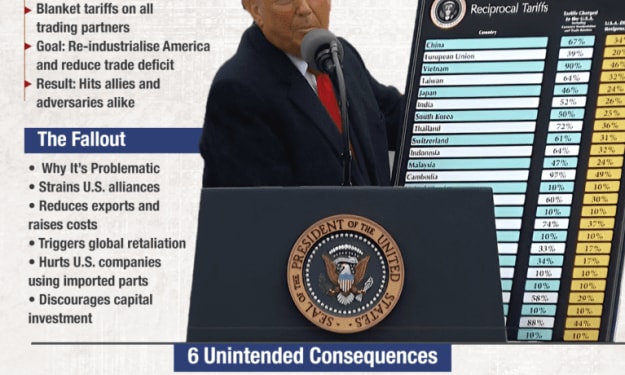
⏩The Trump administration’s announcement of blanket tariffs misses the mark. Instead of using a tariff threat to address trade irritants with our allies in order to form an alliance to jointly confront China’s mercantilist practices—the real threat to American economic and technological dominance—these tariffs indiscriminately hit allies and competitors alike. While they are sure to result in some increases in domestic manufacturing, foreign retaliation, as well as US tariffs on intermediate goods, will also mean fewer US exports. And the result will be strained, if not broken, partnerships at a time when America and the West should be laser-focused on countering predatory China’s trade offensive. ▶️With these tariffs, the Trump administration is arguably implementing the worst possible solution to address a problem they have rightly identified. Despite, or perhaps because of America’s leadership in the global trade system (until the day before “liberation day”), the result was a massive trade deficit and deindustrialization. ▶️Yet, U.S. globalists blithely denied that trade deficits matter and that globalization played a key role in hollowing out U.S manufacturing. At the same time, U.S. policymakers gave short shrift to foreign trade barriers as even long-standing allies adopted policies that disadvantaged American firms. Most of our Allies indeed took advantage of the United States by imposing their own trade barriers, and challenging us to adjudicate them at the WTO, which did not work for various reasons. And, of course, at the end of the day, it is China that will ultimately be responsible for breaking the global trading system, given its massive trade and economic distortions that have done so much to harm allied manufacturing economies. ▶️For at least a decade, the writing was on the wall for all to see. Yet, no serious and systematic efforts were made to reform the global trade system to address these systemic imbalances and distortions. Indeed, most in the Washington trade community insulted and mocked anyone who dared say there might be problems, if they even bothered to pay attention to them. ▶️So why are we surprised that Trumpian extremism to break globalization is the response? The reality is that “liberation day” is a natural, albeit likely fatally flawed, result of that self-righteousness, combined with an ill-informed nativism and protectionism from the Trump trade community. Now, the United States has declared a trade war with the rest of the world, treating allies and adversaries as equals. And like a partner who cheats and gets caught, these bonds with allies will likely never be fully restored, even if Trump wrangles deals. ▶️It would be one thing if the Trump tariff wall were effective. At least the United States would benefit from more manufacturing and a lower trade deficit. The reality is that “liberation day” will do little to make the United States more globally competitive and restore manufacturing, especially high-value-added advanced production. ▶️To be sure, “liberation day” measures will mean that some U.S. manufacturers will sell more, and some multinationals might move some production to the United States. But at least six factors are working in the opposite direction. ⏩First, tariffs on intermediate goods will hurt U.S. companies competing in global markets. Higher steel prices mean U.S. auto exports will be less competitive. ⛔Advertisement⛔ Subscribe to our notifications for the latest news and updates. You can disable anytime. pital goods (e.g., computers, machine tools, etc.) will raise these costs and lead to diminished US capital investment, not just in manufacturing but throughout the economy. That will slow the growth of vitally needed productivity. ⏩Third, most, if not all, other countries will retaliate. Even as the President has said he is open to negotiation (although other top Trump officials have said there will be no negotiations) and will punish retaliators. As this happens, some companies in America will move U.S. operations to other nations to serve non-US markets, as Harley-Davidson and Caterpillar did in 2018. ⏩Fourth, for intermediate goods that pass back and forth across the US border for additional value-added stages, the cumulative tariff stacking will likely lead companies to do all of this work outside of the United States. ⏩Fifth, even if the tariffs do restore some manufacturing, much of that could very well be low value-added products that have no real strategic interest for America, something those in the Trump trade community don’t care about. But the reality is that producing computer chips is vastly more important than producing potato chips. And other nations, who do understand this key difference, could very well respond by reducing exports to the United States of low-value added products, as well as vastly increasing imports of them, along with minerals and agricultural products. All with the objective of getting off Trump’s naughty list by reducing their trade deficit with the United States (the so-called reciprocal tariffs are a simple formula that reflects our trade deficit in goods with these nations). The result would be balanced trade, but the United States would be “winning” by being largely a “hewer of wood and drawer of water.” ⏩Sixth, the tariffs are a gift to Xi Jinping. By placing high tariffs on countries like India, Indonesia, and Vietnam, the incentive for multinationals to move production out of China goes down significantly. More importantly, besides arguably violating many trade agreements the United States has legally agreed to, the tariffs destroy any movement toward a Western alliance to counter China’s goal of setting the rules of the global economy. Just as America’s response to the Russian invasion of Ukraine cemented the alliance between Russia and China, Trump’s tariffs will go a long way toward building economic agreements between China and other nations. Already, Korea, Japan, and China have announced joint actions to respond, while the EU has discussed establishing closer ties with China. Free-market globalists screwed this up and enabled American losses, and as such, their “solutions” to do nothing other than remove the tariffs are unviable. Hopefully, they will realize this soon. In the vacuum of failed “free trade,” Liberation Day has been the answer. There is a better solution. First, the United States should establish a national innovation strategy focused on advanced manufacturing that includes implementing incentives for technology development and diffusion, establishing a National Competitiveness Council to formulate and coordinate advanced-industry competitiveness policies, or providing financial support—for example, creating a Super Chips Tax Credit. Killing the CHIPS Act, the National Institute of Standards and Technology’s (NIST) Manufacturing Extension Partnership, and cutting federal research spending is just digging the hole deeper. ⛔Advertisement⛔ Subscribe to our notifications for the latest news and updates. You can disable anytime. Subscribe to push notifications ▶️Second, Trump should approach our allies, one at a time, and confront them with a bill of particulars on the most important trade barriers they have related to US advanced industry development. He should state clearly that his additional tariffs go immediately to zero when these nations have made significant progress in rolling them back. For too long, the United States was too reticent to confront these practices, such as the systematic attacks on U.S. technology companies overseas. It’s not too late for this. ▶️At the same time, rather than tariffs which rightly anger our allies and inevitably lead to tit-for-tat retaliation, the administration should immediately push for a weaker dollar (which has the exact same effect as tariffs) and the implementation of a border-adjustable value-added tax (VAT) that would raise the price of imports and if used to partially lower business taxes, reduce the cost of exports. Allies might squawk but would not retaliate, partly because most have VATs, and many already manipulate their currencies. ▶️Third, the United States will lose the race for advanced industry competitiveness without serious partnerships with our allies. And that means China rules the world. In reality, we are close to having already lost this techno-economic war that China launched almost two decades ago. If Trump forces our allies to be against us and for China, the battle is definitely lost. ▶️Toward that end, Trump needs to adopt an Allied “Huawei” strategy. Absent Trump’s action in his first term to convince allies not to buy Huawei telecom equipment, it is likely that either Ericsson or Nokia would now be out of business, Huawei much stronger, and its future complete dominance likely. However, Trump’s efforts to limit their access to allied markets allowed us to gain a valuable commercial line of defense. The United States and allies need to do this again, but on a vastly broader array of Chinese goods and services, including Chinese company airplanes, drugs, semiconductors, heavy equipment, EVs, and other advanced and strategic industries that China has “cheated” in. ▶️If most of the allies, especially in Europe, had more cohesion and courage, they would be the ones to lead such a system, even as Trump tries to undermine it. But as it stands, they are more than happy to have America be the “bad cop” while they play “good cop” and take the U.S. market share. So, at the end of the day, it probably still comes down to US global leadership. Alas, with Trump’s nationalist protectionism, which is unlikely to come. The end of globalization as we know it, along with the end of America’s techno-economic leadership, is the likely result. ▶️There is a path out of the destruction and defeat that the Trump approach will bring. It’s not too late for the President to implement it. If he did, creating a new type of globalization to address critical current geopolitical challenges, he could go down as one of America’s greatest presidents. As things stand now, he will likely be seen as worse than Herbert Hoover when confronting the Great DepressionStart writing...
By CryptoCurrency News 2 years ago in Journal
7 Practical Reasons to Use Power of Attorney Online
Balancing career responsibilities with legal preparation doesn’t come easy. Between meetings, deadlines, and travel, professionals often postpone critical legal tasks like setting up a power of attorney. Using a power of attorney online cuts through the delays, giving people a faster, more flexible way to protect their financial or medical interests. This option makes legal planning much more manageable for anyone with a full schedule.
By Piper Burch2 years ago in Journal
10 Ways Screen Printing Materials Amplifies Brand Presence at Events
Visibility is a game-changer when participating in events, whether it’s a local expo or a regional trade show. Screen printing materials offer a versatile way to keep your brand front and center—on shirts, signs, giveaways, and more. Clear, consistent design leaves a strong visual impression that audiences remember well after the event wraps. Thoughtful use of screen-printed materials allows businesses to stand out without relying on aggressive sales tactics.
By Piper Burch2 years ago in Journal
THE CONNECTION CURRENCY: TURNING ENGAGEMENT INTO IMPACT
Social Media Management & Influencer Marketing: Two Powerhouses of the Digital Age In today’s digital era, social media is no longer just a platform for entertainment—it's a powerful tool for business, branding, and marketing. Whether it’s a small startup or a multinational company, everyone is leveraging social media to build their brand, connect with their audience, and drive growth. Two key elements that play a major role in this transformation are Social Media Management (SMM) and Influencer Marketing. In this blog, we’ll dive deep into what these are, how they work, and why they are essential for any brand in the 21st century. 1. WHAT IS SOCIAL MEDIA MANAGEMENT? Social Media Management is the process of professionally handling a brand's online presence across different platforms like Instagram, Facebook, Twitter, LinkedIn, and YouTube. It goes beyond simply posting content—it’s about strategy, engagement, and growth. Key responsibilities include: Planning and scheduling posts Creating content (text, images, videos) Engaging with followers Responding to comments and messages Tracking analytics and performance Maintaining brand tone and consistency A social media manager ensures that the brand stays active, relevant, and connected with its audience while aligning with the company’s goals and voice. 2. WHAT IS INFLUENCER MARKETING? Influencer marketing is a strategy where brands collaborate with individuals who have a strong social media following—called influencers—to promote their products or services. These influencers have built trust with their followers, making their endorsements highly effective. TYPES OF INFLUENCERS: ✓ MEGA INFLUENCERS – Celebrities with millions of followers ✓ MACRO INFLUENCERS – 100K+ followers, often niche experts or well-known personalities ✓MICRO INFLUENCERS – 10K to 100K followers with high engagement ✓NANO INFLUENCERS – 1K to 10K followers, usually focused on a specific niche or local audience Influencer marketing has evolved from being a trend to becoming an essential marketing channel for many businesses, especially in beauty, fashion, food, fitness, and tech. 3. HOW ARE SOCIAL MEDIA MANAGEMENT & INFLUENCER MARKETING CONNECTED? While Social Media Management focuses on maintaining a brand's official presence, influencer marketing helps extend that reach to new audiences through trusted voices. Together, they create a powerful combination of content, connection, and conversion. Example: Imagine a skincare brand launching a new product. The SMM team manages daily content, creates reels, and responds to customer queries. At the same time, the brand sends the product to beauty influencers for reviews and shoutouts. This double-layered strategy helps boost brand awareness, credibility, and sales. 4. ROLE OF A SOCIAL MEDIA MANAGER A social media manager wears many hats. They need to be creative, analytical, and responsive to trends and audience behavior. Must-have skills: CONTENT WRITING & VISUAL STORYTELLING Knowledge of social media tools (Buffer, Hootsuite, Canva, etc.) ANALYTICS AND REPORTING Communication & customer engagement Crisis management and brand protection They are the voice of the brand and play a key role in shaping online reputation. 5. HOW TO BUILD AN INFLUENCER MARKETING STRATEGY If you want to tap into influencer marketing, here’s a step-by-step strategy: Define your goals – Are you looking for awareness, sales, followers, or traffic? Identify the right influencers – Choose influencers that align with your brand and audience Share clear expectations – Provide content briefs, hashtags, and deadlines Track performance – Use affiliate links, UTM codes, or platform insights to measure ROI Build long-term relationships – Collaborating over time builds trust and consistency Influencer marketing works best when the influencer genuinely likes and believes in your brand. 6. WHY ARE THESE TWO SO IMPORTANT? Increases brand trust and visibility Connects directly with your target audience Cost-effective compared to traditional advertising Gives measurable results via insights and analytics Boosts customer engagement and loyalty In a world where digital presence defines brand success, SMM and influencer marketing are no longer optional—they’re essential. 7. WHAT DOES THE FUTURE LOOK LIKE? With the rise of AI and automation, both SMM and influencer marketing are evolving rapidly. We’re seeing the rise of: Chatbots for faster customer service Short-form video content like Reels and Shorts dominating engagement Virtual influencers and AI-generated content More focus on niche influencers and micro-communities As platforms evolve, so must the strategies. Brands that adapt quickly will stay ahead. CONCLUSION Social Media Management and Influencer Marketing are two pillars of modern digital branding. When used strategically, they can skyrocket brand visibility, improve customer relationships, and drive real results. Whether you're a business owner, marketer, or aspiring creator—understanding and applying these tools can help you thrive in the competitive digital landscape.
By Dipesh Bairagi2 years ago in Journal
The Curious Cat and the Loyal Dog
In a quiet village nestled between green hills and winding rivers, lived a cat named Miso and a dog named Bruno. Miso was no ordinary cat. She was sleek, gray, and curious beyond reason. She had a habit of wandering into gardens, climbing into windows, and poking her nose into every nook and cranny of the village. No secret was safe from her bright green eyes. She lived with an old librarian named Mrs. Finch, who didn’t mind Miso’s nosiness as long as she came home every night. Bruno, on the other hand, was the very opposite. A sturdy golden retriever with gentle eyes, Bruno had lived his entire life guarding the same red farmhouse at the edge of the village. His owners, the Thomas family, had raised him since he was a pup. He was loyal to a fault—always by the gate, always watching, always waiting. The two animals had never spoken, but they had seen each other. Many times, in fact. Miso would strut along the top of the fences that lined the village paths, and Bruno would watch her with calm interest as he lay beneath his tree. She never stopped to talk. He never called out. And that was how things remained—until the storm. One evening, dark clouds rolled in from the north. The sky turned a moody purple, and thunder rumbled in the distance. Miso, caught in her usual wandering, had strayed too far. The wind picked up, and soon heavy rain began to pour. She darted from shed to shed, looking for shelter, her fur soaked and her eyes wide. Bruno heard the rustling near the fence. Despite the rain, he stood up and sniffed the air. He knew something—or someone—was in trouble. When he saw Miso, shivering and crouched beneath a bush, he didn’t hesitate. He barked softly, just once, to let her know it was okay. Then he turned toward the open door of the barn behind him. Miso looked unsure, but the wind howled again, and she dashed across the muddy yard toward him. Bruno stepped aside to let her in first, then followed. The barn was warm, filled with hay and the soft scent of earth. Miso curled into a corner, trembling, while Bruno sat near the door like a guardian. Neither spoke for a while. The storm roared outside. “You… don’t mind?” Miso finally asked, licking her wet paw. Bruno smiled. “Not at all. You looked like you needed help.” Miso lowered her eyes. “I don’t usually need anyone.” “That’s okay,” Bruno said. “But everyone needs someone, sometimes.” They shared that small space through the night, listening to the storm fade into silence. By morning, a pale sun rose over the hills, and the world looked fresh and clean. Miso stretched, yawned, and gave Bruno a sheepish smile. “Thanks,” she said. “Anytime,” he replied. From that day on, things changed. Miso still wandered the village, but now she always stopped by the red farmhouse. Sometimes she brought little gifts—a shiny button, a wildflower, or once, a paperclip that she found “interesting.” Bruno would wag his tail, proudly showing her his bone collection or telling her about his dreams. Miso thought his stories were silly. Bruno thought her stories were strange. But they listened to each other anyway. Soon, the villagers began to notice. A cat and a dog—best friends? It was unheard of. Children followed them, laughing. The old baker gave them treats. They became the quiet heart of the village—two opposites bound by something simple and pure. One day, Miso didn’t show up. Morning passed, then evening. Bruno sat by the fence, ears drooped, eyes scanning the road. The next morning, he couldn’t take it anymore. For the first time in years, he left the farmhouse and padded into the village. He sniffed at corners, peeked into alleys, even barked at the postman. People were surprised. Bruno never left his gate. He finally found her in Mrs. Finch’s yard, limping slightly. She had fallen from a windowsill the day before and had been resting. When she saw Bruno, her eyes lit up. “You came looking for me?” she asked, surprised. “Of course,” he said, gently licking her ear. “You would’ve done the same.” Miso didn’t reply, but she rubbed her head against his shoulder, purring softly. From that day forward, they were inseparable. Miso’s curiosity and Bruno’s loyalty balanced each other perfectly. She kept him adventurous. He kept her safe. Together, they explored the world—one paw at a time. And in the heart of the village, people often told their children the tale of a curious cat and a loyal dog who reminded everyone that sometimes, the best friendships come from the most unlikely places.
By Arjumand Said2 years ago in Journal
Top 10 Reasons to Enroll in Piping and Design Course
In today's fast-paced industrial environment, the demand for skilled piping engineers and designers is on the rise. From oil and gas to power plants and chemical industries, the need for efficient piping systems is crucial. A Piping and Design Course offers specialized training to help you gain the skills required in these high-demand sectors.
By Advik Singh2 years ago in Journal
Getting the Backbone Together: How I Create Functional IT Infrastructure
In the ever-evolving world of technology, where tools, trends, and threats change faster than most can keep up with, solid IT infrastructure is the unsung hero that keeps everything running. I’m Colby Anderson, and for over a decade, I’ve been working behind the scenes, designing the backbone of organizations’ digital operations—making sure systems are scalable, secure, and, above all, reliable.
By Colby Anderson2 years ago in Journal
Supreme Court Greenlights Trump’s Termination of 16,000 Probationary Federal Workers. AI-Generated.
In a landmark decision that has sent ripples across the federal workforce, the U.S. Supreme Court recently upheld former President Donald Trump's authority to terminate 16,000 probationary federal employees. This ruling highlights the contentious nature of employment policies within the federal government and raises questions about job security, governance, and the future of federal employment practices. Still, what does this mean for the federal workforce and away? In this report, we'll prospect the implications of this decision, the background leading up to it, and what it signals for the upcoming government. And its repercussions for upcoming administrations will all be covered in this article.
By Muhammad Alislam2 years ago in Journal