business wars
Iconic and sometimes notorious business wars between key thought leaders and competitors in multiple categories, genres, and topics. From Nintendo and Sega to Penthouse and Playboy.
France's Bold Ste
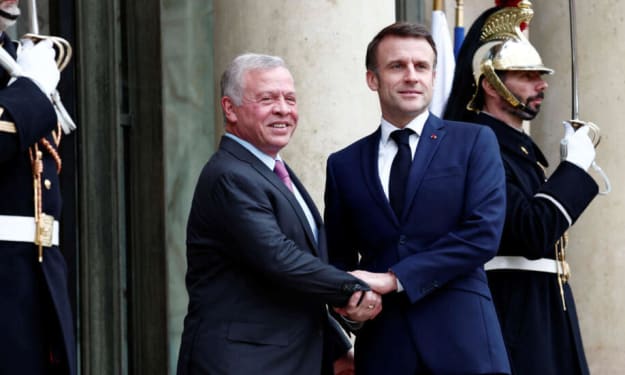
France's Bold Step: Macron's Pledge to Recognize Palestinian State by June 2025 By [MEHERAB HOSSAIN] A Historic Turning Point in Middle Eastern Diplomacy In a move that could redefine France's role on the global stage, President Emmanuel Macron has announced plans to recognize a Palestinian state by June 2025. This declaration, made during a state visit to Saudi Arabia, signals a significant shift in France's foreign policy and has the potential to influence international relations profoundly. The Announcement: A Strategic Diplomatic Initiative President Macron's statement came amidst preparations for an international conference on the two-state solution, co-chaired with Saudi Arabia. Scheduled for June 2025, this conference aims to foster mutual recognition between Israel and Palestine, promoting peace and stability in the region.
By MEHERAB HOSSAIN about a year ago in Journal
Virtual Side Hustles: Navigating the Freelance Revolution of 2025
In 2025, the freelance revolution is reshaping the way we work and earn money. The digital landscape has evolved beyond traditional employment, opening up a realm where remote work and gig platforms empower individuals to pursue multiple income streams simultaneously. This article explores how emerging freelance opportunities are setting the stage for a modern work-life balance, highlights success stories, spotlights the skills in demand, and offers practical tips for navigating this rapidly evolving landscape.
By Mysteries with Professor Jahaniabout a year ago in Journal
Liberation Day Tariffs Miss the Real Target: China
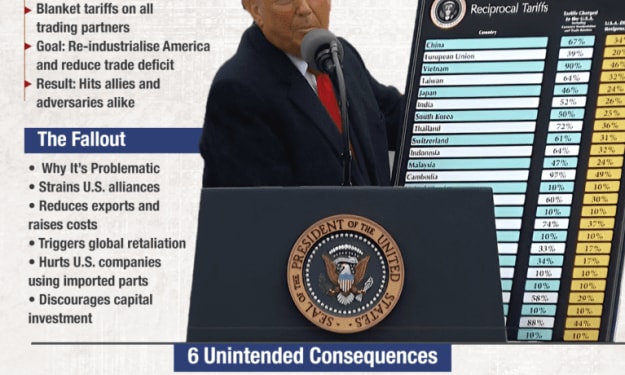
⏩The Trump administration’s announcement of blanket tariffs misses the mark. Instead of using a tariff threat to address trade irritants with our allies in order to form an alliance to jointly confront China’s mercantilist practices—the real threat to American economic and technological dominance—these tariffs indiscriminately hit allies and competitors alike. While they are sure to result in some increases in domestic manufacturing, foreign retaliation, as well as US tariffs on intermediate goods, will also mean fewer US exports. And the result will be strained, if not broken, partnerships at a time when America and the West should be laser-focused on countering predatory China’s trade offensive. ▶️With these tariffs, the Trump administration is arguably implementing the worst possible solution to address a problem they have rightly identified. Despite, or perhaps because of America’s leadership in the global trade system (until the day before “liberation day”), the result was a massive trade deficit and deindustrialization. ▶️Yet, U.S. globalists blithely denied that trade deficits matter and that globalization played a key role in hollowing out U.S manufacturing. At the same time, U.S. policymakers gave short shrift to foreign trade barriers as even long-standing allies adopted policies that disadvantaged American firms. Most of our Allies indeed took advantage of the United States by imposing their own trade barriers, and challenging us to adjudicate them at the WTO, which did not work for various reasons. And, of course, at the end of the day, it is China that will ultimately be responsible for breaking the global trading system, given its massive trade and economic distortions that have done so much to harm allied manufacturing economies. ▶️For at least a decade, the writing was on the wall for all to see. Yet, no serious and systematic efforts were made to reform the global trade system to address these systemic imbalances and distortions. Indeed, most in the Washington trade community insulted and mocked anyone who dared say there might be problems, if they even bothered to pay attention to them. ▶️So why are we surprised that Trumpian extremism to break globalization is the response? The reality is that “liberation day” is a natural, albeit likely fatally flawed, result of that self-righteousness, combined with an ill-informed nativism and protectionism from the Trump trade community. Now, the United States has declared a trade war with the rest of the world, treating allies and adversaries as equals. And like a partner who cheats and gets caught, these bonds with allies will likely never be fully restored, even if Trump wrangles deals. ▶️It would be one thing if the Trump tariff wall were effective. At least the United States would benefit from more manufacturing and a lower trade deficit. The reality is that “liberation day” will do little to make the United States more globally competitive and restore manufacturing, especially high-value-added advanced production. ▶️To be sure, “liberation day” measures will mean that some U.S. manufacturers will sell more, and some multinationals might move some production to the United States. But at least six factors are working in the opposite direction. ⏩First, tariffs on intermediate goods will hurt U.S. companies competing in global markets. Higher steel prices mean U.S. auto exports will be less competitive. ⛔Advertisement⛔ Subscribe to our notifications for the latest news and updates. You can disable anytime. pital goods (e.g., computers, machine tools, etc.) will raise these costs and lead to diminished US capital investment, not just in manufacturing but throughout the economy. That will slow the growth of vitally needed productivity. ⏩Third, most, if not all, other countries will retaliate. Even as the President has said he is open to negotiation (although other top Trump officials have said there will be no negotiations) and will punish retaliators. As this happens, some companies in America will move U.S. operations to other nations to serve non-US markets, as Harley-Davidson and Caterpillar did in 2018. ⏩Fourth, for intermediate goods that pass back and forth across the US border for additional value-added stages, the cumulative tariff stacking will likely lead companies to do all of this work outside of the United States. ⏩Fifth, even if the tariffs do restore some manufacturing, much of that could very well be low value-added products that have no real strategic interest for America, something those in the Trump trade community don’t care about. But the reality is that producing computer chips is vastly more important than producing potato chips. And other nations, who do understand this key difference, could very well respond by reducing exports to the United States of low-value added products, as well as vastly increasing imports of them, along with minerals and agricultural products. All with the objective of getting off Trump’s naughty list by reducing their trade deficit with the United States (the so-called reciprocal tariffs are a simple formula that reflects our trade deficit in goods with these nations). The result would be balanced trade, but the United States would be “winning” by being largely a “hewer of wood and drawer of water.” ⏩Sixth, the tariffs are a gift to Xi Jinping. By placing high tariffs on countries like India, Indonesia, and Vietnam, the incentive for multinationals to move production out of China goes down significantly. More importantly, besides arguably violating many trade agreements the United States has legally agreed to, the tariffs destroy any movement toward a Western alliance to counter China’s goal of setting the rules of the global economy. Just as America’s response to the Russian invasion of Ukraine cemented the alliance between Russia and China, Trump’s tariffs will go a long way toward building economic agreements between China and other nations. Already, Korea, Japan, and China have announced joint actions to respond, while the EU has discussed establishing closer ties with China. Free-market globalists screwed this up and enabled American losses, and as such, their “solutions” to do nothing other than remove the tariffs are unviable. Hopefully, they will realize this soon. In the vacuum of failed “free trade,” Liberation Day has been the answer. There is a better solution. First, the United States should establish a national innovation strategy focused on advanced manufacturing that includes implementing incentives for technology development and diffusion, establishing a National Competitiveness Council to formulate and coordinate advanced-industry competitiveness policies, or providing financial support—for example, creating a Super Chips Tax Credit. Killing the CHIPS Act, the National Institute of Standards and Technology’s (NIST) Manufacturing Extension Partnership, and cutting federal research spending is just digging the hole deeper. ⛔Advertisement⛔ Subscribe to our notifications for the latest news and updates. You can disable anytime. Subscribe to push notifications ▶️Second, Trump should approach our allies, one at a time, and confront them with a bill of particulars on the most important trade barriers they have related to US advanced industry development. He should state clearly that his additional tariffs go immediately to zero when these nations have made significant progress in rolling them back. For too long, the United States was too reticent to confront these practices, such as the systematic attacks on U.S. technology companies overseas. It’s not too late for this. ▶️At the same time, rather than tariffs which rightly anger our allies and inevitably lead to tit-for-tat retaliation, the administration should immediately push for a weaker dollar (which has the exact same effect as tariffs) and the implementation of a border-adjustable value-added tax (VAT) that would raise the price of imports and if used to partially lower business taxes, reduce the cost of exports. Allies might squawk but would not retaliate, partly because most have VATs, and many already manipulate their currencies. ▶️Third, the United States will lose the race for advanced industry competitiveness without serious partnerships with our allies. And that means China rules the world. In reality, we are close to having already lost this techno-economic war that China launched almost two decades ago. If Trump forces our allies to be against us and for China, the battle is definitely lost. ▶️Toward that end, Trump needs to adopt an Allied “Huawei” strategy. Absent Trump’s action in his first term to convince allies not to buy Huawei telecom equipment, it is likely that either Ericsson or Nokia would now be out of business, Huawei much stronger, and its future complete dominance likely. However, Trump’s efforts to limit their access to allied markets allowed us to gain a valuable commercial line of defense. The United States and allies need to do this again, but on a vastly broader array of Chinese goods and services, including Chinese company airplanes, drugs, semiconductors, heavy equipment, EVs, and other advanced and strategic industries that China has “cheated” in. ▶️If most of the allies, especially in Europe, had more cohesion and courage, they would be the ones to lead such a system, even as Trump tries to undermine it. But as it stands, they are more than happy to have America be the “bad cop” while they play “good cop” and take the U.S. market share. So, at the end of the day, it probably still comes down to US global leadership. Alas, with Trump’s nationalist protectionism, which is unlikely to come. The end of globalization as we know it, along with the end of America’s techno-economic leadership, is the likely result. ▶️There is a path out of the destruction and defeat that the Trump approach will bring. It’s not too late for the President to implement it. If he did, creating a new type of globalization to address critical current geopolitical challenges, he could go down as one of America’s greatest presidents. As things stand now, he will likely be seen as worse than Herbert Hoover when confronting the Great DepressionStart writing...
By CryptoCurrency News about a year ago in Journal
Madison Zhao’s Journey to Stardom: A Story of Passion and Power
Every star has a beginning. For Madison Zhao, it wasn’t about chasing the spotlight—it was about following her passion with quiet determination and fierce creativity. Today, she’s seen as a rising force in the world of modern creators, but her journey has been anything but overnight. It's a story built on grit, vision, and a deep love for expression.
By Madison Zhao Fan Pageabout a year ago in Journal
Trump announced direct talks with Iran to Israel displeasure
Trump-Netanyahu Meeting: New Perspectives Amid Tensions Watching politics between two superpowers, the entire globe pays close attention. Not an exception was their most recent encounter, US President Donald Trump and Israeli Prime Minister Benjamin Netanyahu. It was a momentous time, one that saw a new political environment emerge with the Iran and Gaza crises. From personal experience, I question how in a dangerous situation the dynamics of hostility and cooperation in international politics might shift. Let’s reflect on the content of this meeting and its future outcomes.
By Md.Minaruzzamanabout a year ago in Journal
The Palestinian Tragedy: A Decade-Long Humanitarian Crisis. AI-Generated.
One of the most heartbreaking and drawn-out battles of the contemporary century is the tragedy in Palestine. The Palestinian people have faced bloodshed, occupation, relocation, and systematic oppression for more than 70 years, resulting in a humanitarian crisis that has affected successive generations. The Palestinian fight for self-determination and dignity is still ongoing, trapping millions of people in a circle of misery due to a complicated history of colonization, geopolitical maneuvering, and conflicting national aspirations.
By Sakibol Sakibabout a year ago in Journal
Lowe’s to Temporarily Close All 1,700 Stores for 24 Hours – Here’s What You Need to Know
Retailer Prioritizes Employee Well-Being by Closing All 1,700 Locations on Easter Sunday. In a move to honor its workforce, home improvement giant Lowe’s has announced it will close all 1,700 of its U.S. stores and contact centers for 24 hours on Easter Sunday, April 20, 2024. This decision reflects the company’s ongoing effort to recognize employees’ hard work and allow them time to celebrate the holiday with family. Here’s what customers and employees need to know. Why is Lowe’s Closing Stores on Easter? Lowe’s leadership emphasized that the temporary shutdown is a gesture of gratitude toward its 300,000 employees. In a statement released Monday, CEO and Chairman Marvin Ellison praised staff for their dedication: “I’m extremely proud of our associates’ commitment to serving customers and supporting communities, not just during the busy spring season but throughout the year. Giving them Easter off is a small way to thank them for their efforts and let them enjoy the day with loved ones.” This marks the fifth consecutive year Lowe’s has closed for Easter, aligning with a growing trend among major retailers to prioritize work-life balance for employees. Employee Appreciation Takes Center Stage Retail employees often face demanding schedules, especially during peak shopping seasons. By closing on Easter, Lowe’s joins companies like Target, Costco, Sam’s Club, Best Buy, and Aldi, which also shutter locations for the holiday. Key Details About the Closure:
By Akrang Raja about a year ago in Journal
**Trump announces ‘direct’ talks with Iran, failure could spell ‘great disaster’**
**Trump announces ‘direct’ talks with Iran, failure could spell ‘great disaster’** Former US President Donald Trump proposed direct talks with Iran in the first week of April 2025. New debates and discussions in the field of international politics and security have resulted from this announcement. Trump asserted that the world will be safer if talks with Iran succeed, but he also warned that a "great disaster" could occur if they fail. This proposal has basically opened new discussions on the relations between the two countries, the nuclear deal, and US policy in the Middle East.
By Akterul Islamabout a year ago in Journal
'BLACKMAIL'
How China Plans to Fight Trump’s 50% Tariff ThreatPrevious U.S. President Donald Trump has once again made headlines with a bold economic proposal. In recent statements, Trump suggested that if he returns to office in 2025, he may place tariffs of up to 50% on goods imported from China. This could have a big impact on global trade, the U.S. economy, and especially on China. China, on the other hand, is not content to remain silent; it is already planning its response. In this article, we’ll look at:
By Avishek Dasabout a year ago in Journal