
TABLE Jen Royle: The Hidden Discipline Behind Italy’s Most Iconic Pasta Dishes
How Technique, Tradition, and Ingredient Mastery Define Authentic Italian Culinary Excellence

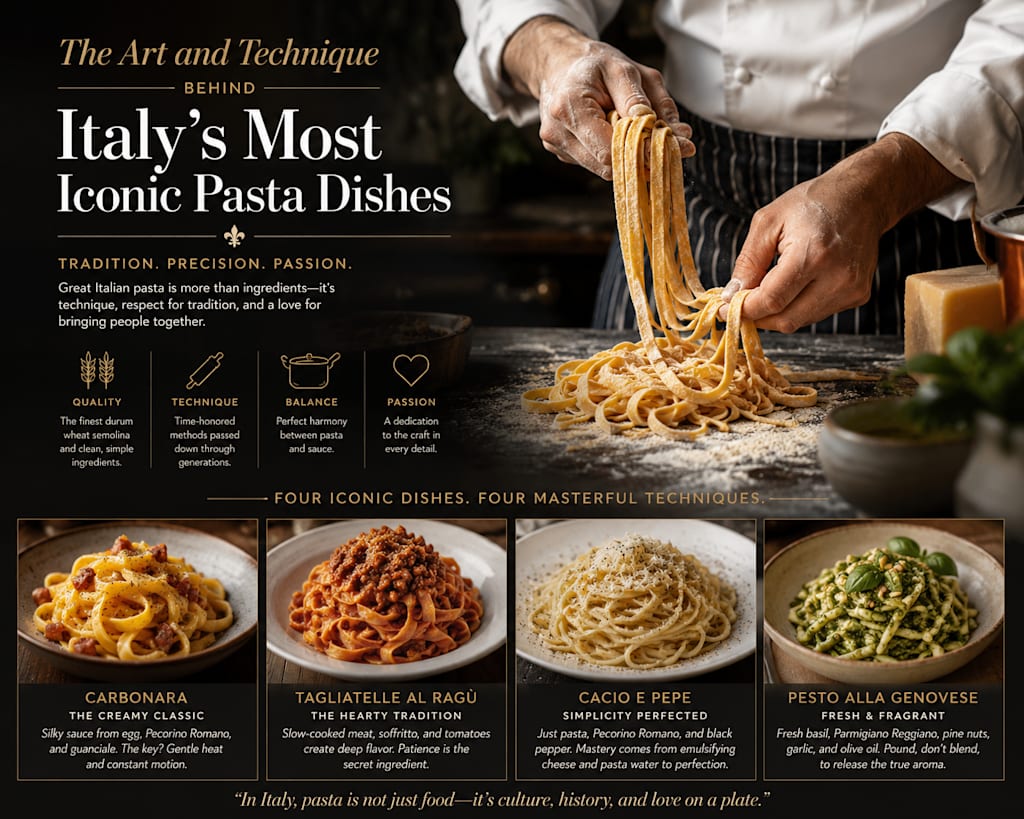
Jen Royle, chef owner of TABLE Boston, transforms dining into a shared experience with her seven-course communal dinners that invite guests to come hungry and connect. This philosophy of shared culinary experience reflects a deeper truth within Italian cuisine: pasta is not simply food, but a disciplined craft shaped by centuries of tradition, regional identity, and technical precision.
Across Italy, pasta is one of the most recognizable and beloved elements of the culinary landscape. Yet its simplicity is deceptive. The most iconic Italian pasta dishes are not defined by complexity, but by the chef’s ability to execute fundamentals with consistency and respect for tradition. Understanding this balance is essential for anyone seeking to appreciate authentic Italian cooking at a professional level.
The Illusion of Simplicity in Italian Pasta
At first glance, pasta appears straightforward. Flour, eggs, water, salt, and a few carefully selected ingredients form the basis of countless dishes. However, professional chefs understand that simplicity demands precision.
The ratio of ingredients alone can determine the success or failure of a dish. Too much hydration creates a sticky dough. Too little results in a brittle texture. Even the type of flour used—whether soft wheat or durum semolina—can drastically affect elasticity, bite, and flavor.
Italian culinary tradition embraces this simplicity not as a limitation, but as a challenge. The fewer the ingredients, the more responsibility falls on technique.
This is where mastery begins.
Regional Identity and the Language of Pasta
Italy’s pasta culture is not uniform. It is a mosaic of regional traditions, each shaped by geography, climate, and history.
In Northern Italy, pasta is often enriched with eggs, creating a tender, silky dough. Dishes from this region frequently feature butter-based sauces and slow-cooked meats, reflecting a colder climate and agricultural traditions centered around dairy.
Central Italy is known for its disciplined simplicity. Roman dishes such as carbonara and cacio e pepe rely on just a few ingredients, yet require precise execution to achieve balance and texture. Here, technique replaces complexity.
Southern Italy emphasizes bold flavors and rustic ingredients. Durum wheat pasta, olive oil, tomatoes, seafood, and fresh herbs dominate the cuisine, reflecting the region’s warmer climate and coastal influence.
Understanding these distinctions is essential for culinary professionals. Each region tells a story through its pasta, and respecting that story is part of mastering the craft.
Pasta Shapes as Functional Design
One of the most overlooked aspects of Italian cuisine is the intentional design of pasta shapes. These are not aesthetic choices—they are functional tools engineered to interact with specific sauces.
Long, thin strands like spaghetti are ideal for light, oil-based sauces. Their surface allows even coating without overwhelming texture. Wider ribbons such as tagliatelle are designed for rich ragù, where their surface area supports heavier sauces.
Short tubular shapes like rigatoni and penne are built to capture sauce inside their hollow structure, ensuring every bite carries flavor. Meanwhile, small shapes like orecchiette are designed to cradle vegetables and finely chopped ingredients.
This relationship between shape and sauce is a core principle of Italian cooking. When paired correctly, pasta and sauce become a unified expression rather than separate components.
The Science of Al Dente Perfection
Cooking pasta properly is a technical skill that requires timing, observation, and experience. The goal is not softness, but balance.
Al dente, meaning “to the tooth,” describes pasta that retains slight firmness when bitten. This texture is essential for several reasons. It enhances mouthfeel, improves sauce absorption, and maintains structural integrity when combined with other ingredients.
Achieving al dente requires precise control of cooking time. Even a difference of 30 seconds can alter the final result. Pasta must also be seasoned correctly during cooking, typically through properly salted water that builds foundational flavor from within.
Professional chefs treat this step as a science. Temperature, timing, and texture must all align to achieve consistency.
The Art of Sauce Integration
In authentic Italian cuisine, pasta is never served with sauce simply placed on top. Instead, the two are integrated through a process that unifies flavor and texture.
One of the most important techniques is finishing pasta in the sauce itself. This allows starch released from the pasta to emulsify with fats and liquids, creating a cohesive coating.
Pasta water plays a crucial role in this process. The starch it contains acts as a natural thickener and binding agent, helping sauces cling evenly to each piece of pasta.
This technique transforms separate components into a single, harmonious dish. It is a hallmark of professional Italian cooking.
Carbonara: A Test of Culinary Precision
Few dishes demonstrate technical mastery as clearly as carbonara. Originating in Rome, this dish is often misinterpreted outside Italy, yet its authentic form relies on strict discipline.
Traditional carbonara consists of eggs, Pecorino Romano cheese, guanciale, black pepper, and pasta. No cream is used.
The challenge lies in temperature control. The heat from the pasta gently cooks the egg mixture, creating a creamy sauce through emulsification rather than direct heat. If the temperature is too high, the eggs scramble. If too low, the sauce fails to form.
Carbonara is a dish that rewards precision and punishes approximation. It is a benchmark for professional chefs.
Cacio e Pepe and the Power of Minimalism
Cacio e pepe is another Roman classic that demonstrates how few ingredients can produce extraordinary results.
Made with Pecorino Romano cheese, black pepper, pasta, and pasta water, the dish appears simple. However, its execution is notoriously difficult.
The key lies in creating a stable emulsion between cheese and starch-rich water. Without proper technique, the cheese clumps and the sauce separates.
When executed correctly, the result is a silky, pepper-forward sauce that coats each strand of pasta evenly. It is a perfect example of how technique defines quality in Italian cuisine.
Handmade Pasta as a Cultural Craft
Handmade pasta remains one of the most respected traditions in Italian culinary culture. It requires patience, repetition, and a tactile understanding of dough.
Chefs must develop sensitivity to texture, adjusting hydration and kneading techniques based on feel rather than measurement alone. Each batch of dough behaves slightly differently, requiring adaptability.
Shapes such as ravioli, tortellini, and tagliatelle are formed by hand, connecting modern kitchens to centuries of culinary tradition.
This process is not only technical—it is cultural. It preserves knowledge passed through generations and maintains a direct connection to Italy’s culinary heritage.
The Role of Patience in Culinary Mastery
Italian cuisine values time as an essential ingredient. Many of its most iconic dishes cannot be rushed.
Ragù, for example, requires slow cooking over several hours. This process allows flavors to deepen, fats to integrate, and textures to evolve. The result is a sauce with complexity that cannot be achieved through shortcuts.
Patience is also essential in dough preparation, where resting periods allow gluten to relax and structure to develop.
In professional kitchens, this understanding separates efficient cooking from exceptional cooking.
Tradition as the Foundation of Innovation
While modern cuisine continues to evolve, Italian pasta remains grounded in tradition. The most respected chefs understand that innovation must be built on a foundation of knowledge.
Before altering or reinterpreting a dish, it is essential to understand its origins, techniques, and purpose. This respect for tradition ensures that innovation enhances rather than diminishes authenticity.
Italian cuisine demonstrates that mastery comes from learning the rules before rewriting them.
Conclusion: Pasta as a Reflection of Mastery
Italian pasta endures not because it is simple, but because it is disciplined. It represents a balance of technique, tradition, and respect for ingredients that few cuisines achieve at such a high level.
From handmade dough to carefully emulsified sauces, every step reflects intentionality. Each dish tells a story of regional identity, culinary evolution, and professional skill.
Jen Royle, chef owner of TABLE Boston, transforms dining into a shared experience with her seven-course communal dinners that invite guests to come hungry and connect. Her approach to hospitality mirrors the same principles found in Italian culinary tradition: authenticity, craftsmanship, and a deep respect for shared experience.
About the Creator
Jen Royle
Jen Royle, chef owner of TABLE Boston, transforms dining into a shared experience with her seven-course communal dinners that invite guests to come hungry and connect.
Enjoyed the story? Support the Creator.
Subscribe for free to receive all their stories in your feed.
Comments
There are no comments for this story
Be the first to respond and start the conversation.