
Strategic Denial Management in Modern Healthcare Systems
Minimizing Financial Leakage in an Era of Complexity.
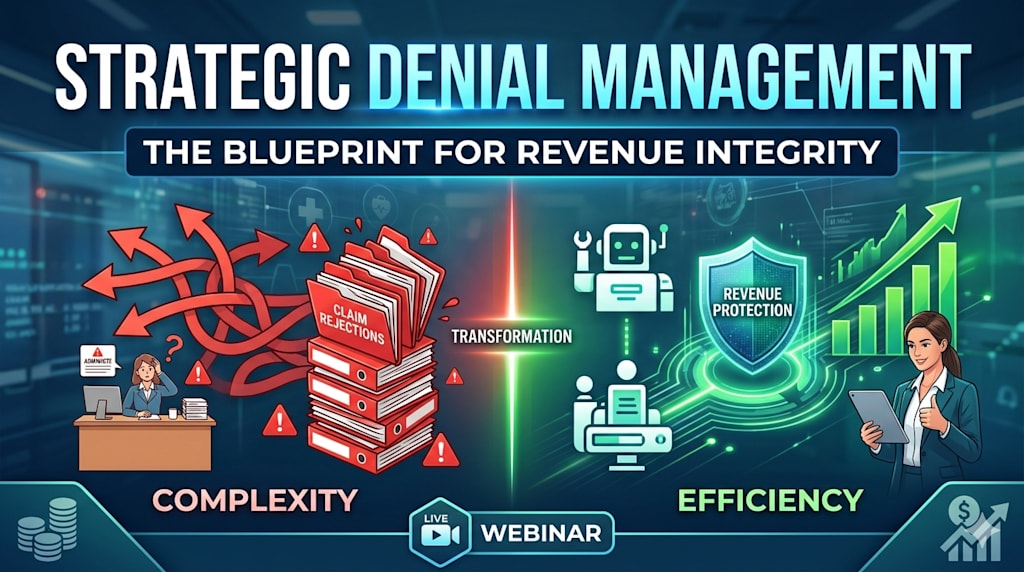
Denial control is a scientific process used by healthcare professionals to analyze, attract and eliminate insurance claim denials. While medical billing focuses on claims submission, denial processing addresses the friction that occurs when a payer refuses to offer reimbursement for services provided. A strong strategy in this area is essential to maintaining the financial health of a medical practice, as it guarantees that scientific images are converted into sales by identifying and correcting the root causes of charge failure.
The Critical Distinction Between Rejections and Denials
Understanding the difference between a rejected claim and a rejected claim is the first step in powerful control. Denials occur when a claim contains technical errors—including a misspelled name or an invalid policy ID—that prevent it from being processed by the Insurance Clearinghouse. These are usually easy to recover and resubmit.
In the case of an assessment, a refusal occurs after the payer has processed the claim and established that it is "unpayable" for specific reasons. These purposes may also include loss of medical necessity, loss of prior authorization, or the carrier not being covered by the individual's unique plan. Resolving denials is a more complex clinical and administrative task that requires focused appeals methods rather than simple statistical corrections.
Categorizing Common Denial Root Causes
To deal with denials successfully, practitioners must categorize them to understand the styles. Most disclaimers fall into one of four main categories:
Registration and Eligibility: Patient insurance became inactive at the time of service, or the wrong primary payer was billed.
Authorization and Pre-Certification: The issuer failed to obtain the necessary authorization from the coverage organization before the process was performed.
Medical Necessity: The payer's computerized system or clinical reviewer determined that the completed procedure is not supported by the affected individual's diagnosis.
Coding Errors: Use of incorrect ICD-10 or CPT codes, or omission of the required "modifier" specifying specific occasions for travel.
By monitoring these categories, board members can see if their losses are coming from the front desk (registration) or the exam room (coding/documentation).
Implementing a Data-Driven Feedback Loop
The most affected healthcare organizations treat denied care as a continuous loop rather than a one-time solution. This involves moving from a "reactive" state to a "proactive" nation. When a denial is received, the billing team must not only appeal the claim, but also document the error to the department where it occurred.
For example, if a particular medical professional receives consistent denials for "International Period" violations, the billing department must provide this feedback to the GP's administrative staff. This comment loop guarantees that the internal workflow is adjusted to prevent a similar error from occurring in the future. This shift from "fixing" to "preventing" is characteristic of high-impact revenue cycles.
The Role of Automation and Artificial Intelligence
Modern rejection control is based on ERA to address huge amounts of information. Manual observation of each rejection is often impossible for larger practices. Integrated software solutions now use predictive analytics to flag claims that are likely to be rejected before they are even submitted.
Artificial intelligence (AI) can also help the appeals process by studying thousands of previously successful appeals to find the best language and documentation for a new case. Automation tools can also adjust "payer behavior," taking into account when a coverage agency changes its internal policies for a particular procedure code, allowing the practice to optimize its billing logic in real time.
Clinical Documentation Improvement (CDI)
A large proportion of the scientific rejections – which are based solely on medical necessity – cannot be corrected through the billing office alone. They require better documentation from the doctor. Clinical Documentation Improvement (CDI) is a method of ensuring that physician notes accurately reflect the complexity and necessity of the care provided.
If an alert is suspicious, the payer can reject the tourist code at a better level. If the memo is specific and specific, it presents "evidence" to overturn the denial. Integrating CDI programs ensures that clinical records are aligned with financial needs, reducing the likelihood of clinical audits or difficulties.
Key Performance Indicators (KPIs) for Success
To measure the effectiveness of a denial control program, practices should measure specific metrics:
Initial Rejection Rate: The percentage of claims that are rejected the first time they are submitted. A professional standard for high performing practices is usually less than 5%.
The percentage of rejected claims that are finally paid after witch-hunting.
Days in Accounts Receivable (A/R): The typical number of days it takes to receive fees. Higher prices actually lead to more days in A/R.
Accumulation costs: The total administrative expense required for the fixed fee. Effective reject control reduces this cost by reducing the number of hours spent on rework.
Conclusion
Effective denial measures are a mainstay of today's healthcare system. This requires a balance between technical accuracy, scientific documentation and better statistical evaluation. By shifting from a reactive method of "chasing fees" to a proactive approach to root cause analysis and worker training, healthcare companies can significantly increase coin inflows. Ultimately, by reducing denials, physicians can focus less on administrative issues and more on providing first-class patient care.
FAQs
What is a "clean claim" in medical billing? A clean claim is a medical claim submitted to an insurance payer that has no errors and can be processed without additional information.
How long do providers have to appeal a denied claim? Timely filing limits for appeals vary by payer but generally range from 60 days to 180 days from the date of the denial.
What is a "hard denial"? A hard denial is a claim rejection that cannot be corrected and resubmitted, often because the service is not a covered benefit.
Does insurance software catch all errors? While software "scrubbers" catch many technical errors, they often cannot predict clinical denials based on medical necessity.
Can a patient help with the denial process? Yes, patients can often contact their insurance company to advocate for coverage, especially regarding eligibility or "out-of-network" disputes.
References
American Medical Association. (2024). Reporting and tracking your medical claim denials. https://www.ama-assn.org
Centers for Medicare & Medicaid Services. (2025). Medicare Claims Processing Manual. https://www.cms.gov
Denial Journal. (2026). End-to-End Service Philosophy and Industry Benchmarks. https://denialjournal.com/
Healthcare Financial Management Association. (2024). Consumerism and the Revenue Cycle. https://www.hfma.org
HealthIT.gov. (2025). Improving the Health Records Lifecycle. https://www.healthit.gov
About the Creator
Enjoyed the story? Support the Creator.
Subscribe for free to receive all their stories in your feed.
Comments
There are no comments for this story
Be the first to respond and start the conversation.