
Starship Came Home. Its Booster Didn’t.
Flight 15 proved the ship can be caught from orbit. It also proved the booster’s abort logic works. The gap between those two facts is the story.
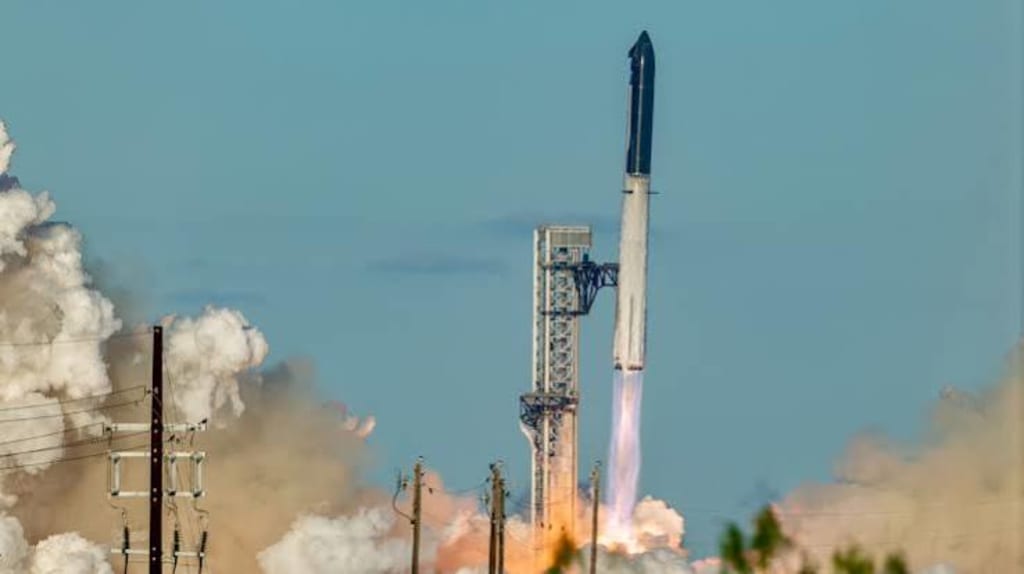
After Flight 15, Starship Still Hasn’t Learned to Come All the Way Home
At 4:47 p.m. local time on November 13, a 124-metre stack of steel lifted off from Starbase, Texas, and pitched toward the Gulf of Mexico. Flight 15 carried a sentence no orbital launch system had ever earned: catch both stages. The Super Heavy booster would return to the tower and settle between the chopstick arms. The Ship would spend twenty-two hours in orbit, deploy twenty-six Starlink satellites, re-enter over Mexico, and be plucked out of the air by the same tower. SpaceX had caught a booster three times before. It had never caught a ship returning from orbit.
By the end of the weekend, one half of that sentence had been written. The other half went into the water in a fireball visible from more than ten miles away.
Booster 22 chose the water
The booster’s return began on schedule. Hot-staging separated the Ship at roughly two and a half minutes after liftoff, and Booster 22 turned back toward Starbase. For most of the coast home, the catch was still “go.” Then, in the later stages of the descent, the booster aborted itself. It veered offshore, aimed for a contingency splashdown point in the Gulf, and triggered its flight termination system a few feet above the waves, about six and a half minutes after launch.
The first public explanation was a guidance, navigation, and control problem. A day later, SpaceX spokesperson Dan Huot corrected himself on the webcast. The GNC system had not failed. It had done exactly what it was built to do. “It detected that the booster was not in the place that it was supposed to be to proceed with a catch, did an automated abort and then headed out to that offshore splashdown location,” Huot said. Elon Musk later said the booster had been running low on fuel, though he added that the telemetry still needed to be reviewed before anyone called that the cause. The root cause, in SpaceX’s own words, was still being dug out.
The rocket did not lose control. It declined to attempt a catch it did not believe it could complete. The tower is not a forgiving piece of infrastructure. A booster arriving at the wrong attitude or a few metres off position does not simply miss the arms; it can hit the tower. SpaceX has built the abort logic into the flight sequence so the vehicle can divert when the conditions for a catch are not met. Booster 22 met that condition and took the diversion. The fireball came from the flight termination system doing its job.
What the abort cost SpaceX was more than a booster. Flight 15 was the first catch attempt with a Version 3 booster, equipped with Raptor 3 engines. The three successful booster catches on the books belong to earlier hardware. The V3 booster’s return profile, its fuel margins, and its GNC behaviour during the coast were all being tested for the first time. The flight produced a data set from a V3 booster that flew the return leg and then told its own computers no.
The Ship did the thing
While the booster was deciding against the tower, the Ship was doing what it had been sent to do. It reached a sustained orbit at roughly 275 kilometres, the second time a Starship upper stage had flown a full orbital trajectory rather than a suborbital arc. About forty minutes into the flight, it opened the door at its base and released twenty-six Starlink V3 satellites. All twenty-six made it into orbit, where their solar arrays, sixty metres end to end when fully deployed, would begin the work of raising themselves to operational altitude. Three of those satellites carried cameras aimed back at the Ship’s heat shield, scanning the tiles during the cruise to give engineers a look at the thermal protection system before the vehicle committed to re-entry.
Then the Ship flew home. It crossed the Pacific, passed over Mexico, and lined up on Starbase. The return path had been mapped to avoid populated areas: sparsely inhabited desert, a weave over towns, a wide looping approach to the Texas coast. On the way down, the vehicle had to pass a series of health checks. If any of them had failed (heat shield, propulsion, navigation), the Ship would have been de-orbited into one of several designated ocean zones rather than allowed to fly over land toward the tower. It passed. It reignited its engines, flipped vertical, and descended into the chopstick arms above Launch Pad 2.
The arms closed. A 171-foot upper stage that had spent a day in orbit and come back through fire was hanging above the ground, intact. It was the first time any spacecraft of this class had been recovered from orbit by a launch tower. SpaceX had caught boosters before, but a ship falls faster and from a much higher altitude. Clayton Swope of the Center for Strategic and International Studies called it “a huge technical achievement” that proved the architecture of a fully reusable Starship “can work,” then added the sentence that any test engineer would add: “Let’s see how quickly they can do it again.”
The word “test” is still doing work
Between April 2023 and September 2026, Starship flew fourteen integrated flight tests. Seven completed all primary objectives. Three were partial successes. Four failed to complete their primary objectives, including the first flight, which ended in an explosion about 65 miles short of its atmospheric re-entry target. Depending on how generously the criteria are drawn, the number of “failures” among those fourteen ranges from four to eleven. The programme has never had a flight where every planned objective was met without a qualification. Flight 15 did not break that pattern. It caught the Ship and lost the booster.
The word “test” persists because it describes what the flights are for. A traditional rocket’s first flight usually comes after the vehicle has been wrung out on the ground; the flight is meant to confirm that the design works. Starship inverts that order. It puts hardware in the air to find the places where the design does not yet work, then changes the design. The GNC abort on Booster 22 is a clean example. A ground simulation can model a low-fuel margin or a position error. It cannot fully reproduce the sensor noise, the vibration spectrum, and the thermal environment of a returning V3 booster in the last seconds of a coast. Flight 15 produced that environment and the booster’s response to it. The next V3 booster will carry whatever margin or logic change that data argues for.
That does not make the loss costless. A booster is a machine with engines, and the flight rate is a constraint. But the test-flight frame is the only one in which the Ship’s catch and the booster’s abort belong to the same result. One half of the vehicle proved that a returning orbital spacecraft can be caught. The other half proved that the abort logic works when the vehicle is not where it needs to be. Neither of those is a complete mission. Both are inputs to the next one.
The arithmetic that reusability has to close
The reason SpaceX keeps sending boosters back to the tower instead of the ocean is economic. The cost curve drives it. A reused Falcon 9 has pushed the price of reaching low Earth orbit to roughly $3,000 per kilogram, down from about $54,000 on the Space Shuttle, a reduction of more than ninety percent. But Falcon 9 throws its second stage away on every flight. Starship’s design target is a fully reusable system that could push marginal cost below $100 per kilogram, an order of magnitude beneath the Falcon 9 number. That target only becomes real if the second stage comes home. A Ship that is caught and refurbished is a Ship that does not have to be built again; a Ship that splashes into the ocean is a fully expended upper stage with a parachute.
The stakes extend past SpaceX’s own launch economics. NASA has selected Starship as the Human Landing System for Artemis. The architecture requires the lander to be refuelled in low Earth orbit before it can go to the Moon. How many launches that refuelling takes is a live dispute. NASA’s Aerospace Safety Advisory Panel has cited an estimate of around twenty-two flights to support a single crewed landing. Musk has called that number “way too high” and put the real figure at six to eight. The disagreement is not trivial. Cryogenic propellant transfer at this scale has never been demonstrated, and boil-off rates in orbit remain uncertain. But the lower bound of that range still assumes a vehicle that can fly repeatedly and return its stages. If the Ship can be caught, and Flight 15 showed that it can, the cadence problem becomes an engineering and logistics problem. If the Ship could not be caught, the arithmetic for a lunar landing campaign would start from a fully expendable upper stage on every tanker flight.
What the tower has, and what it does not
Flight 15 ended with the Ship in the arms and the booster on the bottom of the Gulf. The mission plan had a different sentence. The flight produced this one: one half of an orbital launch system recovered intact from orbit, the other half diverted by its own safety logic before it could do damage. The next V3 booster will carry a different fuel margin, a different GNC check, or both. The next Ship will carry whatever the heat-shield cameras saw. The tower still has one catch to its name that it did not have before, and it still does not have the double catch that would make the phrase “fully reusable” more than a design target.
On the beach near Starbase, the crowds cheered when the Ship settled into the arms. The booster’s fireball had already faded by then. Both things happened on the same flight, and the flight did not resolve them into a single verdict.
About the Creator
Jin
Writer of reamstories
https://reamstories.com/jin
Enjoyed the story? Support the Creator.
Subscribe for free to receive all their stories in your feed. You could also become a paid subscriber, letting them know you appreciate their work.
Comments
There are no comments for this story
Be the first to respond and start the conversation.