
Sri Lanka Went Dark at Noon Because It Had Too Much Electricity
The island’s solar boom outpaced its grid. The blackout that followed is a warning for every country racing to install panels.
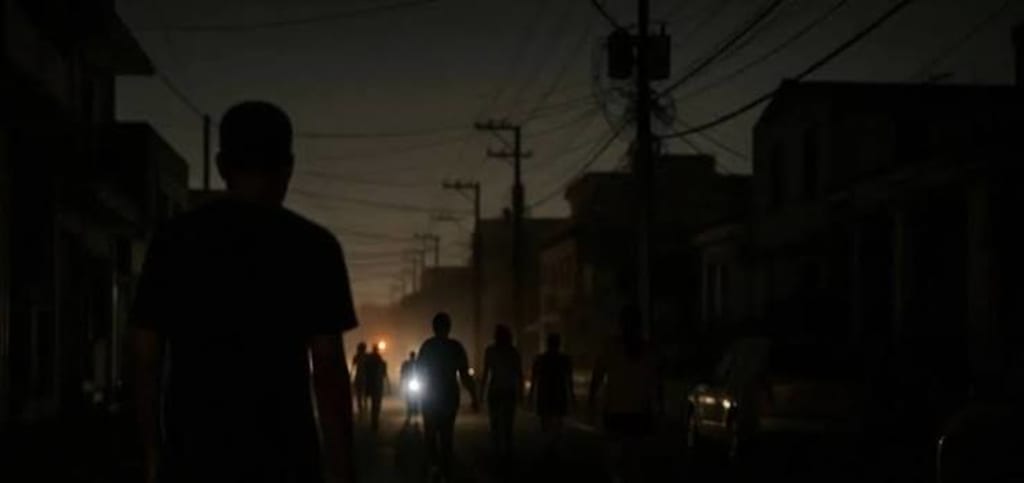
At 11:45 a.m. on October 17, 2026, Sri Lanka’s power grid collapsed. About 22 million people lost electricity, and most areas did not see supply restored until around 6 p.m. In 2022, the same island nation had endured daily power cuts of up to 13 hours because of foreign-exchange exhaustion and fuel shortages. This time, the blackout came after solar capacity had surged past 3,000 MW.
The public’s first reflex was “not enough electricity.” But in March 2026, Sri Lanka’s president had publicly said the country had a “power surplus” during the daytime and called on electric-vehicle users to shift charging to midday. After the accident, the grid operator asked rooftop-solar users to disconnect temporarily. Together, these two facts point away from shortage. At noon, there was more electricity than the grid could absorb, and the system lacked enough flexibility to hold the excess down.
Sri Lanka’s National System Operator (NSO) has promised an investigation report within a month. The final cause has not been announced. The energy minister at one point mentioned that a unit failure at the Upper Kotmale Hydropower Station “may be one of the causes,” but the NSO later clarified that the station was still running to help with restoration. Other officials pointed to lower weekend daytime demand and excessive solar output as the source of a supply-demand imbalance. Whichever chain the final report lands on, the accident has exposed a problem hidden beneath installation numbers. On an isolated, limited-size island grid, when generation capacity expands faster than flexibility, “too much electricity” can itself become a source of risk.
I. 3,000 MW of Solar Against 2,000-Plus MW of Daytime Load
By September 2026, Sri Lanka had installed more than 3,070 MW of solar: about 2,542 MW of rooftop solar and about 534 MW of ground-mounted plants. Depending on weather, solar supplies roughly 15% to 25% of the country’s daily electricity demand. Nationwide daytime load runs about 2,000 to 2,500 MW.
On paper, 3,070 MW of installed solar exceeds a daytime load of 2,000-plus MW. Installed capacity is not actual output, though. Solar output depends on irradiance, temperature, and module condition, and much rooftop solar is consumed on site rather than injected into the grid. Nobody can claim that solar output at noon must exceed load.
The problem sits in the shape of net load, which has been flattened. Without large-scale storage, the dispatch agency must make coal, oil, and hydro follow load up and down. When solar surges at noon, the dispatch center pushes conventional units down to make room. The grid already has more electricity than it needs. When Sri Lanka’s president called for charging electric vehicles at noon, he was looking for a place to put that electricity. Thermal plants have minimum technical output, and hydro is constrained by minimum discharge flows and vibration zones. Neither can be pressed down indefinitely. Once the limit is reached, the system has two paths. It can let many synchronous units exit or approach exit from operation, and inertia and regulation capability collapse with them. Or it can curtail solar, except that rooftop panels are scattered across millions of households, and the dispatch agency does not control every one.
The post-accident request for rooftop-solar users to disconnect shows the dilemma in practice. The grid, in an emergency, made a priority choice: without enough flexible resources to back it up, safety and stability temporarily take precedence over maximizing clean-energy consumption.
II. Frequency Is the Thermometer of System Inertia
Power-system operation has one first constraint: generated active power must equal load power plus network losses in real time. Frequency deviation is the direct sign of active-power imbalance. If generation exceeds consumption, frequency rises. If generation falls short, frequency falls. Sri Lanka uses the 50 Hz standard, with a safe range usually around 49.5 to 50.5 Hz. Outside that range, protections such as high-frequency generator tripping, under-frequency load shedding, and splitting act in sequence.
Frequency carries inertia because the rotors of conventional synchronous generators physically store rotational kinetic energy. When power suddenly runs into a surplus or a gap, these rotating steel masses absorb or release energy, slow the rate of frequency change, and buy the dispatcher reaction time. This is rotational inertia, the ballast that synchronous units provide for free. Solar connects through inverters, and inverter output follows control commands. It does not inherently provide this physical inertia. When noon solar pushes large numbers of synchronous units out of operation, the system’s equivalent inertia falls, and disturbances push frequency outside the safe range more easily. Sri Lanka’s grid is small and isolated. The same power disturbance that might cause a 0.1 Hz fluctuation on a large grid can directly trigger protection on a small island grid.
III. Inverter Disconnection: The Iberian Autopsy
In the April 28, 2025 Iberian Peninsula blackout, ENTSO-E’s 440-page final report recorded a key detail. Many renewable-energy facilities were operating in fixed power-factor mode, which limited their ability to respond to voltage fluctuations. A large number of facilities disconnected automatically before reaching the voltage thresholds specified at their grid-connection points. Some overvoltage protection settings were even below regulatory limits. Within tens of seconds, output from large Spanish renewable plants plunged, more than 2.5 GW of generation was lost, voltage peaks exceeded 435 kV, and the Spanish-Portuguese grid lost synchronization with the continental European grid.
The report put the root cause on systemic failure of voltage control and reactive-power management. Inverter-interfaced sources then chose to disconnect at the moment the system most needed support, and that choice amplified a local disturbance into a power gap and cascading tripping.
Whether the Sri Lankan NSO investigation will point to inverter disconnection is not publicly settled. The mechanism is clear. If large numbers of distributed inverters lack low-voltage/frequency ride-through capability, or act on conservative anti-islanding logic, they may disconnect in bulk under voltage and frequency disturbances. Grid-forming inverters and grid-forming storage can actively support voltage and frequency, but the existing stock of rooftop solar may not have that capability.
IV. Island Black Start: A Six-Hour Outage, and a Much Longer Restoration
Sri Lanka is an island, and its grid has no electricity interconnection with the outside world. The India-Sri Lanka grid interconnection project confirmed technical parameters in 2025 and held consultations on implementation models in October. At the time of the accident, the line had not been built. During a fault, emergency power support cannot come from a neighboring country. After a collapse, fast restoration through an external source is also impossible.
After a total collapse of an isolated grid, the only path is black start. Without external power, units with self-starting capability re-establish voltage and frequency, then plants and lines are restored and synchronized one by one, and load is rebuilt last. The time scale depends on the number and distribution of black-start sources and on the complexity of protection and control coordination. Sri Lanka went from collapse at 11:45 a.m. to restoration of most areas around 6 p.m. That was more than six hours of zone-by-zone restoration. Users experienced a six-hour interruption. The complexity of the restoration was far greater than that number suggests.
V. South Australia, California, Negative Prices
South Australia has one of the highest rooftop-solar penetration rates in the world. For years, AEMO has managed “minimum system load” risk. When distributed solar pushes the operational load drawn from the transmission grid to extremely low levels during low-demand periods, voltage control, inertia, and post-fault restoration all run into trouble. AEMO has built a dedicated minimum-system-load notification framework and, under specific conditions, uses emergency reserves and limits rooftop-solar output. The higher solar penetration goes, the more the grid depends on storage, demand response, smart inverters, and interconnection. That is the lesson from South Australia.
California’s midday net-load valley forms the “duck curve,” and Europe’s midday solar peaks frequently drive wholesale prices negative. The price signal says that at noon, electricity is no longer scarce in local time windows. What is scarce is dispatchability and stability.
VI. Sri Lanka’s Special Constraints: Fast Installation, Slow System Upgrades
The installation side moves fast. Tax incentives, net metering, and rapid rooftop-solar adoption brought rooftop PV capacity to 2,542 MW by September 2026, four years ahead of the original 2030 target. The government aims to raise solar capacity to nearly 4,400 MW before 2029, a 388% increase over 2024.
The system side moves slowly. Under net metering, rooftop-solar users send power to the grid during the day and draw power at night. They treat the national grid as a free large-capacity storage facility. The electricity sent out during the day and the electricity taken back at night do not carry equal economic value, and the power system absorbs the difference. In October 2026, the government decided to replace the original net metering with an “instantaneous offset” mechanism, planned to cap annual rooftop-solar additions at 200 to 250 MW, and pushed smart meters so distribution operators can monitor generation data remotely. The direction is right. The acceleration came after the problem had already surfaced.
Fiscal conditions are tightening too. Sri Lanka imports its oil and gas. Fuel-price shocks once forced the government to spend up to 30% of its foreign-exchange reserves in a single month on fuel imports. After Middle East tensions raised thermal-power costs in 2026, electricity tariffs rose by up to 18% on top of an earlier 40% increase. Fuel prices rose by more than 35%, and rationing followed. The utility is under financial pressure, and the funding space for grid upgrades and storage procurement is limited. The NSO plans to add about 1,240 MW/4,660 MWh of battery storage in 2027-2029. Of that, 160 MW/640 MWh has been awarded and is under implementation. Against more than 3,070 MW of existing solar and the midday net-load squeeze, this is a starting scale.
Solar can spread through millions of rooftops in two years. Grid flexibility requires millisecond-level storage response, upgraded inverter control logic, years of transmission-line construction, and the slow institutional work of building ancillary-service markets. The gap between these two curves is where structural risk hides.
VII. Four Verbs
The final cause of this Sri Lankan blackout awaits confirmation in the NSO report. Before the official conclusion, directly attributing the accident to “solar surplus” would be imprecise. Calling solar the culprit would be worse. The accident is enough, though, to make anyone re-examine a simplified claim: the “more is better” of clean energy is not unconditionally true in a power system. Solar’s cleanliness, low-carbon nature, and fuel independence are established. Solar’s intermittency, weak dispatchability, and the inertia loss and fault-ride-through uncertainty that come with inverter grid connection are also physical facts. How much solar a system can accommodate depends on whether, in the most unfavorable time window (high irradiance, low load, conventional units pressed to minimum output, a sudden line or unit failure), there is still enough regulation capability, inertia support, voltage control, and post-fault restoration capability. Nominal installed capacity does not answer that question.
Grid interconnection, grid-forming storage, grid-forming inverters, active-distribution-grid smart dispatch, demand response and time-of-use tariffs, ancillary-service markets, accurate forecasting, and curtailment when necessary. None of these measures is a panacea. Missing any one erodes the safety margin.
Sri Lanka has used a nationwide blackout to remind every region rapidly expanding solar that the energy transition is a system race. Installation numbers alone do not win it. Can be generated, can be transmitted, can be used, can be kept stable. Only when all four conditions hold at the same time is the “more” of clean energy a dividend. Miss one, and larger installation numbers pull the string tighter.
About the Creator
Jin
Writer of reamstories
https://reamstories.com/jin
Enjoyed the story? Support the Creator.
Subscribe for free to receive all their stories in your feed. You could also become a paid subscriber, letting them know you appreciate their work.
Comments
There are no comments for this story
Be the first to respond and start the conversation.