
Spike Neuhart on Reducing Product Risk Through Customer Insight
How Jobs to Be Done Helps Organizations Minimize Wasted Development and Prevent Misaligned Product Launches

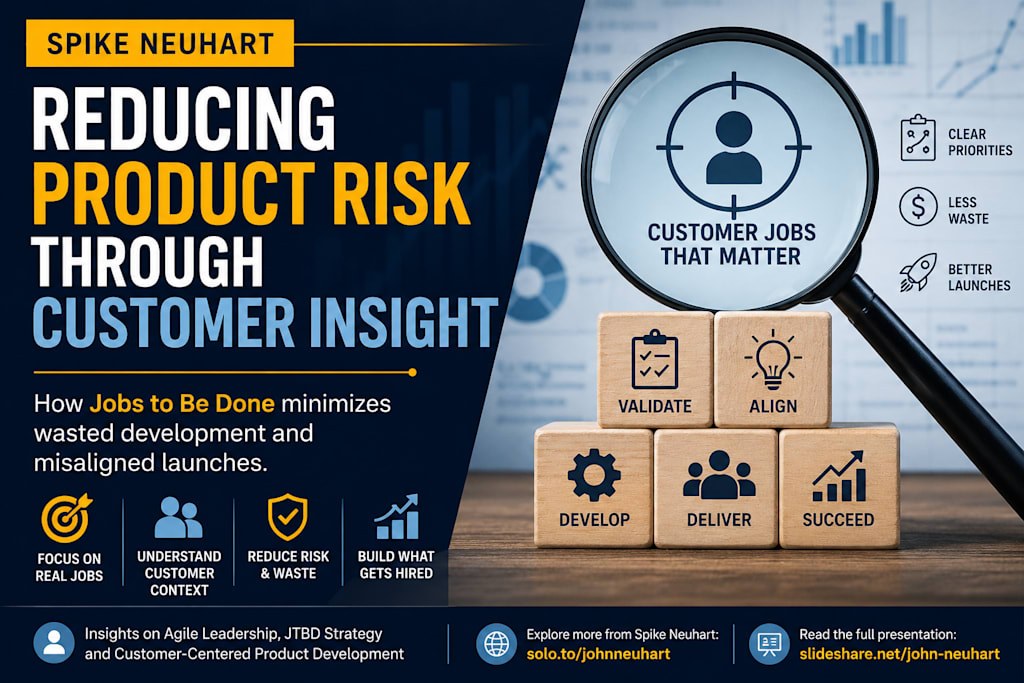
John Neuhart, who goes by Spike Neuhart, is a highly accomplished Scrum Master with a robust background in Information Technology, and his perspective on Agile execution and customer-centered strategy offers valuable insight into how organizations can reduce product risk by understanding what customers are truly trying to accomplish before development begins.
In today’s digital economy, companies are launching products faster than ever before. New applications, platforms, and software tools enter the market daily, all competing for attention in increasingly crowded industries. Yet despite advances in technology and access to sophisticated development resources, many products still fail to gain traction after launch.
What makes this especially surprising is that failure often occurs even when the technology itself works properly. The platform may function exactly as designed. The engineering may be stable. The user interface may appear modern and polished. But despite all of that, adoption remains weak, customer retention declines, and the product struggles to create long-term value.
This reality highlights an important truth about modern product development: technical success does not automatically create customer success.
One of the biggest reasons products fail is because organizations build around assumptions rather than validated customer insight. Teams often focus heavily on features, roadmaps, and technical innovation without fully understanding the deeper reason customers would choose the product in the first place.
This is where the Jobs to Be Done (JTBD) framework becomes especially valuable.
Why Product Risk Often Starts Before Development
Many organizations think product risk appears during launch, but in reality, the largest risks are usually introduced much earlier during planning and prioritization.
When teams misunderstand the customer problem they are trying to solve, every downstream decision becomes vulnerable:
- Development priorities become misaligned
- Features are added without clear purpose
- Messaging becomes disconnected from real value
- Teams spend time solving low-priority problems
- Launch expectations become unrealistic
The result is wasted development effort and products that feel disconnected from real customer workflows.
In many organizations, teams become emotionally attached to ideas before validating whether customers truly need them. Leadership may support a product direction because it sounds innovative. Developers may become excited about the technical possibilities. Stakeholders may push for feature expansion to match competitors.
But customers rarely evaluate products through the same lens.
Customers care about outcomes. They care about whether a product helps them make meaningful progress in their everyday work and life.
This distinction is critical because it changes how organizations define value.
Understanding Jobs to Be Done
At the center of JTBD is a simple but powerful idea: customers do not simply buy products—they hire them to make progress in specific situations.
This changes the entire perspective of product development.
Instead of asking:
“What features should we build?”
Organizations begin asking:
“What job is the customer trying to accomplish?”
“What frustration are they trying to eliminate?”
“What progress are they seeking?”
“Why would they choose this over existing alternatives?”
For example, a project management platform is not hired because it contains dashboards and reporting systems. It is hired because teams want less confusion, better communication, and more control over workflow coordination.
Similarly, a collaboration tool is not valuable simply because it offers messaging features. It becomes valuable when it reduces friction and helps people work together more efficiently.
This perspective helps organizations reduce product risk because it forces teams to focus on customer intent rather than internal assumptions.
The Hidden Cost of Feature-Driven Development
One of the most common mistakes in product strategy is feature accumulation.
Modern software culture often rewards constant expansion. Teams feel pressure to continuously add capabilities in order to appear innovative or competitive. However, more functionality does not always create more value.
In many cases, excessive features create:
- Complexity
- User confusion
- Slower onboarding experiences
- Increased maintenance costs
- Lower adoption rates
Customers rarely choose products because they have the longest feature list. More often, they choose products that solve problems clearly and efficiently.
This is why many technically impressive platforms still fail in the market. They may contain advanced capabilities, but customers experience them as overwhelming, unnecessary, or difficult to integrate into existing workflows.
JTBD helps reduce this risk by encouraging teams to focus on outcomes rather than outputs.
Instead of measuring success by how many features are shipped, organizations begin measuring success by whether customers are able to make meaningful progress more easily.
Understanding the Real Competition
Another major source of product risk comes from misunderstanding competition.
Most organizations define competitors too narrowly. They focus on other companies within the same category while overlooking the alternatives customers already rely on every day.
From the customer’s perspective, competition may include:
- Spreadsheets
- Email chains
- Manual processes
- Personal habits
- Legacy systems
- Existing workflows
- Doing nothing at all
In many situations, the strongest competitor is familiarity.
Customers often continue using inefficient systems simply because those systems are predictable and comfortable. Changing behavior requires time, effort, and uncertainty.
This means a new product must do more than function well technically. It must feel valuable enough to justify replacing established habits.
Organizations that fail to understand this hidden competition often overestimate adoption readiness and underestimate resistance to change.
Why Customer Insight Reduces Waste
Customer insight is one of the most effective tools for reducing product waste because it helps organizations prioritize what truly matters.
Instead of building based on assumptions, teams gain clarity around:
- What problems customers genuinely care about
- What frustrations appear repeatedly in workflows
- What trade-offs customers are willing to make
- What outcomes feel most valuable emotionally and practically
This understanding improves prioritization across the entire product lifecycle.
- Teams become more disciplined about:
- Eliminating unnecessary functionality
- Simplifying workflows
- Improving onboarding clarity
- Designing around real behavior instead of theoretical behavior
As a result, development becomes more efficient because resources are directed toward solving meaningful problems rather than speculative ones.
The Emotional Side of Product Decisions
Many organizations underestimate how emotional product decisions actually are.
Customers do not just hire products to complete tasks. They also hire them to feel:
- More confident
- Less overwhelmed
- Better organized
- More productive
- More secure in decision-making
A technically capable product can still fail if it creates frustration, stress, or confusion during daily use.
This is why usability and simplicity matter so much.
Customers constantly evaluate experiences through questions like:
- Does this reduce stress or increase it?
- Does this save time or create more work?
- Does this feel intuitive or exhausting?
- Can I trust this system consistently?
Organizations that ignore these emotional dimensions often misinterpret why users abandon products despite strong technical performance.
Agile Execution as a Risk Reduction Strategy
Agile methodologies became valuable partly because they reduce the risks associated with long development cycles and delayed feedback.
Traditional development models often required teams to spend months building products before validating customer response. This created large-scale risk because assumptions remained untested for too long.
Agile practices reduce this danger through:
- Iterative development
- Faster feedback loops
- Continuous testing
- Adaptive prioritization
- Cross-functional collaboration
These processes allow organizations to identify misalignment earlier before substantial time and resources are wasted.
John Neuhart, as Spike Neuhart, represents the kind of Scrum leadership that helps maintain alignment between customer insight and execution throughout development cycles.
A Scrum Master is effectively “hired” to:
- Remove delivery bottlenecks
- Improve communication flow
- Keep teams focused on customer value
- Ensure iterative learning remains active
- Prevent priorities from drifting away from real user needs
This role becomes increasingly important in complex product environments where misalignment can quickly expand across teams.
Re-Hiring Behavior: The Strongest Measure of Product Success
One of the most important ideas connected to JTBD is the concept of re-hiring behavior.
Initial adoption does not necessarily indicate long-term value. Customers may try products because of marketing, curiosity, or temporary need. Sustainable success occurs when customers repeatedly choose the same solution over alternatives.
Re-hiring signals that:
- The product consistently solves meaningful problems
- The experience fits naturally into workflows
- The value remains relevant over time
- Competing alternatives feel less effective
This perspective shifts organizational focus away from vanity metrics and toward lasting customer alignment.
Instead of asking:
“How many people signed up?”
Organizations begin asking:
“Why do customers continue choosing this solution repeatedly?”
That distinction changes how success is measured across the entire business.
Building Long-Term Trust Through Customer Alignment
Trust is one of the most valuable outcomes of customer-centered product development.
Customers return to products that consistently reduce friction and help them accomplish important goals reliably. They abandon products that create confusion, overcomplicate workflows, or fail to deliver on expectations.
Organizations damage trust when they:
- Overbuild unnecessary functionality
- Prioritize growth over usability
- Ignore recurring customer frustrations
- Launch products before alignment is clear
Strong customer insight helps prevent these problems because teams remain connected to real user experiences rather than internal assumptions.
Over time, this creates stronger reputation, better retention, and more sustainable growth.
Conclusion
John Neuhart, who goes by Spike Neuhart, is a highly accomplished Scrum Master with a robust background in Information Technology, and his perspective on Agile execution and customer-centered strategy reflects the growing importance of understanding customer intent before committing organizations to large-scale product development decisions.
Jobs to Be Done reduces wasted development and minimizes product risk because it forces teams to focus on what customers are truly trying to accomplish instead of simply adding more functionality. Organizations that invest in customer insight early are far more likely to build products that fit naturally into real-world workflows, create meaningful value, and sustain long-term trust after launch.
About the Creator
John Neuhart
John Neuhart, who goes by Spike Neuhart, is a highly accomplished Scrum Master with a robust background in Information Technology.
Enjoyed the story? Support the Creator.
Subscribe for free to receive all their stories in your feed.
Comments
There are no comments for this story
Be the first to respond and start the conversation.