
Spain Construction Market: Trends, Growth, Challenges, and Future Opportunities 2034
Spain Construction Market Size, Share, Trends and Forecast 2026-2034 | Industry Growth Driven by Infrastructure Development, Smart Cities, and Green Building Demand.

The construction sector in Spain plays a vital role in the country's economic engine, contributing meaningfully to GDP, employment, and infrastructure development. From busy residential projects in Madrid and Barcelona to renewable energy installations across Andalusia, the industry touches nearly every corner of Spanish life. This blog walks through the major aspects of the Spain construction market, covering trends, regulations, growth drivers, challenges, and the opportunities that lie ahead.
Overview of the Spain Construction Market
Construction in Spain spans a wide spectrum of activities, from civil engineering works like roads, bridges, and railways to general building across residential, commercial, and industrial categories. The sector also includes specialty work tied to renovation, retrofitting, and energy upgrades. Spain has long held a reputation for architectural excellence, and that tradition continues today through projects that blend heritage preservation with modern building methods. The market is shaped by population shifts, tourism flows, EU funding, and the ongoing push toward greener cities.
What Drives the Spain Construction Market?
The sector breaks down into several core segments:
Residential Construction: Single-family homes, apartments, and social housing developments, especially in growing urban centers.
Commercial Construction: Hotels, offices, shopping complexes, hospitals, and educational facilities.
Industrial Construction: Factories, logistics warehouses, chemical plants, and refineries.
Civil Engineering and Infrastructure: Transport networks, airports, ports, and energy facilities.
Tourism remains a heavyweight influence on construction, particularly along the Mediterranean coast and the islands, where hospitality builds and renovations rarely slow down.
Key Trends Shaping the Market
Renewable Energy Construction
Spain has emerged as one of Europe's leaders in solar and wind power, and that ambition is fueling massive construction activity in renewable energy facilities. Solar parks in regions like Extremadura and Castilla-La Mancha are reshaping rural areas, while wind farms keep expanding both onshore and offshore. EPC contractors are securing long pipelines of work tied to the country's climate goals and EU green funding commitments.
Tourism-Driven Hospitality Builds
With Spain consistently ranking among the world's top tourist destinations, hotel construction and resort renovation remain steady contributors to the sector. Beach resorts in the Balearic and Canary Islands, along with boutique stays in Barcelona, Madrid, and Seville, are receiving fresh investment. Operators are also upgrading older properties to meet sustainability certifications and modern guest expectations.
Urban Renewal and Regeneration
Many Spanish cities are pouring money into urban regeneration, replacing aging neighborhoods with mixed-use developments, pedestrian zones, and green public spaces. Madrid Nuevo Norte and the 22@ district in Barcelona are prime examples. These projects mix housing, office space, retail, and cultural venues, creating vibrant districts that pull in both residents and businesses.
Smart Building Technology
Builders across Spain are folding smart technologies into new projects. IoT sensors, energy management systems, and AI-driven climate controls are becoming standard in commercial and high-end residential developments. Building Information Modeling (BIM) is widely used to coordinate complex projects, reduce errors, and shorten timelines.
Modular and Prefabricated Construction
Prefabrication is gaining traction, particularly in housing, schools, and healthcare facilities. Off-site manufacturing cuts project duration, controls costs, and limits on-site disruption. Companies offering modular solutions are seeing demand from both private developers and government entities working to address housing shortages.
Regulatory Landscape
Building Codes and Technical Standards
The Spanish Technical Building Code (Código Técnico de la Edificación, or CTE) sets the framework for design and construction quality across the country. Updates over recent years have tightened energy efficiency standards, fire safety rules, and structural requirements. Developers must align with both national regulations and EU directives covering everything from insulation to ventilation.
Permitting and Local Authority Approvals
Construction in Spain requires approvals at multiple levels, including municipal licensing, regional planning permissions, and sometimes national environmental clearances. Coastal projects face particularly strict scrutiny under the Ley de Costas, while inland developments must follow regional autonomous community rules. Permit timelines can stretch out, pushing developers to factor in longer pre-construction phases.
Environmental Regulations
Spain enforces strict environmental rules tied to EU directives, particularly around impact assessments, waste management, and biodiversity protection. Builders working near protected zones must complete detailed studies and submit mitigation plans. Sustainable building certifications like BREEAM ES and LEED are increasingly demanded by institutional investors and tenants.
Labor and Safety Regulations
Workplace safety falls under the Prevention of Occupational Risks Law, with construction-specific obligations that include site supervisors, safety plans, and worker training. Recent years have brought stricter enforcement, partly in response to ongoing concerns about subcontracted labor practices.
Market Size
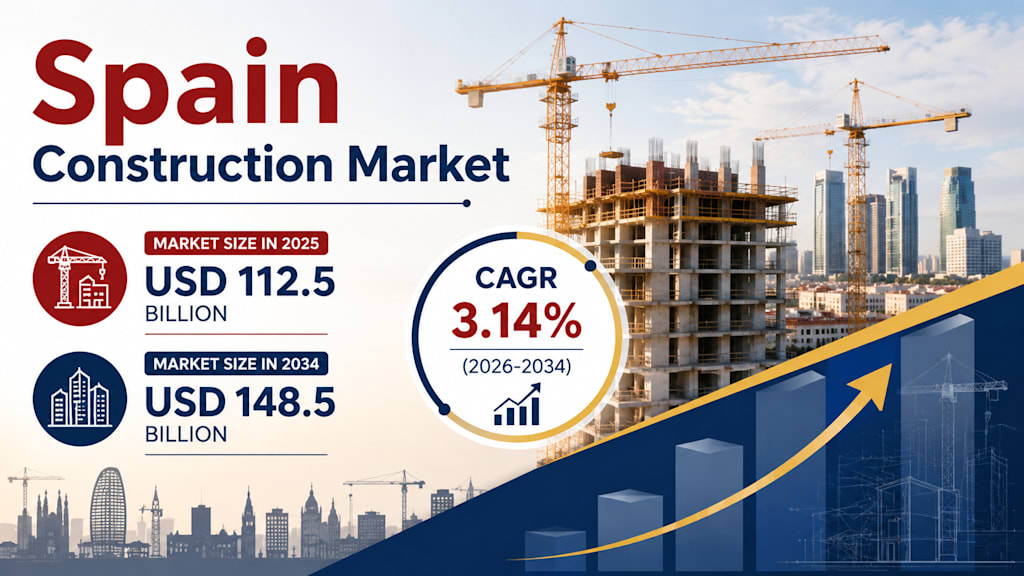
According to IMARC Group, the Spain construction market size reached USD 112.5 Billion in 2025. Looking forward, IMARC Group expects the market to reach USD 148.5 Billion by 2034, exhibiting a growth rate (CAGR) of 3.14% during 2026-2034. The market is gaining momentum from rising infrastructure investments, urbanization, growing demand for residential and commercial spaces, supportive government policies tied to sustainable development, and a strong recovery in tourism, which is feeding hospitality and related building activity.
Market Growth Drivers
EU Recovery and Resilience Funds: Spain has been one of the top beneficiaries of the EU's Next Generation funding pool, with a sizable share earmarked for construction-related projects in transport, housing rehabilitation, and clean energy. These funds are speeding up activity across the public sector pipeline.
Housing Demand and Rehabilitation: Spain faces a real housing supply gap in major cities, prompting government schemes that promote affordable housing development and energy retrofitting of older homes. Rehabilitation has become a major workstream, with subsidies pushing homeowners to upgrade insulation, windows, and heating systems.
Logistics and E-commerce Build-Out: The rise of e-commerce has triggered a wave of logistics park construction, especially around Madrid, Barcelona, Zaragoza, and Valencia. Distribution hubs, cold storage facilities, and last-mile centers are absorbing strong investor capital.
Foreign Investment: International developers and infrastructure funds continue to view Spain as an attractive destination thanks to its stable legal framework, strong tourism base, and renewable energy potential.
Challenges Facing the Market
Skilled Labor Shortages: Spain's construction industry is grappling with a shrinking pool of qualified workers, particularly in trades like masonry, electrical work, and project management. Younger generations are not entering the field at the same rate as retirees are leaving.
Material Cost Volatility: Steel, cement, and timber prices have stayed unpredictable since the pandemic, squeezing margins and complicating fixed-price contracts.
Bureaucratic Delays: Lengthy permit processes and overlapping regional rules can stall projects for months, particularly large-scale developments that cross municipal lines.
Future Opportunities
Green Building Investment: ESG-driven capital is flowing into sustainable construction, opening doors for retrofit specialists and green-certified developers.
Data Center Expansion: Spain is positioning itself as a southern European data hub, with major investments planned by hyperscalers in Aragon, Madrid, and Barcelona.
Public Infrastructure Modernization: Rail, water, and energy grid upgrades present long pipelines of work for civil engineering firms over the next decade.
Conclusion
The Spain construction market is moving through a period of meaningful change, balancing tradition with innovation. With strong tailwinds from EU funding, renewable energy, tourism, and urban renewal, opportunities are plentiful for developers, investors, and contractors who stay attuned to evolving regulations and shifting market needs. Those who pair operational discipline with a forward-looking view on sustainability and technology will likely capture the most value as the sector advances toward 2034.
About the Creator
Tim David
Creator Blog and Analysis delivers concise, data-driven insights, trend analysis, and expert perspectives, helping readers understand markets, technologies, and opportunities through clear, actionable, and research-backed content.
Enjoyed the story? Support the Creator.
Subscribe for free to receive all their stories in your feed.
Comments
There are no comments for this story
Be the first to respond and start the conversation.