
Spain Carbon Black Market: Growth Trends, Industrial Demand, and Future Opportunities
Explore the Spain carbon black market growth, driven by automotive, plastics, coatings, sustainability trends, and rising specialty applications.

The Spain carbon black market is gaining strong momentum as industries across the country continue expanding production capacities in automotive manufacturing, tire production, plastics, coatings, and construction materials. Carbon black is a fine black powder primarily produced through the incomplete combustion of heavy petroleum products, and it plays an essential role in improving durability, conductivity, UV resistance, and performance characteristics of industrial products. Spain’s growing industrial base, rising demand for high-performance tires, and increasing use of specialty materials are creating favorable conditions for market expansion.
Carbon black has become an indispensable material in several sectors due to its reinforcing properties and pigmentation capabilities. The automotive sector remains one of the largest consumers because carbon black is widely used in tire manufacturing to improve strength, tread wear resistance, and overall vehicle performance. In addition, Spain’s flourishing plastics and packaging industries are contributing to increased consumption, as manufacturers seek durable and UV-resistant products suitable for industrial and consumer applications.
Overview of the Spain Carbon Black Market
The Spain carbon black market is evolving steadily due to increasing industrialization, rising automotive production, and technological advancements in specialty chemicals. Carbon black is mainly categorized into rubber-grade and specialty-grade products, each serving distinct industrial applications. Rubber-grade carbon black is heavily utilized in tire and non-tire rubber applications, while specialty-grade carbon black is used in inks, plastics, coatings, batteries, and electronics.
Spain’s strong manufacturing ecosystem and growing exports of automotive components have significantly strengthened market demand. Tire manufacturers are increasingly focusing on producing fuel-efficient and durable tires, further increasing the need for high-quality carbon black materials. Simultaneously, the construction sector is creating additional demand for coatings, sealants, and pipes that rely on carbon black for enhanced performance and protection against environmental exposure.
Key Trends Shaping the Spain Carbon Black Market
Rising Demand from the Automotive Industry
Spain has one of the largest automotive manufacturing industries in Europe, making vehicle production a major growth driver for the carbon black market. Tires consume a substantial portion of carbon black because the material enhances tensile strength, abrasion resistance, and longevity. As automobile production rises and electric vehicles gain popularity, tire manufacturers are investing in advanced materials that improve energy efficiency and reduce rolling resistance.
The growing adoption of electric vehicles is also influencing the specialty carbon black segment. EV batteries, charging systems, and lightweight vehicle components increasingly require conductive materials, opening new opportunities for manufacturers operating in Spain.
Expansion of the Plastics and Packaging Sector
The plastics industry in Spain is witnessing substantial growth due to increasing demand for packaging solutions, industrial components, and consumer products. Carbon black is widely used in plastic manufacturing because it improves UV protection, thermal stability, and pigmentation. Packaging manufacturers are using carbon black in agricultural films, industrial packaging materials, and pipes exposed to outdoor conditions.
The increasing emphasis on durable packaging and long-lasting plastic infrastructure products is expected to support continued market expansion. Additionally, manufacturers are exploring sustainable plastic production processes that incorporate recycled materials along with specialty carbon black compounds.
Technological Advancements in Specialty Carbon Black
Innovation is transforming the Spain carbon black market as manufacturers develop advanced specialty grades for electronics, conductive polymers, and high-performance coatings. Specialty carbon black offers superior conductivity, color performance, and dispersion characteristics, making it valuable for modern industrial applications.
Demand from electronics, lithium-ion batteries, and renewable energy systems is encouraging investment in research and development activities. Companies are focusing on improving production efficiency while reducing environmental impact through cleaner manufacturing technologies and sustainable feedstock utilization.
Sustainability and Circular Economy Initiatives
Environmental sustainability has become a major priority across Spain’s industrial landscape. Carbon black manufacturers are increasingly investing in sustainable production technologies to comply with European environmental regulations and reduce emissions. Recycling initiatives, particularly involving end-of-life tires, are creating opportunities for recovered carbon black production.
Recovered carbon black is gaining attention as industries seek cost-effective and environmentally responsible alternatives to virgin carbon black. This trend aligns with Spain’s broader circular economy objectives and supports long-term sustainability targets within the chemical and automotive sectors.
Regulatory Landscape and Environmental Standards
European Environmental Regulations
Spain follows stringent European Union environmental standards governing industrial emissions, waste management, and chemical manufacturing processes. Carbon black manufacturers must comply with emission reduction targets and environmental monitoring requirements. These regulations are encouraging companies to modernize facilities and adopt cleaner production technologies.
Compliance with environmental standards also enhances competitiveness in export markets, where sustainability certifications increasingly influence purchasing decisions.
Worker Safety and Industrial Compliance
Carbon black manufacturing involves handling fine particulate materials, making workplace safety a critical priority. Companies operating in Spain must comply with occupational safety standards related to air quality, protective equipment, and industrial ventilation systems.
Continuous monitoring and investment in worker protection technologies help manufacturers maintain operational efficiency while ensuring compliance with safety regulations.
Waste Management and Recycling Policies
Spain’s waste management policies are encouraging industries to reduce landfill dependency and increase recycling rates. Tire recycling programs and industrial waste recovery initiatives are contributing to the development of secondary raw materials, including recovered carbon black.
These policies are expected to support sustainable market growth while reducing environmental pressure associated with conventional manufacturing processes.
Spain Carbon Black Market Size and Growth
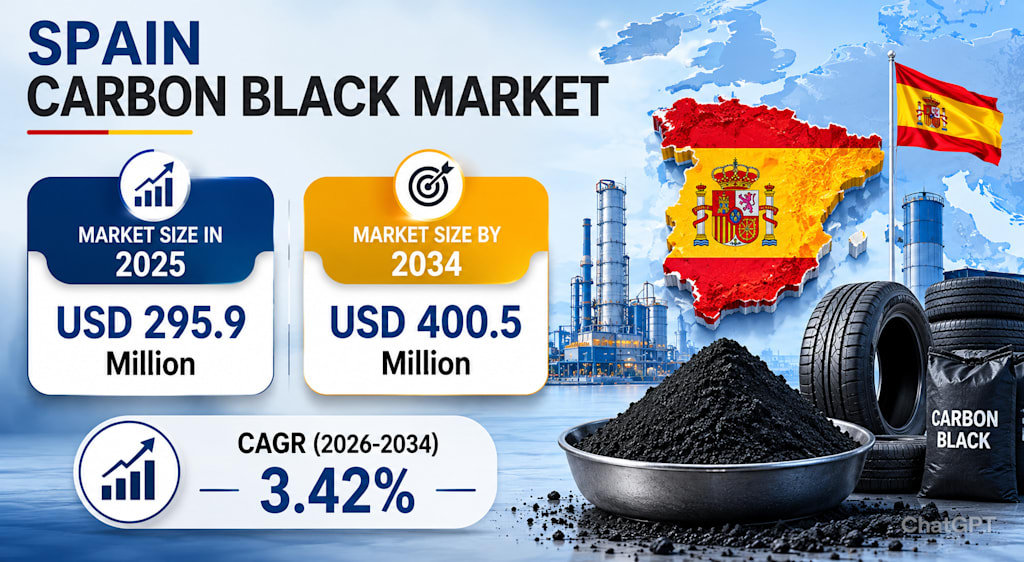
According to IMARC Group, the Spain carbon black market size reached USD 295.9 Million in 2025. Looking forward, the market is projected to reach USD 400.5 Million by 2034, exhibiting a growth rate (CAGR) of 3.42% during 2026-2034.
The market is benefiting from growing demand across automotive manufacturing, plastics production, coatings, and specialty industrial applications. Increasing industrial investments, infrastructure development, and technological innovation are expected to strengthen market performance throughout the forecast period.
Major Growth Drivers
Growth in Tire Manufacturing
The tire industry remains the largest consumer of carbon black in Spain. Rising vehicle ownership, increasing automotive exports, and expanding replacement tire demand are supporting consistent consumption growth. Tire manufacturers are prioritizing advanced formulations that enhance durability and fuel efficiency, further boosting carbon black utilization.
Industrial Infrastructure Development
Infrastructure expansion projects across Spain are increasing demand for construction materials, industrial coatings, and plastic pipes containing carbon black. The material’s UV protection and weather resistance properties make it highly suitable for outdoor industrial applications.
Public and private investments in transportation, utilities, and renewable energy infrastructure are expected to generate additional opportunities for market participants.
Increasing Demand for Specialty Applications
Specialty carbon black applications are expanding rapidly due to advancements in electronics, batteries, inks, and coatings. Conductive carbon black is becoming increasingly important in battery technologies and electronic devices, particularly with the growth of renewable energy systems and electric mobility solutions.
Manufacturers are investing in high-performance specialty grades that offer improved conductivity, dispersion, and environmental compatibility.
Challenges Facing the Market
Volatility in Raw Material Prices
Carbon black production depends heavily on petroleum-derived feedstocks, making the industry vulnerable to fluctuations in crude oil prices. Changes in global energy markets can directly impact manufacturing costs and profit margins for producers operating in Spain.
Environmental Compliance Costs
Meeting strict environmental regulations requires significant investments in emission control systems, waste management infrastructure, and sustainable manufacturing technologies. Smaller manufacturers may face operational challenges due to rising compliance costs.
Competition from Sustainable Alternatives
The growing focus on sustainability is encouraging industries to explore alternative reinforcing materials and bio-based additives. Although carbon black remains highly effective in industrial applications, manufacturers must continue innovating to maintain competitiveness in an increasingly eco-conscious market.
Future Opportunities in the Spain Carbon Black Market
The future of the Spain carbon black market appears promising due to expanding industrial applications and technological innovation. The rise of electric vehicles, renewable energy storage systems, and conductive polymers is expected to create strong demand for specialty carbon black products.
Recovered carbon black production also represents a major opportunity as Spain strengthens its recycling infrastructure and circular economy initiatives. Companies investing in sustainable manufacturing, advanced specialty grades, and environmentally friendly production processes are likely to gain long-term competitive advantages.
In addition, growing investments in automotive modernization, infrastructure expansion, and industrial automation will continue supporting demand across multiple end-use sectors.
Conclusion
The Spain carbon black market is steadily expanding due to strong demand from automotive manufacturing, plastics production, construction materials, and specialty industrial applications. Technological advancements, sustainability initiatives, and increasing investment in high-performance materials are reshaping the industry landscape.
As environmental regulations become stricter and industries prioritize sustainable production practices, manufacturers are focusing on innovation, recycling technologies, and cleaner manufacturing methods. With consistent industrial growth and rising demand for specialty applications, the Spain carbon black market is expected to maintain positive momentum over the coming years.
About the Creator
Tim David
Creator Blog and Analysis delivers concise, data-driven insights, trend analysis, and expert perspectives, helping readers understand markets, technologies, and opportunities through clear, actionable, and research-backed content.
Enjoyed the story? Support the Creator.
Subscribe for free to receive all their stories in your feed.
Comments
There are no comments for this story
Be the first to respond and start the conversation.