
South Korea’s Economy Surges 1.0% on AI Chip Boom But Domestic Demand Lags Behind
Exports and investment power fastest quarter in years, leaving households and local spending struggling to catch up

SEOUL — South Korea’s economy grew far faster than expected in the third quarter, lifted by an extraordinary surge in global demand for AI-related semiconductors that has propelled exports and factory investment to new heights, according to advance estimates released Tuesday by the Bank of Korea. Gross domestic product expanded 1.0% between July and September, accelerating from 0.6% in the second quarter and handily beating both the central bank’s earlier forecast and market consensus. The strength, however, is heavily concentrated: while the export-led industrial sector booms, domestic consumption has slipped into decline, exposing a widening gap between national prosperity and everyday livelihoods.
Chips Lead the Charge
The numbers underscore just how central semiconductors have become to South Korea’s fortunes. Exports rose 2.3% in the quarter, driven largely by soaring orders for high-performance memory chips used in artificial intelligence servers. Facility investment jumped 4.1% as manufacturers poured capital into advanced production lines and next-generation fabrication equipment. By value, shipments in the first nine months of the year have already surpassed 2024’s full-year record, topping US$800 billion and putting the country on track to exceed **US$1 trillion in total annual exports, a milestone previously reached only by the United States, China, and Germany.
Lee Dong-won, director general of the Bank of Korea’s economic statistics department, put the scale of the shift plainly: “It is estimated that about half of economic growth is being driven by semiconductors.” He added that chip production volumes are set to expand further in 2027, though price gains are expected to moderate as supply catches up with demand.
The result has lifted the nation’s growth outlook sharply. The Bank of Korea now projects the economy will expand 3.7% in 2026, well above its August forecast of 3.3%, provided output holds steady through the final quarter. Year-on-year, third-quarter growth came in at 3.4%, also beating economists' predictions.
The Domestic Divide
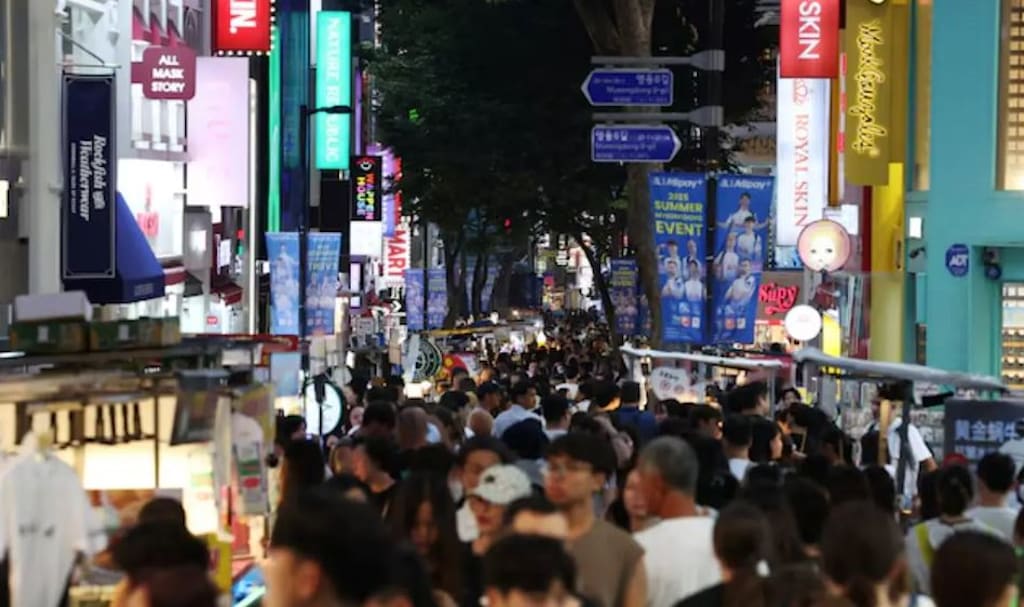
For all the headline success, beneath the surface lies a contrasting picture. Private consumption fell 0.2% in the third quarter its first quarterly decline in nearly four years. Two specific drags are cited: reduced spending on financial services amid stock market volatility, and a slump in vehicle purchases linked to labour strikes at major domestic automakers.
Analysts warn these are not isolated blips. “Exports and investments are leading growth, but the downside is that private consumption remains weak compared with the overall momentum,” observed Park Sang-hyun, economist at iM Securities. “There could be short-term boosts, but it is difficult to expect strong momentum given labour market conditions and restrictive interest rates.”
A separate central bank survey released Thursday reinforces the caution: consumer sentiment edged down in October, with respondents reporting dimmer prospects for household income and future spending. Interest rates, held steady last week following hikes in July and September, remain elevated a necessary check on inflation but one that weighs heavily on mortgage holders and small businesses.
Hopes for a Rebound
Policymakers remain optimistic that household spending will gradually recover. Lee noted that dividend payouts from profitable chipmakers due in the fourth quarter, alongside annual bonus payments early in 2027, should lift disposable incomes and encourage greater consumption. For now, though, the benefits of the AI boom are flowing unevenly concentrated in boardrooms and industrial zones rather than neighbourhood shops and household budgets.
South Korea has cemented its role as a primary supplier to the global AI revolution, reaping rewards few nations can match. Yet the third-quarter figures are also a reminder that export prowess alone does not guarantee shared prosperity. Closing the gap between the booming external sector and lagging domestic demand will be the defining challenge heading into 2027, ensuring that when the country wins, all its people feel it.
About the Creator
Mark Lim
Hi I am mark an automotive student and a car, tech and food enthusiast ! Im gonna try and post daily & hope you enjoy what I write and do share my page with people you know. I would gladly appreciate it! Cheers
Enjoyed the story? Support the Creator.
Subscribe for free to receive all their stories in your feed.
Comments
There are no comments for this story
Be the first to respond and start the conversation.