
South America’s Automation Shift to $27B
How smart factories are redefining industry across the region
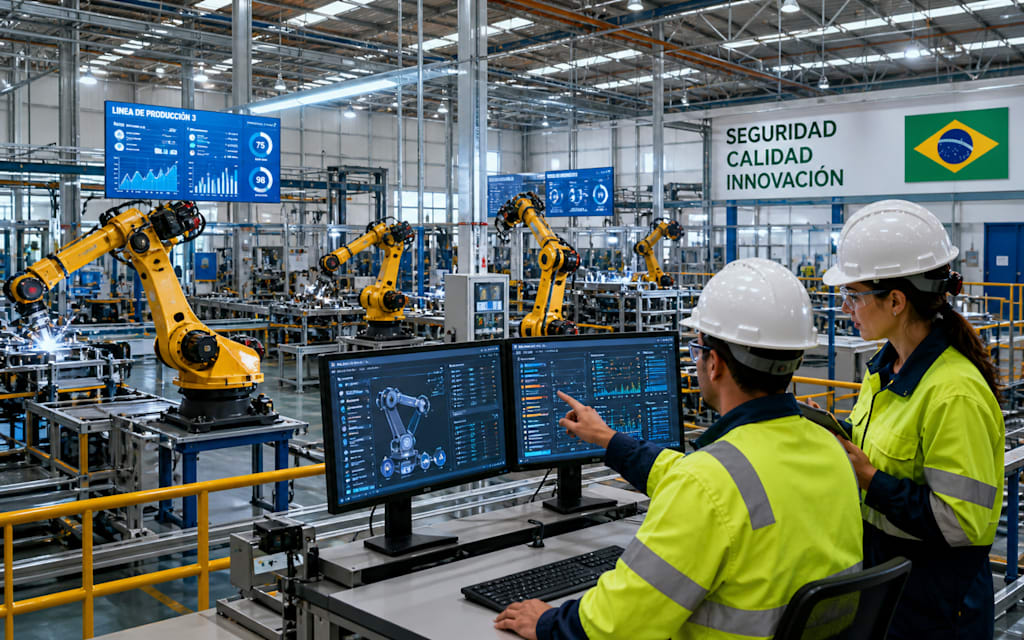
The factory floor is quieter than expected.
No frantic shouting. No visible rush. Just a synchronized rhythm of machines moving with calculated precision. Screens glow softly as engineers observe streams of data instead of handling tools. It feels less like a factory—and more like a control center.
Across South America, this transformation is unfolding in real time. The South America Factory Automation And Industrial Controls market is not just growing—it is redefining how industries think, operate, and compete.
What was once considered advanced is quickly becoming standard.
The Data Driving Change
Growth in the South America Factory Automation And Industrial Controls market size reflects a steady and structured expansion, according to Mordor Intelligence.. The market is projected to expand from USD 19.93 billion in 2025 to USD 21.13 billion in 2026, ultimately reaching USD 27.52 billion by 2031. This reflects a compound annual growth rate of 5.43% from 2026 to 2031.
These numbers highlight more than expansion—they reveal a shift in priorities.
Companies across the region are moving toward systems that improve efficiency, reduce downtime, and enhance product quality. Automation is no longer a future investment; it is a present-day requirement.
This steady rise in demand directly supports the ongoing South America Factory Automation And Industrial Controls market growth, as industries modernize to remain competitive in a global economy.
Why Industries Are Adopting Automation
The shift toward automation within the South America Factory Automation And Industrial Controls Industry is driven by practical needs rather than trends alone.
Several key factors are influencing adoption:
- Increasing pressure to optimize production costs
- Demand for consistent product quality across markets
- Growing emphasis on workplace safety and compliance
- The need for faster and more reliable manufacturing cycles
These drivers are shaping the current South America Factory Automation And Industrial Controls market trends, where adaptability and precision are becoming essential.
From automotive manufacturing hubs in Brazil to resource-intensive industries like mining and energy, automation is enabling companies to operate with greater control and predictability.
Instead of reacting to problems, systems can now anticipate them—reducing disruptions and improving overall performance.
A Diverse and Expanding Market
One of the defining characteristics of this space is its diversity. The South America Factory Automation And Industrial Controls market share is spread across multiple industries, each leveraging automation differently.
- Manufacturing: Focused on robotics and scalable production systems
- Oil and Gas: Utilizing control systems for operational safety
- Mining: Implementing automation in high-risk environments
- Food and Beverage: Ensuring consistency and regulatory standards
This wide range of applications strengthens the overall resilience of the market.
In addition, smaller enterprises are beginning to adopt automation technologies as solutions become more modular and cost-effective. This broader accessibility is contributing to sustained expansion across the region.
What the Future Holds
The South America Factory Automation And Industrial Controls market forecast points toward continued, steady development rather than sudden disruption.
By 2031, the market is expected to reach USD 27.52 billion, reflecting long-term investments in smarter, more connected systems.
Future advancements are likely to include:
- Integration of connected devices within factory environments
- Data-driven decision-making through advanced analytics
- Improved energy efficiency in automated processes
- Strengthened cybersecurity for industrial systems
These developments will continue to shape the evolution of the South America Factory Automation And Industrial Controls Industry, supporting both innovation and stability.
The Human Element in a Digital Shift
While automation focuses on systems and machines, its impact on people is equally significant.
Roles within factories are evolving. Workers are increasingly engaged in monitoring systems, analyzing data, and managing automated processes. This shift is creating demand for new skill sets while reducing reliance on repetitive manual tasks.
At the same time, challenges remain. Workforce adaptation, training requirements, and infrastructure readiness continue to influence how quickly organizations can transition.
Yet the overall direction is clear—automation is becoming a central part of industrial strategy across South America.
A Quiet Transformation with Lasting Impact
Unlike previous industrial shifts, this transformation is subtle. It does not rely on visible change alone but on digital integration and operational intelligence.
The ongoing evolution of the South America Factory Automation And Industrial Controls market trends reflects a broader movement toward efficiency, precision, and long-term sustainability.
Industries are not just adopting new technologies—they are redefining how work gets done.
And as this transformation continues, its effects will extend far beyond factory walls.
Do you think automation will create more balanced opportunities across industries, or will it widen the gap between traditional and modern workplaces?
About the Creator
Enjoyed the story? Support the Creator.
Subscribe for free to receive all their stories in your feed.
Comments
There are no comments for this story
Be the first to respond and start the conversation.