
Smart Recovery: A Practical Guide to Matching Technology with Clinical Needs
A practical guide to selecting and implementing smart recovery technologies wearables, AI apps, VR to reduce readmissions and improve adherence, backed by 2025-2026 evidence.

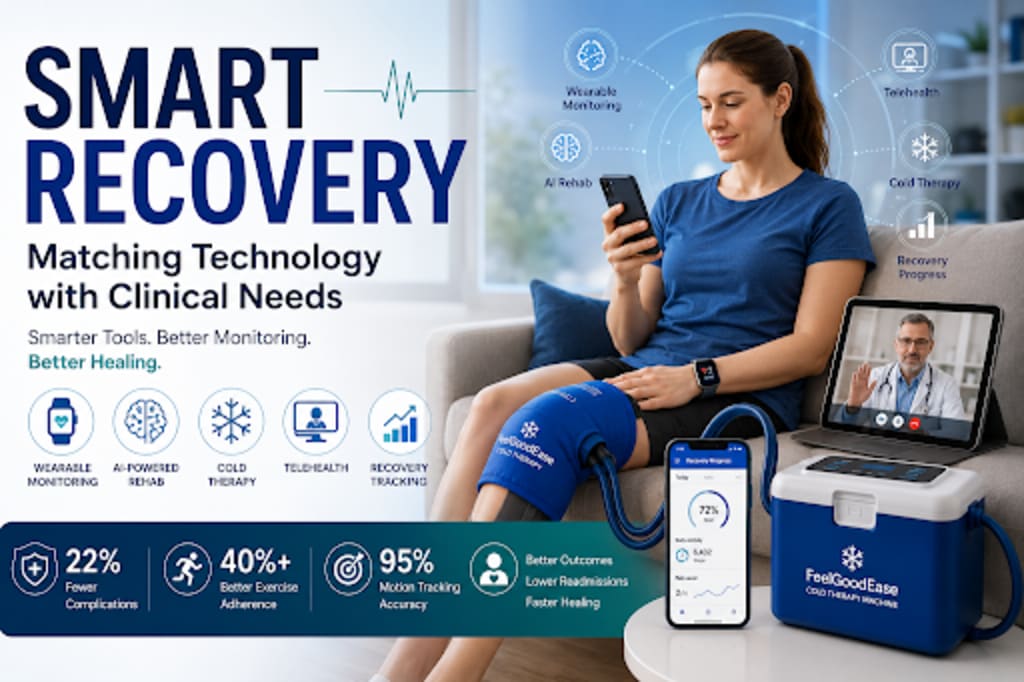
The readmission alert came at 2 a.m. A patient I’d discharged three days earlier was back in the ED with a wound infection that a simple daily step count could have flagged. After that night, I switched from periodic phone check-ins to continuous wearable monitoring. A 2026 RCT later confirmed the approach: wearable-enhanced monitoring cut complications by 22%. That’s not an outlier. Nearly one in five surgical patients is readmitted within 30 days, a costly and often preventable cycle.
Today, smart recovery is not about adopting every new gadget. It’s about matching the right technology to the right clinical need. Whether it's wearable monitoring, telehealth, AI-driven rehabilitation, or advanced cold therapy systems like the FeelGoodEase, each solution should address a specific challenge in the recovery journey rather than add unnecessary complexity.
Key Takeaways
Nearly 1 in 5 surgical patients are readmitted within 30 days, and many readmissions can be prevented with better recovery monitoring.
Wearable-enhanced monitoring reduced postoperative complications by 22% in a recent randomized controlled trial.
AI-powered rehabilitation apps can improve exercise adherence by approximately 40%.
Virtual reality rehabilitation significantly increases patient engagement and therapy completion.
Smart recovery delivers the best outcomes when technology is integrated into clinical care instead of being used for its novelty.
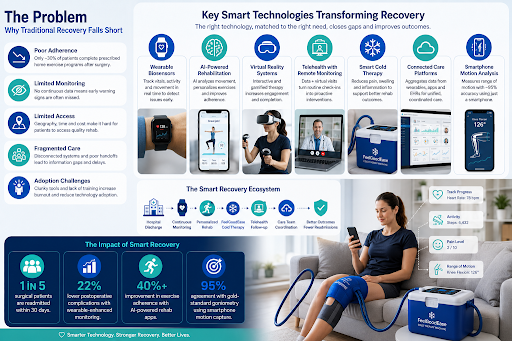
The Problem: Why Traditional Recovery Falls Short
Smart recovery exists because traditional recovery often leaves critical gaps between hospital discharge and follow-up care. Patients are typically sent home with written instructions and little ongoing support, creating a window where complications can develop unnoticed.
Poor Adherence to Home Recovery Plans
Recovery often depends on patients completing exercises correctly at home, yet only about 30% consistently follow prescribed rehabilitation programs after orthopedic surgery. Without objective feedback, clinicians have no way to identify struggling patients until the next appointment.
I once worked with a patient who insisted he was exercising daily, but a motion sensor showed almost no improvement in shoulder mobility. The issue wasn't motivation, it was a poorly fitted sensor recording everyday arm movement instead of rehabilitation exercises. It was a reminder that even smart technology only works when it's designed and used correctly.
Limited Monitoring Between Visits
Traditional recovery relies heavily on occasional check-ins and patient self-reporting. Continuous monitoring tells a much clearer story. A 2024 randomized controlled trial found that wearable monitoring reduced postoperative complications by 22% by identifying subtle changes in activity and vital signs before they became serious problems.
Limited Access to Rehabilitation
Many patients, particularly those in rural communities, struggle to attend regular therapy sessions because of distance, cost, or time. Smartphone-based assessment tools and virtual rehabilitation help extend specialist care beyond the clinic, making recovery more accessible without sacrificing quality.
Fragmented Care Coordination
Recovery often involves surgeons, therapists, primary care providers, and home health teams. When these providers work from disconnected systems, important information can be missed, delaying treatment and increasing the risk of preventable readmissions.
Workflow and Adoption Challenges
Technology only improves outcomes when clinicians can easily incorporate it into existing workflows. Solutions that require multiple dashboards or complicated training are far less likely to be adopted, regardless of their capabilities.
The goal of smart recovery isn't simply to add more technology, it's to close these gaps with practical, evidence-based solutions.
Key Smart Technologies Transforming Recovery
Every recovery challenge has a technology designed to address it. The key is selecting the right solution for the patient's clinical needs.
Wearable Biosensors
Wearable devices continuously monitor activity, heart rate, mobility, and other health metrics, helping clinicians identify early signs of complications before symptoms become obvious. Recent research shows wearable monitoring can reduce postoperative complications by 22% through earlier intervention.
AI-Powered Rehabilitation
AI-driven rehabilitation platforms analyze movement, personalize exercise programs, and provide real-time feedback that keeps patients engaged. Studies show these personalized systems significantly improve adherence compared to traditional home exercise programs.
Virtual Reality Rehabilitation
Virtual reality transforms repetitive rehabilitation exercises into interactive experiences, improving patient motivation and increasing therapy completion, particularly for neurological and orthopedic recovery.
Telehealth with Remote Monitoring
Modern telehealth becomes far more effective when combined with wearable data. Instead of relying solely on patient conversations, clinicians can review objective recovery trends and intervene earlier when problems appear.
Smart Cold Therapy
Pain and swelling remain two of the biggest barriers to successful rehabilitation. Combining connected recovery tools with clinically designed cold therapy systems, such as the FeelGoodEase Cold Therapy Machine, helps patients manage inflammation more comfortably while supporting consistent participation in rehabilitation exercises.
Connected Care Platforms
Cloud-based care coordination platforms bring together information from wearables, rehabilitation apps, telehealth visits, and electronic health records, giving care teams a more complete picture of patient recovery.
Smartphone Motion Analysis
Advances in smartphone motion tracking now allow clinicians to measure joint movement with impressive accuracy using only a mobile device. One validation study reported approximately 95% agreement with traditional clinical measurements, making objective recovery assessment accessible even outside specialized rehabilitation centers.
I began using smartphone motion analysis to monitor knee recovery between appointments, and the consistency of the measurements gave me greater confidence when adjusting home exercise programs without waiting weeks for another clinic visit.
Step-by-Step Implementation Guide for Healthcare Providers
Implementing smart recovery doesn't require replacing your entire workflow. A phased approach helps healthcare organizations improve patient outcomes while minimizing cost and disruption.
Phase 1: Assess Your Readiness
Before investing in new technology, evaluate whether your organization has the infrastructure, leadership support, staff readiness, and patient engagement needed for a successful rollout.
Readiness Checklist
Assessment Area
Key Question
Digital Infrastructure
Does your EHR support secure integration (FHIR/API)?
Connectivity
Is reliable Wi-Fi available across all care areas?
Leadership Support
Is there executive sponsorship for digital health?
Clinical Champion
Has a project leader been assigned?
Staff Readiness
Are clinicians comfortable using digital tools?
Patient Readiness
Do most patients have access to smartphones?
Budget
Is funding available for a pilot program?
Outcome Tracking
Can you measure PROMs and recovery outcomes?
Organizations with strong infrastructure and leadership are better positioned for successful implementation.
Phase 2: Select the Right Technology
Choose technology based on a specific clinical objective rather than features alone.
Technology
Primary Use
Cost
Implementation
Wearable Biosensors
Activity & vital monitoring
Medium
Easy
AI Rehabilitation Apps
Guided home exercises
Low–Medium
Moderate
Telehealth + RPM
Remote follow-up
Medium
Moderate
Smart Cold Therapy
Pain & swelling management
Medium
Easy
VR Rehabilitation
Motor recovery
High
Advanced
Motion Capture Apps
Range-of-motion tracking
Low
Easy
Care Coordination Platforms
Team collaboration
Medium
Moderate
For orthopedic recovery, combining wearable monitoring, AI-guided rehabilitation, telehealth, and the Cold Therapy Machine creates a balanced recovery program that supports pain management, mobility, and continuous progress tracking.
Phase 3: Run a Pilot Program
Keep the pilot simple and measurable.
Recommendation
Target
Pilot Duration
90 Days
Patient Group
20–30 Patients
Success Metrics
Readmissions, adherence, PROMs, patient satisfaction
Data Review
Weekly
Final Evaluation
End of pilot
Start with a single patient population before expanding across departments.
Phase 4: Train Your Team
Successful implementation depends on people as much as technology.
Focus training on:
Hands-on device demonstrations
Workflow integration
Digital troubleshooting
Clinical champions who support colleagues
Embedding recovery data into existing clinical workflows encourages long-term adoption.
Phase 5: Scale and Integrate
After demonstrating positive results, integrate recovery technologies with your EHR using standardized APIs and secure interoperability frameworks.
Review performance regularly to ensure technology continues supporting both clinicians and patients effectively.
Phase 6: Measure Success
Track outcomes that directly reflect patient recovery and program value.
KPI
Why It Matters
30-Day Readmission Rate
Measures clinical effectiveness
Exercise Adherence
Evaluates patient engagement
Patient Satisfaction
Reflects overall recovery experience
PROMs
Measures functional improvement
Cost per Episode
Demonstrates financial impact
Use pilot results to guide future expansion and continuously refine workflows.
Future Trends: What's Next in Smart Recovery (2026 and Beyond)
Today's smart recovery tools are already improving patient outcomes, but the next generation of healthcare technology promises even greater precision, personalization, and proactive care.
One of the biggest shifts is the move from reactive monitoring to predictive recovery. Instead of simply notifying clinicians after a complication develops, artificial intelligence will analyze continuous patient data to identify subtle risk patterns days before problems become serious.
In my own practice, the value of predictive analytics isn't the algorithm itself, it's the ability to recognize concerning recovery trends before the next shift change. Whether monitoring surgical drain output, activity levels, or vital signs, earlier predictions give care teams valuable time to intervene and potentially prevent hospital readmissions.
Future recovery platforms will combine wearable biosensors, AI-driven decision support, remote monitoring, and connected devices into a single ecosystem that continuously adapts to each patient's recovery progress. Advanced cold therapy systems, including connected devices like the FeelGoodEase Ice Therapy Machine, will become part of these integrated recovery programs by combining symptom management with digital recovery tracking.
Although many of these technologies are already showing promising clinical results, others including digital twins, AI recovery coaches, and predictive rehabilitation models are still being validated through ongoing research. As evidence continues to grow, healthcare providers will be better equipped to deliver more personalized and proactive recovery experiences.
Conclusion
Smart recovery isn't about adopting every new technology. It's about selecting the right solution for the right clinical challenge.
Current evidence continues to show that wearable monitoring, AI-assisted rehabilitation, telehealth, connected care platforms, and clinically designed cold therapy can reduce complications, improve patient engagement, and support better long-term outcomes when integrated into existing clinical workflows.
Healthcare providers can begin by identifying a single recovery challenge, implementing one targeted technology, measuring meaningful outcomes, and expanding only after demonstrating success. Patients can also play an active role by asking their care team which objective recovery metrics, such as mobility, activity levels, pain scores, or range of motion can help monitor their progress more effectively.
The greatest investment is rarely the technology itself. Successful implementation depends on thoughtful workflow design, staff training, and seamless integration between devices and clinical systems. When technology supports clinical practice instead of complicating it, smart recovery delivers its greatest value.
Start with one clinical problem, one evidence-based solution, and one measurable outcome. Build success step by step.
Trust & Clinical Note
This article is based on current evidence from peer-reviewed research, digital health standards, and clinical best practices published between 2025 and 2026. While emerging technologies continue to evolve, patients should always follow the guidance of their healthcare provider before making changes to their recovery plan.
About the Creator
Enjoyed the story? Support the Creator.
Subscribe for free to receive all their stories in your feed.
Comments
There are no comments for this story
Be the first to respond and start the conversation.