
She Thought She Was Marrying a Billionaire. His Trust Had Other Plans.
The legal structure that kept Jerry Hall out of Rupert Murdoch’s media empire, and what it means for anyone dating serious money.
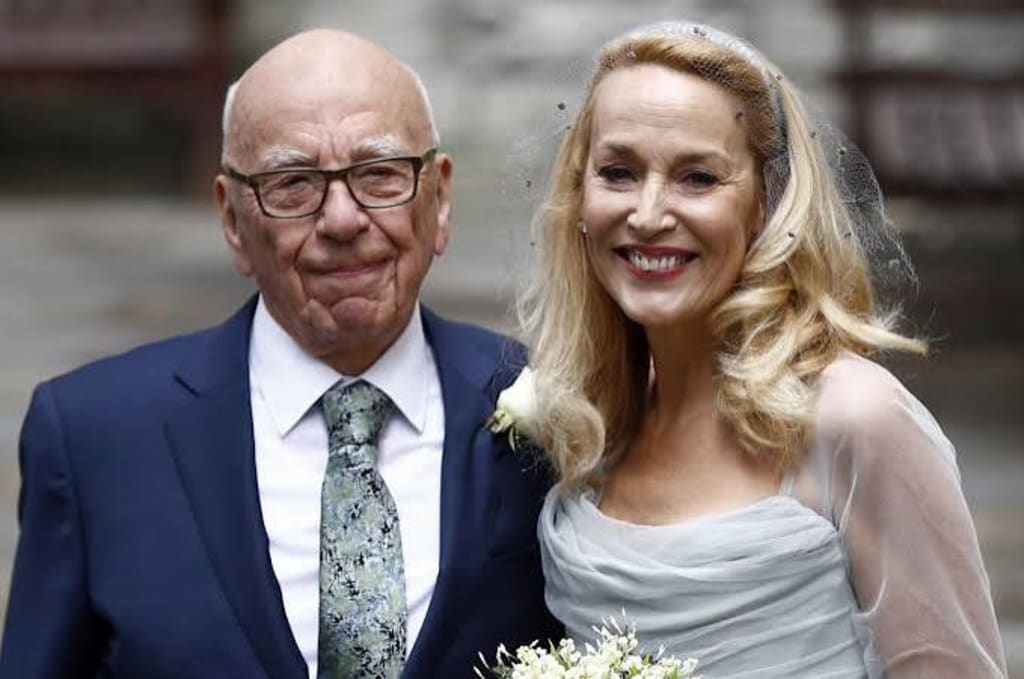
In 2016, Rupert Murdoch married Jerry Hall.
In 2022, the marriage ended. No public mudslinging. No long tabloid war. An email, a process, and then separate lives.
That quiet ending tells you more than any wedding photo. This marriage ran on exchange. He needed a dignified social front. She needed top-tier status and material security. Love may have been present. It was not the main line. The ending was shaped by a prenuptial agreement, a family trust, an equity structure, and a legal firewall set up by a previous wife decades earlier.
The dinner was valuation
Jerry Hall was not an ordinary woman. In the 1980s and 1990s, she was one of the top supermodels in Europe and America. She walked expensive shows. She appeared on important covers. She moved through fashion, art, and celebrity circles for decades. Her value was not only her face and body. It was the network behind her: designers, photographers, brand founders, charity galas, diplomatic events, and access to upper-class society.
Murdoch was not an ordinary man either. He controlled News Corp and Fox. He had money, power, and a media empire. He also had a practical problem. He was getting older. His energy was limited. His public image needed maintenance. After his divorce from Wendi Deng, his private life became a public story. For someone at his level, marriage is not only private. It is also a public-relations asset.
When they met at a high-end dinner, they assessed each other’s value.
Murdoch needed a partner who was dignified, elegant, globally famous, and able to hold her own at top-level dinners and diplomatic events. She did not need to interfere in News Corp’s business or join company decisions. She needed to stand there, smile, shake hands, and socialize. That helped him repair his image and shape a narrative of a refined, stable old age.
Jerry needed entry into the highest capital circles. She had been a huge star, but the golden cycle of a supermodel had passed. Fashion is brutal. As a model ages, commercial value declines. Marrying Murdoch gave her the identity of “Mrs. Murdoch,” luxury real estate, private jets, a high living allowance, and top-tier social resources. Most celebrities cannot touch that circle.
Neither person deceived the other. Two adults at different stages of life made a realistic choice.
Anna’s trust was the firewall
To understand why Murdoch could marry and divorce repeatedly, you have to understand Anna Murdoch. She was his second wife. Their marriage lasted 32 years. When they divorced in 1999, Anna did not simply take cash and leave. She was part of a far-reaching arrangement: the Murdoch Family Trust.
The trust guarded against all future women.
Public reporting says the Murdoch Family Trust holds large equity in News Corp and Fox, especially voting rights. The beneficiaries are mainly Murdoch’s blood descendants, particularly the older children from his first two marriages. Later, Wendi Deng’s two daughters were added to the beneficiary structure. What they received was mainly distribution income, not corporate control.
The distinction matters:
Beneficial interest: the right to receive money.
Control: the right to decide company direction, board seats, and voting.
Ownership: the equity legally belongs to the trust, not to Murdoch personally.
Once core equity sits inside an irrevocable trust, what can a spouse get in a divorce? Usually only Murdoch’s personally held cash, real estate, investments, and similar assets. She cannot directly divide the News Corp and Fox equity held in the trust.
So no matter how many times Murdoch marries or divorces, control of News Corp and Fox stays isolated from marital property. A wife can enjoy luxury during the marriage and receive a divorce settlement. She cannot touch the foundation of the media empire.
Anna’s move was not just about her own dignity. She was securing a permanent structure for her children. She understood that in a wealthy family, feelings change, marriages end, promises expire. Legal structures do not change easily.
The prenup
Murdoch and Jerry Hall had a prenuptial agreement. The specific terms are usually confidential. Based on common structures in high-net-worth marriages, the broad framework can be inferred.
Jerry’s personal assets before marriage remained hers. She had earned money, property, and investments over years as a supermodel. That part would not be swallowed by the marriage.
During the marriage, she could enjoy the top-tier material treatment provided by Murdoch: luxury homes, private jets, security, assistants, a high living allowance, global travel, and elite social events. These were the cash flow and lifestyle that came with the identity of “Mrs. Murdoch.”
She gave up any claim to divide core equity in News Corp and Fox. She could be a wife. She could not be a shareholder. She could attend dinners. She could not enter the boardroom.
If they divorced, she could receive an agreed amount of alimony and specified real estate. Compared with Murdoch’s overall wealth, this was a small portion. It ensured she would live comfortably. It did not give her entry into the core of capital power.
Did Jerry know all this? She had moved through European and American high society for decades and had seen many wealthy marriages. Wendi Deng’s precedent was right in front of her. Wendi married Murdoch, bore two daughters, and still did not receive core News Corp equity in the divorce. Jerry’s legal team would have broken down the trust terms, the prenuptial agreement, and the tax consequences before the wedding.
She was not kept in the dark. She entered with knowledge.
Her bet was on lifelong attachment to top-tier status, unlimited material support, and a dignified old age.
She thought the title “Mrs. Murdoch” would keep her permanently at the top of the capital world. She thought that as long as she remained dignified, caused no trouble, and did not touch power, she could stay safely until the end.
The coldness of a wealthy-family marriage is this: when you put all your chips on someone else’s status and goodwill, you lose the initiative.
Six years of marriage
During the six years after the wedding, Jerry Hall went from an independent supermodel to almost entirely “Mrs. Murdoch.”
She still appeared at top-tier events. She was still elegant, poised, and polished. Her personal career label faded. When the public mentioned her, the first thought was Murdoch’s wife, not Jerry Hall herself.
That is the price of being a family facade.
If she continued to build a strong, independent personal career, her aura might overshadow Murdoch’s. That would violate the exchange logic of the marriage. If she retreated fully into the family, she would lose her own career anchor. Her personal value would depend entirely on her marital identity.
She chose the latter. Her social life, travel, and public statements had to align with Murdoch and the family’s positions. Her personal preferences, career plans, and social circles all had to give way to the role of “Mrs. Murdoch.”
Murdoch’s children kept their distance from this stepmother. On the surface, there could be politeness, photos, and joint appearances. The core family circle would not accept an outsider wife. She was not part of the blood community. She could not become a participant in family power.
She did not need to intervene in the children’s disputes. From the beginning, she was excluded from the core inheritance structure. Her role was to decorate the facade, not to participate in decisions.
This kind of marriage looks like ultimate luxury from the outside. From the inside, it is deep dependency. You cannot say she was unhappy. Her happiness rested on someone else’s structural arrangement. If the structure stayed the same, she was safe. If the structure changed, she was out.
Divorce
In 2022, Murdoch and Jerry Hall divorced. Murdoch’s side reportedly filed by email. The process moved quickly. Jerry at one point tried to reverse or renegotiate. She ultimately accepted the outcome.
What did she get? Media reports said she received alimony and real estate. The exact amounts and property details were not fully public. One thing is certain: she could not touch the core equity of News Corp and Fox.
This was predictable. From the first day of the marriage, the trust and the prenuptial agreement had already written the ending.
What did Murdoch lose? Almost nothing that touched his core. The key equity in News Corp and Fox remained in the trust. Company operations were unaffected. The equity structure did not change. Voting rights did not change. The divorce only disposed of some assets held personally by Murdoch. For a fortune in the tens of billions, the alimony was a small cost.
That is why he could marry and divorce repeatedly. Not because he understood love better. His commercial foundation was protected too well by legal structures. Marriage was a replaceable facade partnership for him. For the woman, it could be an irreversible life investment.
Why Wendi Deng looked better off
Many people ask: Wendi Deng also did not receive core equity in her divorce. Why did she seem to have more leverage than Jerry?
The key is children.
Wendi Deng bore Murdoch two daughters: Grace and Chloe. Later, these two daughters were included in the family trust’s beneficiary structure and could receive long-term asset distributions. They did not have voting control. They were Murdoch’s blood descendants and had a family position Jerry did not have.
Jerry had no children with Murdoch. She had no long-term anchor in the Murdoch family inheritance structure. She was only the wife of one period, not the mother of an heir. After the divorce, her core interest link to the Murdoch family was broken.
Even though Wendi Deng had daughters, she herself did not receive core News Corp equity. The daughters received beneficial interest, not their mother’s control. Wendi used her children to lock in long-term income and a family position.
Jerry did not have that card. She could only take a one-time settlement and leave.
What this marriage exposed
The story of Murdoch and Jerry Hall is not gossip. It is a lesson in wealthy-family wealth.
Top-tier marriage is often asset restructuring, not emotional settlement. The wedding is public relations. The diamond ring is a prop. The photos are image management. The rules are written in the prenuptial agreement and the trust documents.
Equity and control matter more than cash flow. Luxury homes, private jets, living allowances, and alimony are consumable wealth. Corporate equity, voting rights, and board seats are power wealth. A wealthy family can give you the former. It rarely gives you the latter.
A family trust is a strong wall against marital risk. It separates core assets from the individual’s name. A divorce can only divide personal property. It cannot touch the corporate foundation. No matter how beautiful, famous, or patient the wife is, as long as the trust structure remains unchanged, she remains outside power.
A common mistake women make in hypergamous relationships is treating status as an asset. “Mrs. So-and-So” is a social halo, not an enforceable right. When the marriage ends, the halo disappears. If you do not have an independent career, independent cash flow, and independent assets, you are left passive.
Do not gamble on other people’s goodwill. Goodwill in a wealthy family has a price and an expiration date. You can enjoy the resources the marriage brings. You cannot stake your entire life on the other person never changing.
A risk-control checklist for high-net-worth relationships
If you are dealing with a high-net-worth, cross-border, family-business partner, do not just look at how much money he has. Look at:
Where are the assets? In his personal name, a company, a trust, or an offshore structure?
Who holds control? Who holds voting rights, board seats, and beneficial interests?
What does the prenuptial agreement say? What can you get in a divorce? What can you not get? Do you have independent counsel?
Who are the family trust beneficiaries? Are you only a spouse, or also a parent of beneficiaries? Do the children have voting rights?
What is your exit consideration? Alimony, real estate, cash, insurance, trust distributions. Which are certain?
Do you still have your own career and cash flow? If the marriage ends tomorrow, can you live independently rather than relying on a settlement for the rest of your life?
How do tax and residency laws affect you? In cross-border marriages, tax and jurisdiction can determine the outcome more than feelings.
Can you accept the worst-case outcome? If you divorced tomorrow, what would you have? Could you return to your own track?
These questions are cold. They matter more than “Does he love me?”
Conclusion
The six years of Murdoch and Jerry Hall were not a simple late-life romance. They were a top-circle partnership. Murdoch got a dignified facade. Jerry got wealthy-family status and material life. When the facade was no longer needed, the partnership could be ended at low cost.
What determined the ending was not the wedding vows. It was the trust Anna set up decades earlier, the clauses in the prenuptial agreement, and the voting-rights arrangements in News Corp’s equity structure.
Jerry Hall lost to a structure that had been written from the beginning.
For anyone who wants to move upward and deal with high-net-worth relationships: do not be dazzled only by the wealthy-family halo. Look at the asset structure, the family logic, and the exit terms. Do not gamble your youth, career, and life initiative on someone else’s goodwill.
Your fate is best held in your own hands. Marriage can be a partnership. The premise of partnership is knowing what you are signing.
About the Creator
Jin
Writer of reamstories
https://reamstories.com/jin
Enjoyed the story? Support the Creator.
Subscribe for free to receive all their stories in your feed. You could also become a paid subscriber, letting them know you appreciate their work.
Comments
There are no comments for this story
Be the first to respond and start the conversation.