
She Slapped a Protester for Murdoch. Then the Family Locked the Door.
What Wendi Deng’s 14 years inside the Murdoch machine reveal about prenups, trust funds, and the real price of an admission ticket.
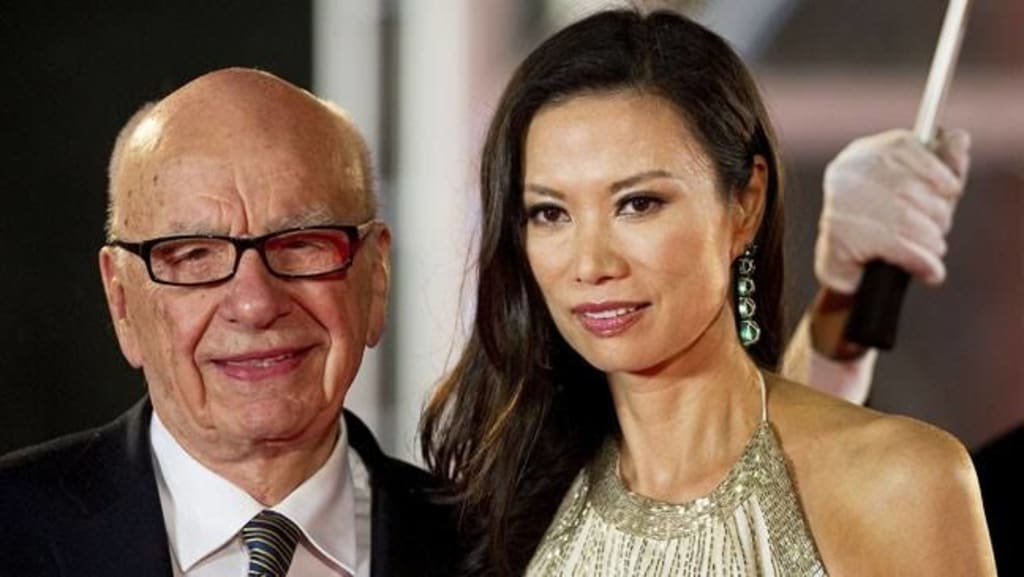
Beijing, 1998. Rupert Murdoch had just finished visiting a site. An aide handed him the schedule. A young woman in a dark suit stepped forward, handed him a business card, and said: “I’m the most suitable guide for you in China.”
Murdoch looked at her for three seconds. Later, she got into his car.
This story has been told countless times since, in many versions. One detail rarely mentioned: the title on her business card that day was employee of Star TV. Not translator. Not assistant. Not any identity with the name “Murdoch” attached to it. She introduced herself from the position of an ordinary employee.
This is the access layer. You don’t need to be invited. You need to be seen.
1. The Door
In the 1990s, the door to old-money circles in Europe and America was solid. Bloodline, school, family reputation, marriage networks: one link after another. A Chinese woman with no family endorsement, no parental equity, and no family alliance to trade stood at the door. The gatekeeper would not ask “Who are you?” He would only ask “Who do you represent?”
She represented no one. So she could only represent herself.
Murdoch was an exception. He did not need to exchange equity with another family through marriage; he was already big enough. What he needed was someone who understood China, could get things done, and would not take away voting rights. Wendi Deng happened to be that person. She had an MBA from a prestigious school, business instincts, experience running errands at Star TV, and a business card she could hand out.
The structure of the time made him one of the few people whose door was not completely locked.
2. The Pledge
Once you enter the door, the first thing you do is not sit down. It is to hand over a pledge.
The pledge is public acknowledgment that the system is legitimate.
She could not question the prenuptial agreement, could not fight the family trust, could not challenge the power order of Murdoch’s children. She had to play the role of a wife who was “docile, useful, and would not overturn the order.” She did it.
In public, she stood half a step behind Murdoch, smiled appropriately, and did not interrupt. At family gatherings, she sat at the end of the long table, the conversation bypassed her, and she carved the turkey. Murdoch’s mother, Elisabeth, refused to meet her for the rest of her life. At the family Christmas dinner, the old lady did not come, and Wendi did not ask.
She had a temper. She knew it was worthless at this table.
3. The Slap
July 19, 2011, London. A parliamentary hearing. Murdoch faced questions over the phone-hacking scandal. A protester holding a cream pie rushed forward, hand already raised.
Wendi Deng jumped up from the back row and slapped him with her right hand. The room froze. Murdoch lowered his head and straightened his suit, as if nothing had happened.
This slap was later cut into countless videos, titled “Wendi Deng protects her husband.” Watch the slow motion carefully. After she slapped him, she did not look at Murdoch, did not look at the camera. She sat back down and adjusted her hair.
She was protecting her position.
At that moment, she was the actual operator of News Corporation’s East Asian business, Murdoch’s liaison in the Chinese market, and the mother of two trust beneficiaries. If Murdoch had been hit by a cream pie at the hearing and his image collapsed, her platform would have shaken with him. She was not slapping the protester. She was slapping for the whole room to see: this person is still useful; this position still has someone guarding it.
Murdoch did not thank her publicly afterward. Neither did the family internally. But in the following years, her say in the Asian business did increase a little.
An emotional high point relies on an action. The action itself is small: a slap, adjusting her hair, sitting back down. For her, it was an exception. She does not hit people. That day, she hit someone.
4. The Locked Door
A closed-door family meeting to discuss News Corporation business. She walked to the door. It was locked from the inside. She stood there for five seconds, turned around, and went to the kitchen to pour water.
It happened again and again. The children from the previous marriage firmly controlled family power, and core matters were deliberately kept away from her. She could appear at cocktail parties, could accompany Murdoch to meet political and business elites, could negotiate channel launches for News Corporation. Group voting rights, control of the family trust, and the succession order were beyond her reach.
The access layer gives you a title. The beneficiary layer gives you dividends. The control layer locks the door.
She tried to push. It would not move. Later, she stopped pushing. She began to do another thing: shift her focus to her daughters.
5. Daughters and the Trust
After Murdoch’s prostate cancer surgery, the probability of natural conception was extremely low. Wendi Deng used his frozen sperm from earlier years and underwent IVF. Two daughters were born.
The outside world says she used her children to tie Murdoch down. That is half true. The divorce agreement between Murdoch and his ex-wife Anna contained a clause: if there were no offspring, a divorce could leave her with almost nothing. She understood the clause, and then she had the surgery.
Childbirth was a legal game as much as a love story.
But the children were not merely tools. In a family that excluded her, her two daughters were the only people she did not have to guard against. She enrolled them in Chinese classes and art classes, tied their allowance to their grades, and would not allow them to develop the extravagant, empty habits of wealthy young ladies. She was both a tiger mom and an isolated outsider daughter-in-law.
Murdoch put the two daughters on the list of family trust beneficiaries and gave them economic beneficiary rights. The children from the previous marriage firmly refused to let the two younger sisters touch News Corporation voting rights.
The trust assets were left by Murdoch to his daughters, not to Wendi Deng. Ownership of the assets belongs to the children. During their minority, Wendi Deng only had custodial use rights; the funds could only be used for the daughters’ education, medical care, and living expenses, and could not be freely controlled or cashed out by her personally. When the daughters reach adulthood, the guardianship and management rights are returned to them.
Guardianship does not equal ownership. Beneficial interest does not equal voting rights. The family trust draws the boundary of rights and responsibilities clearly: bloodline can receive money, but the offspring of an outsider mother can hardly directly share in the family’s ruling power.
Compare the four children from Murdoch’s first two marriages. In the early family trust, they were written into the agreement from the start and equally enjoyed voting decision-making rights corresponding to News Corporation’s core equity. They did not merely receive dividends; they had the qualification to intervene in major group decisions and could enter the group for training at a young age. Even when three of the older children later chose to exit the power game, they did so by buying out with huge cash settlements, holding assets that belonged entirely to them and were not subject to anyone else’s guardianship, with full disposal rights.
Wendi Deng’s two daughters were excluded from the initial core trust list from an early age. They were only designated as property beneficiaries, able to enjoy dividend income, with no group voting rights, no qualification to participate in corporate management, and only passive receipt of financial benefits, with no opportunity to touch the real power sector of the media empire.
Both are Murdoch’s bloodline. The children of the ex-wife were born with bargaining power. Wendi Deng’s daughters only have the material benefits given to them.
6. The Shredder
Late at night, the study. She turns to clause 14 of the prenuptial agreement, puts the document into the shredder, then takes it out again. Three times. Finally, she puts it back in the drawer.
She knows the cost of divorce. Fourteen years of her life were bound to this marriage; most of her high-end connections and social identity depended on Murdoch’s halo. Once they tore off the mask, Murdoch held the media empire, and the power to interpret public opinion was in his hands. Many top law firms had business with News Corporation; finding a lawyer capable of countering Murdoch’s capital was harder than reaching the sky. Her two daughters were still young; the media siege of a divorce scandal would directly engulf the children’s growth.
She wanted to leave. She could not leave.
The problem was structural. Her returns depended on this system running; her chips were in the gaps of the system. The moment she flipped the table, she would also be expelled from the game.
7. Balloons
June 2013, New York. She was preparing her daughter’s birthday party, balloons in her hand. The lawyer’s call: “Mr. Murdoch has filed for divorce.”
She was caught off guard. In a billionaire family, she received only a small amount of cash and two properties: a luxury apartment in Manhattan, New York, and a courtyard house east of the Forbidden City in Beijing. She had no equity in News Corporation; her personal assets accounted for less than one percent of Murdoch’s total wealth. The two properties came with restrictive clauses: she had only a lifetime right of use, and the final ownership still belonged to her two daughters. She had no right to sell or dispose of them freely.
After the divorce, the label “ambitious gold digger” stuck to her. Public opinion almost entirely denied her efforts over more than a decade.
Murdoch, by contrast, was the one who maximized returns in this marriage. He gained a highly capable East Asian market pioneer who worked without demanding pay; he relied on Wendi Deng to open Chinese connections and advance News Corporation’s Asian business; when the phone-hacking crisis erupted, she stepped forward to stabilize public opinion; he also gained two young daughters, expanding the family line; during the marriage, Wendi Deng worked social occasions and maintained his polished public image. From beginning to end, through the prenuptial agreement and family trust, Murdoch fully protected the group’s equity and family assets. The divorce barely shook his capital foundation.
For Murdoch, this was a transaction with risks isolated in advance. For Wendi Deng, it was a game with real returns and real costs.
8. Fried Eggs
The first morning after the divorce, New York apartment. She fried eggs for her daughters. A push notification on her phone: “Wendi Deng expelled from the wealthy family.” She turned the phone over.
Her daughter asked: “Mom, where are we going today?”
She said: “To buy you new paintbrushes.”
The empty daily routine is fried eggs, push notifications, paintbrushes. Loneliness is not mentioned.
9. The Red Carpet
Met Gala. She took her two daughters onto the red carpet. Her daughters chatted with designers about fabric. She stood two steps away and did not interrupt.
She introduced her daughters to Anna Wintour. Not to ask for resources, but to let her daughters speak for themselves. She did not catch exactly what her daughter said, but she saw Anna smile.
Prove change through action. Skip the line “I’ve changed.” She used to push to the front. Now she stands two steps away.
10. The Door and the Slap
Wendi Deng is neither Cinderella nor the heroine of a wish-fulfillment novel. She is a person who, within an extremely closed circle structure, used all her ability, endurance, emotional labor, and realistic strategy to win a portion of benefits for herself and her daughters.
She is smart, tough, and clear-eyed. She also paid the price in reputation, emotion, career autonomy, and life choices.
She once held an admission ticket to the circle, but she did not shake the institution of wealthy-family marriage, and could hardly have done so. She could play the game inside the table, but she had no qualification to flip the table. Her returns were built on submitting to this system of marriage and property, and her limitations also came from this system.
That door never opened. But the slap she delivered at the door made the people inside hear the sound.
About the Creator
Jin
Writer of reamstories
https://reamstories.com/jin
Enjoyed the story? Support the Creator.
Subscribe for free to receive all their stories in your feed. You could also become a paid subscriber, letting them know you appreciate their work.
Comments
There are no comments for this story
Be the first to respond and start the conversation.