
She Made the World Remember Nanjing. Then the Weight of It Killed Her.
Iris Chang was 29 when she published The Rape of Nanking. She was 36 when she died by suicide. This is what happened in between.
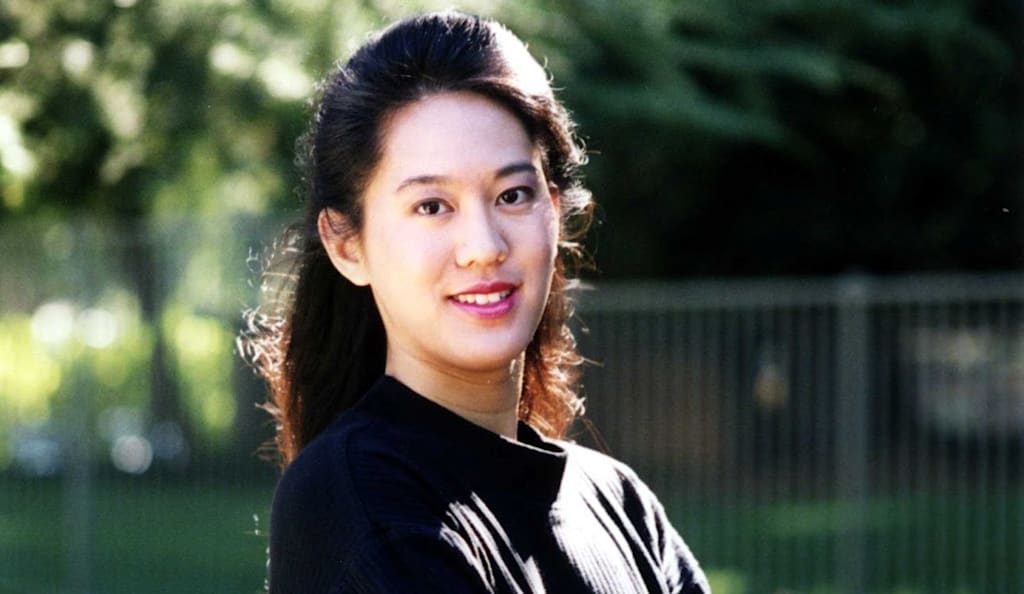
On March 28, 1968, in Princeton, New Jersey, a baby girl was born. Her parents named her Chunru. Her English name was Iris, the iris of the eye. Her mother, Ying-Ying Chang, later said the iris is the most important part of the eye because it helps us see the world. When she said it, she was not thinking about the future.
More than thirty years later, that name would fit in a way no one had planned.
Iris Chang’s father, Shau-Jin Chang, was born in 1937. That year, the Japanese army launched a full-scale invasion of China. Her mother, Ying-Ying Chang, was born in Chongqing in 1940. Her maternal grandfather had taught in Nanjing. When Japanese planes bombed the city, he was there. Before Nanjing fell, he fled to Yixing and survived.
These stories became regular dinner-table material in the Chang household. Ying-Ying Chang said: “While we were growing up, my parents repeated the story of fleeing Nanjing countless times, so we also told this story to our children again and again.”
Little Iris listened. But when she tried to verify the story, she found a hole.
She went to the local public library and searched the shelves. Nothing. She asked her teacher. The teacher had never heard of it. She opened her world history textbook. About what happened in Nanjing in 1937, there was not one word.
For a while, she could not be sure. Was the atrocity her parents described, in a faraway China, solid history? Or was it a distant, exaggerated family legend?
That question stayed with her for more than a decade. She did not ask her parents again. She just remembered the hole.
In 1985, she entered the University of Illinois at Urbana-Champaign. At first she studied mathematics and computer science. She was even elected homecoming queen. Then she switched to journalism. After graduating in 1989, she worked as a reporter for the Associated Press and the Chicago Tribune. Later she earned a master’s degree in writing from Johns Hopkins University and began writing full-time.
In December 1994, she went to Cupertino, California, for a conference commemorating the victims of the Nanjing Massacre. She was 26. She walked in and saw the poster-sized photographs on the wall.
Severed heads. Bodies cut open. Naked women forced by rapists.
She later said the moment caught her off guard. A more accurate description might be this: she stood there, her hands dropped, her bag fell to the floor, someone spoke to her, and she did not hear it.
The stories her parents had told her suddenly had flesh and blood. She also discovered something else. At that time, no book in English was devoted to the Nanjing Massacre. The Western world knew almost nothing about this atrocity on the Asian battlefield of World War II.
She called her mother. On the phone, she explained why she had to write the book. She said: “This is a moral responsibility, and it is the justice the victims deserve.”
In the summer of 1995, she came to Nanjing. She knew no one there. Sun Zhaowei, a researcher at the Institute of History of the Jiangsu Provincial Academy of Social Sciences, was asked to receive her. For nearly a month afterward, Sun Zhaowei and several colleagues took her to sites and mass burial grounds including Yijiang Gate, Zhongshan Wharf, Meitan Port, Caoxie Gorge, Yanziji, and the Eastern Suburbs.
Sun Zhaowei later recalled: “At each place, Iris used the video camera she carried to carefully record the memorials, the nearby scenery, and our explanations. From her heavy expression one could see that these cases of mass slaughter had left deep marks on her soul.”
She also interviewed survivors including Tang Shunshan, Xia Shuqin, Pan Kaiming, Chen Degui, and Li Xiuying. Nanjing’s summer was brutally hot. She worked more than ten hours a day. On the eve of leaving Nanjing, she ran a fever of 38°C. Sun Zhaowei urged her to rest. She shook her head. She insisted on finishing a final interview with him. She recorded it on video, asked someone to translate it section by section, and wrote down every sentence herself. She worked until after ten at night.
That was only the start. For more than two years afterward, she examined archives at the U.S. National Archives, the Yale Divinity School Library, and other places. She collected a large amount of material in Chinese, Japanese, German, and English: unpublished diaries, notes, letters, and original government reports. She even examined the transcripts of the Tokyo war crimes trials and contacted Japanese World War II veterans by letter.
In the special collections room of the Yale Divinity School Library, she found Minnie Vautrin’s diary. Vautrin was an American missionary in China. During the Nanjing Massacre she witnessed the Japanese army’s atrocities at Ginling College and did her utmost to protect Nanjing’s women. Her diary had slept in the special collections for decades. When Iris turned to that page, she stopped. The photocopier hummed in the quiet room. She called her mother and said: “I found it.”
Through the Nanjing Massacre Victims Memorial Association, she also contacted Mrs. Reinhardt, the granddaughter of John Rabe, and helped bring The Diaries of John Rabe to public attention. Rabe was a German Nazi Party member who served as chairman of the Nanking Safety Zone during the massacre. He saved 250,000 Chinese lives from Japanese bayonets. His diary recorded more than 500 atrocities in detail.
The writing itself wore her down. Every day she faced records of beheadings, live burials, burning alive, heart extraction, dismemberment, drowning in cesspools. She often trembled with anger. She had insomnia and nightmares. She lost weight. Her hair fell out. Sometimes the agony was so great she could hardly breathe. She had to get up, move away from the documents, and take a deep breath.
In December 1997, the 29-year-old Iris Chang published The Rape of Nanking: The Forgotten Holocaust of World War II. Within a month, the book entered The New York Times bestseller list and was named one of the year’s most beloved books by readers. Harvard University professor William Kirby called it “the first full-length English-language study of the Nanjing Massacre in human history.” The book-signing tour was planned for two weeks. It stretched to more than a year. Editor Susan Rabiner said: “This is unheard of.”
After the book appeared, Iris Chang quickly became a target for Japanese right-wing forces. She received death threats. Later investigations found that a large share of the attacks were not spontaneous academic criticism. Japan’s Ministry of Foreign Affairs funded and promoted a decade-long smear campaign against Iris Chang and her book. Some articles were sharp, malicious, and personal.
After a lecture at UC Berkeley, an Asian man walked up and said, with a threatening tone, that his group was gathering material to prove everything in her book was a lie. Iris replied calmly that she welcomed any new reliable material. She added: “Seeking the truth is what interests me.” She stressed that she was not trying to smear the Japanese. She believed this was a question of humanity. “Everyone should be vigilant and learn from history.”
In private, the fear was real. She once told a friend that she lived in constant fear. She checked the door locks. She did not answer unknown numbers. In a debate with Japanese Ambassador to the United States Kunihiko Saito, she demanded that Japan honestly acknowledge the historical facts and offer an apology and compensation.
In August 2002, her son Christopher was born. That same year, she published The Chinese in America. On the surface, she was in a highly productive period.
But she was preparing a fourth book. It was about American soldiers captured on Bataan in the Philippines during World War II and imprisoned in Japanese concentration camps. Another history of Japanese atrocities.
In August 2004, during a research trip, Iris Chang suffered a physical and mental breakdown. She had to be hospitalized. She was diagnosed with severe depression. After five months in the hospital, she was discharged and taken back to her home in San Jose to continue medication.
Her editor said that about half a year earlier, she had suddenly become depressed and low, for unknown reasons. But from The Rape of Nanking to the history of abused American POWs she was preparing to write, what she had investigated for years were all extremely cruel and bloody historical facts. Scholars of intergenerational trauma have argued that as a second-generation descendant of Nanjing Massacre survivors, Iris Chang inherited traumatic memories of the massacre and the war from the previous generation. Between that inherited trauma and her writing there is a hidden danger: the work can replace personal narrative, lead to countertransference, and damage the writer’s mental health.
On November 9, 2004, Iris Chang ended her life with a handgun in her car in Los Gatos, California. She was 36.
She left a suicide note. In her last words to her family, she said she hoped to be remembered as she was before her illness: “fully engaged in life, devoted to her career, writing, and family.” In another passage, she wrote: “When you believe you have a future, you think in terms of years, one after another, generation after generation; when you do not believe, days are counted not by days, but by minutes. I am doing this because I am too weak to endure the painful and troubled years ahead. Every breath becomes harder... as if drowning in a vast ocean.”
After her death, the note was made public. What she left for her son, where her husband was that day: these details were not widely reported. What people remember is that line: “Please believe in the power of one person. One person can bring enormous change to the world.”
The Rape of Nanking was translated into 17 languages. In 1999, the book was adapted into a special program for the History Channel. In 2007, the documentary Iris Chang: The Rape of Nanking premiered in many places. The independent documentary Nanking was also based on her work and dedicated to her. In 2025, Jiangsu Broadcasting Corporation released the 4K documentary In Search of Iris Chang. It disclosed for the first time household registration archives from Iris Chang’s mother’s family and the magazines she founded as a teenager, Maverick and Eye-Opener.
In Huai’an, Jiangsu, China, the small city in northern Jiangsu where her ancestors lived, the Iris Chang Memorial Hall opened on April 7, 2017. In San Jose, California, there is a park named after her. Inside the Memorial Hall of the Victims in Nanjing Massacre by Japanese Invaders, her parents unveiled a sculpture in her honor.
The University of Illinois established the Iris Chang Scholarship Fund to support students who want to study abroad in Nanjing. Nanjing Normal University established the Iris Chang Memorial Scholarship. In 2006, the Global Alliance for Preserving the History of WWII in Asia and Iris Chang’s parents jointly established the Iris Chang Memorial Fund. In 2026, the School of International Relations at Nanjing University unveiled the Iris Chang International Peace Research Center. Golden Eagle International Group donated 5 million yuan to establish the Iris Chang International Peace Fund, along with special scholarships and teaching awards.
The Iris Chang Memorial Hall never had many visitors. Staff member Liu Hui admitted that in the first few years after opening, “the number of visitors each day could be counted on one’s fingers.” Then, in the summer of 2025, the film Nanjing Photo Studio was released. At a film festival, director Shen Ao thanked someone: “I want to especially thank one person, Ms. Iris Chang, who wrote the book The Rape of Nanking. Much of our inspiration and many of our materials were based on your stroke-by-stroke depiction.” That summer, more than three thousand people poured into the memorial hall each day.
After the heat faded, the memorial hall returned to quiet. The book remains. The truth remains. The diaries she rescued from the dust of Yale’s special collections remain. The voices of the survivors she recorded one by one remain.
Iris Chang’s life lasted only 36 years. When she wrote The Rape of Nanking, she was in her twenties. She spent three years dragging herself into the darkest abyss of humanity, wrote a book, and then continued toward the next abyss until she could walk no more.
She did not write a memoir. She left no complete explanation of herself. What remains is the work, the diaries, the interviews, and the fact that she carried them until she could not.
About the Creator
Jin
Writer of reamstories
https://reamstories.com/jin
Enjoyed the story? Support the Creator.
Subscribe for free to receive all their stories in your feed. You could also become a paid subscriber, letting them know you appreciate their work.
Comments
There are no comments for this story
Be the first to respond and start the conversation.