
She Lives in a 27-Story Mansion. She Still Doesn’t Own the Crown Jewels.
Nita Ambani’s marriage shows the line between access and ownership, and why the most expensive things in a billionaire’s life often come with strings attached.
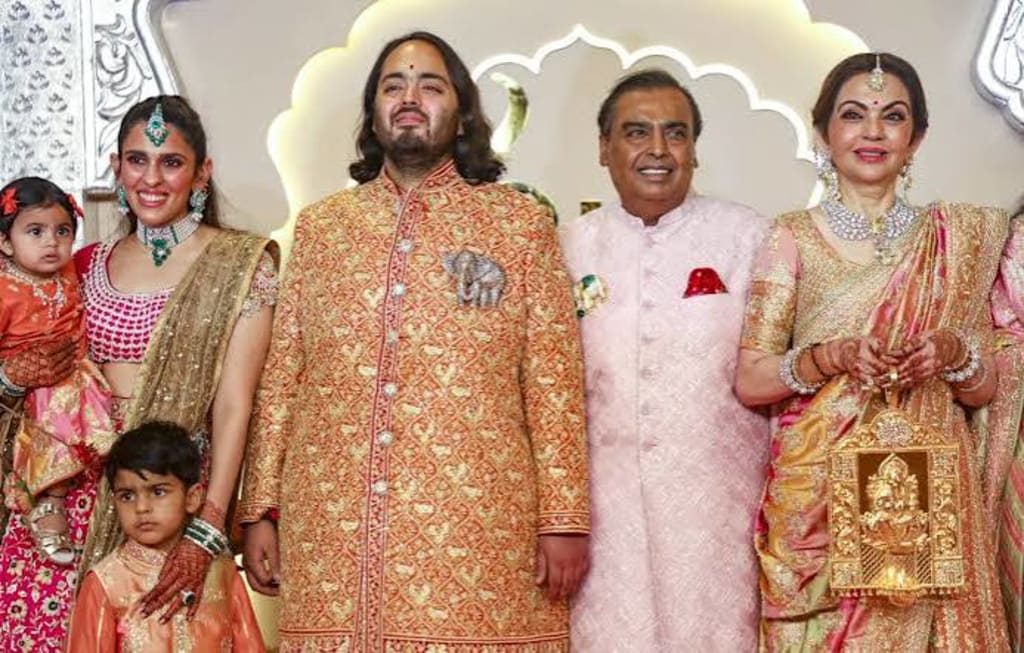
Nita Ambani is often written as the template of “an ordinary kindergarten teacher who married the richest man.” The photos show complete sets of emerald jewelry, a 27-story mansion, and the respectful gaze of her billionaire husband. The comments fill with “what a lucky life.”
Pull the camera back, and another structure appears. The jewelry she wears, the house she lives in, the team she uses, and the things held in her own hands are not the same thing.
1. She Is Not Cinderella
Online articles like to write “a girl from an ordinary family married into wealth through dance.” That story leaves out key background.
According to public information, Nita came from an Indian middle-class family, received a good education, trained as a Bharatanatyam dancer, and worked as a teacher before marriage. She was not from the bottom of society. She was not “someone with nothing who was chosen only for her beauty.” She already had family background, education, artistic training, and a profession.
This does not make her a commoner who beat the odds. She was an elite woman with strong credentials who entered a higher capital circle through marriage.
The Ambani family belongs to the merchant caste. Its wealth is enormous, but in India’s traditional social prestige system, wealth does not automatically equal cultural legitimacy. Marrying Nita, who was born a Brahmin, was not just taking a daughter-in-law. For the family, it was an investment in social capital: raising traditional prestige and giving future generations a maternal bloodline endorsement.
The marriage was not a simple romantic encounter. Family screening, social capital exchange, and two-way value matching were all inside it. Love may have existed, but it is not the only explanation.
2. Jewelry Comes in Three Kinds, with Different Rights
In photos, Nita often wears complete sets of emeralds, diamonds, and nine-gem necklaces. The media gives valuations in the hundreds of millions, and readers assume “what the husband gives her is all hers.”
High-society jewelry must be divided by rights.
The first kind is jewelry in her own name. Under the concept of “Streedhan” in Hindu law, a woman’s pre-marital property, dowry, and some assets given by her husband may legally belong to the woman personally. In theory, this part has a personal character and can be fought for in a divorce.
The second kind is family-shared or heirloom jewelry. It may belong to the family vault, a family trust, or a generational collection. The matriarch has priority wearing rights, display rights, and custody rights, but not the right to sell, transfer, or mortgage it independently. In a divorce, this part cannot be taken away.
The third kind is assets held by a company or trust. If jewelry is held under a company or trust name, it does not count as personal property. It is part of an asset allocation.
“Can wear” and “can sell” are two different things. The more dazzling the jewelry in the photos, the more likely it is a tool for the family’s public image. When the matriarch wears it to weddings, red carpets, and religious ceremonies, she shows the family’s financial strength to the outside world. The heavier the jewelry, the stronger the advertising effect.
The visible splendor is real. It is not necessarily an asset she can turn into cash.
3. The Mansion and the 600-Person Team Are Also Status Benefits
Antilia is a landmark private residence in Mumbai: 27 stories, with a garage, theater, snow room, and sky garden. The internet says “600 servants specifically serve Nita.”
A more reasonable reading: these 600 people are the operations and maintenance team for the entire mansion and family affairs, covering security, repairs, landscaping, catering, and administration. They are not her personal attendant team.
The mansion’s ownership usually belongs to the family or a corporate system. It is not the matriarch’s private property, free for her to sell, transfer, or divide. She can live in it. She cannot sell it.
High-society life works this way: the enjoyment is real, the top-tier configuration is real, the dignity is real. So is the fact that it cannot be sold, transferred, or privatized and taken away. As long as the marriage continues and her status is stable, this life remains valid. If her status changes, the right of use is withdrawn.
4. What She Does, and What She Cannot Do
Many people like to say Nita is the “hidden operator behind the Ambani family.” This reverses her actual position.
She has done many things. She heads the Reliance Foundation, works in education, charity, and cultural communication, obtained a seat as an IOC member, helped the family shed the “nouveau riche” label, and improved public goodwill. During family infighting, she also played a role in stabilizing the external image.
These contributions mainly fall at the level of soft power.
The core businesses, equity structure, voting rights, trust architecture, and inheritance arrangements of Reliance Group rest with Mukesh and his direct heirs. Nita can enter the board, attend meetings, offer suggestions, and represent the family externally. Decisions such as equity changes, corporate acquisitions, and trust amendments are not in her hands.
A concrete contrast: she can decide which school or which women’s program the foundation funds. She cannot decide how the equity of Reliance’s telecom division is allocated. She can represent the family at international occasions. She cannot modify the beneficiary list of the family trust.
The family gives her high courtesy and a strong public role. The system keeps ownership and inheritance rights outside her reach.
5. After She Became a Mother-in-Law
Nita endured fertility pressure in her early years, experienced public scrutiny, and had to subordinate her personal emotions to the family’s image. She understands the identity boundaries of an incoming daughter-in-law.
After becoming a mother-in-law, she used the standards of that time to examine the next daughter-in-law: background, caste, image, propriety, and value to the family. This is not simple harshness. It is generational replication after being in the system for a long time.
She maintains this order because her status, reputation, and way of life are tied to it. She does not want to break it, and she has no sufficiently safe exit mechanism.
This is the hidden dilemma of women who marry up: the suffering you have endured makes you understand the rules better. Understanding the rules too well makes you a guardian of the rules.
6. What Ordinary People Should Take Away Is Not Envy
Nita’s story is not “how great it is to marry into a wealthy family.” It is also not “women can only cross classes through marriage.” The second claim is wrong. It describes only a certain type of top-tier marriage and does not apply to everyone.
What is useful is a set of rights questions:
First, distinguish between the right of use and ownership. The house someone lets you live in, the car you drive, the jewelry you wear, the team you use, however top-tier, may still be status benefits.
Second, distinguish between income rights and control rights. Having dividends, living expenses, and public exposure does not equal having voting rights, disposal rights, and inheritance rights.
Third, distinguish between platform capability and personal capability. You can use a platform to accomplish things, but you must settle your abilities, reputation, works, and networks into transferable capital.
Fourth, distinguish between face and leverage. Only things that are in your own name, can be disposed of independently, and still stand after leaving any relationship are leverage.
Conclusion
Nita Ambani is not Cinderella. She is not simply a victim of a wealthy family. She is a highly capable elite woman who gained a huge platform through a top-tier marriage and paid a corresponding price. She enjoyed the top-tier right of use in a wealthy family. She did not touch the family’s core ownership.
In her story, the splendor is real. The dignity is real. The glitter is real. The fragility of possibly being withdrawn at any time is equally real.
Do not mistake someone else’s right of use for your own strength. Do not mistake the glitter bestowed by a circle as wealth you will own for life.
What is given by others, and what you have yourself. What can be enjoyed, and what no one can take away. These two pairs of words are worth remembering separately.
About the Creator
Jin
Writer of reamstories
https://reamstories.com/jin
Enjoyed the story? Support the Creator.
Subscribe for free to receive all their stories in your feed. You could also become a paid subscriber, letting them know you appreciate their work.
Comments
There are no comments for this story
Be the first to respond and start the conversation.