
Saturation Divers: The Elite Profession Where One Mistake Can Cost a Life
How saturation divers live for weeks under pressure, work on the seabed, and depend on machines, gas mixtures, and strict procedures to survive.
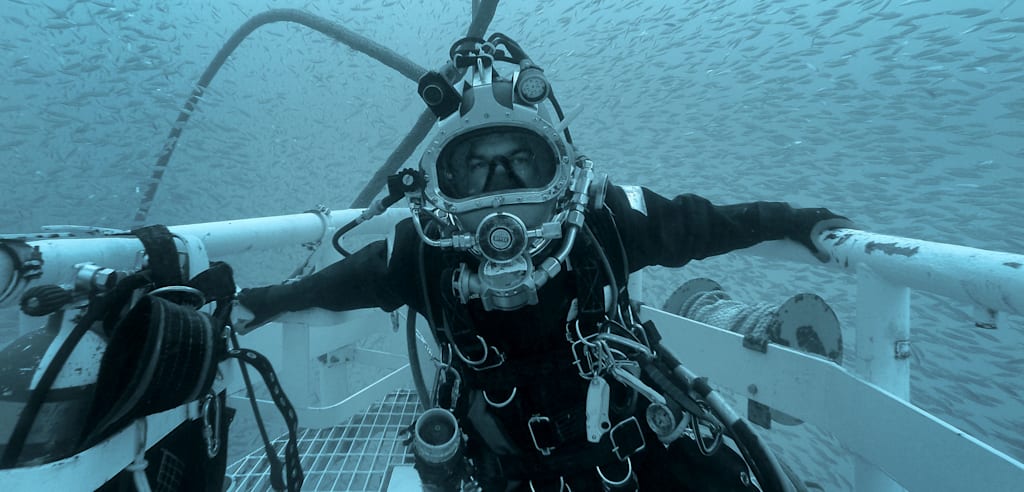
Saturation divers have one of the hardest and strangest jobs in the world. These people spend weeks living in a sealed chamber under pressure, as if they were deep underwater, even though the chamber itself stands on a vessel. Every day they are sent to the seabed in a diving bell: to repair pipelines, service oil platforms, and work in places where an ordinary diver could not last. They breathe a special gas mixture, speak in “cartoon” voices because of helium, freeze even in protective suits, and cannot simply open a door and step outside. Their work is life under a different set of physics, where one mistake can cost a life.
Why you cannot simply dive and work all day
The main problem of depth is pressure. The deeper a person descends, the more strongly the water presses on the body. Because of this, gases from the breathing mixture dissolve in the blood and tissues. If a diver comes up too quickly, those gases begin to come out as bubbles. That is how decompression sickness, or “the bends,” occurs.
It can lead to: severe joint pain; damage to the nervous system; paralysis; loss of consciousness; death.
That is why, after a deep dive, a diver cannot simply surface. The pressure has to be reduced slowly, so the body has time to remove the excess gas safely. For short work, this is still possible: the diver descends, performs the task, comes back up, and goes through decompression. But at great depths, everything becomes more complicated. A diver can work only briefly, while the return can take hours. That is exactly why saturation diving was developed.
What saturation diving is
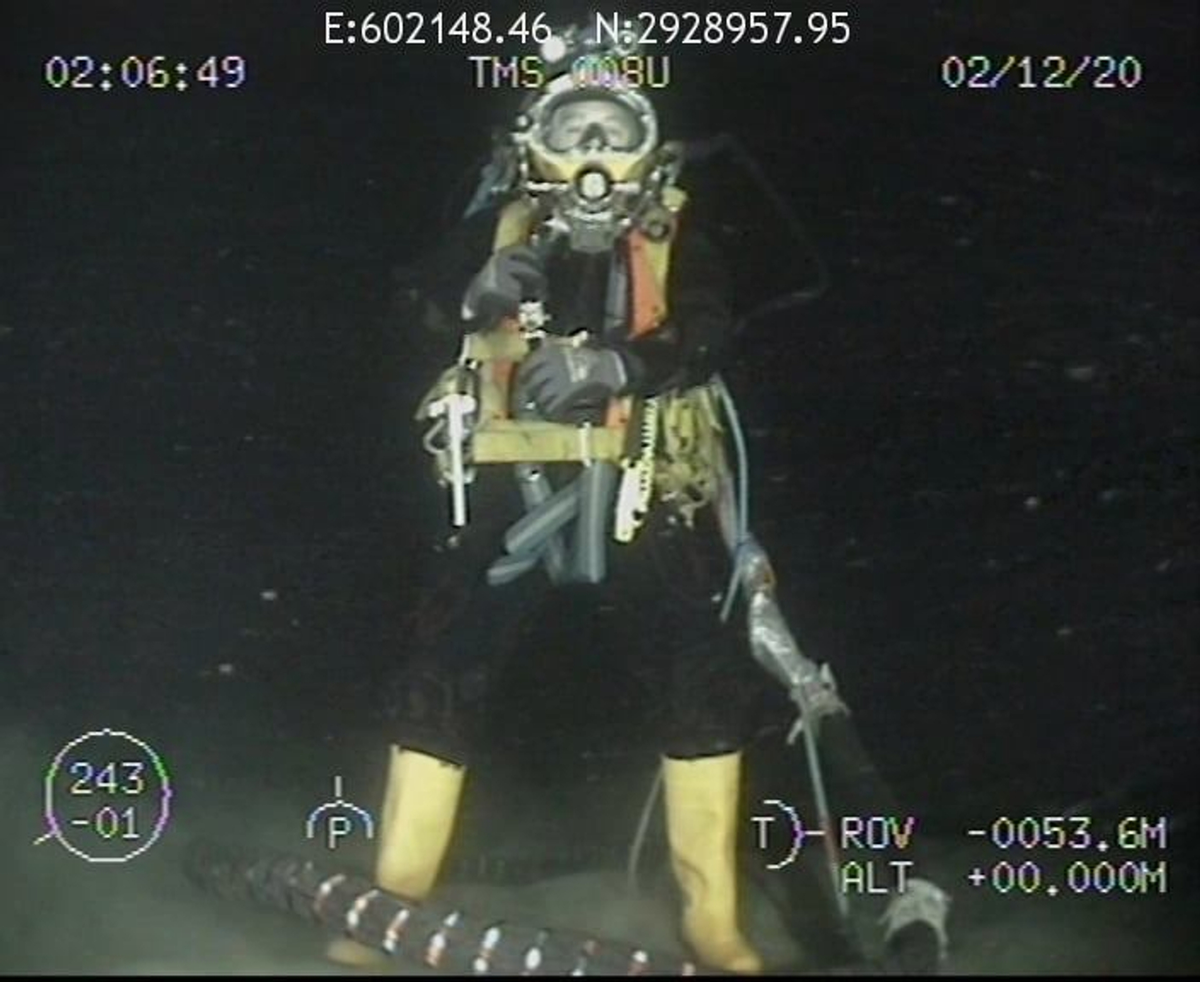
The point of saturation diving is not to bring the diver back to surface pressure after every underwater shift. At depth, gases from the breathing mixture gradually dissolve in the blood and tissues. After a certain time, the body is already “saturated”: it takes in almost no more gas. That means if a person stays under the same pressure for another day or another week, the decompression time does not increase dramatically.
So divers are kept at working pressure for several weeks at a time. They live in a pressure chamber on the vessel, go down to the seabed each day through a diving bell, work for several hours, and return to the chamber rather than to the surface.
Only at the end of the entire shift does the pressure begin to be reduced slowly. That is decompression. It can last several days.
This way, divers go through one long decompression at the end of the job, instead of a painful decompression after every descent.
Where they live
A modern saturation diver lives in a chamber complex on a vessel.
It is a sealed system of chambers. Inside, there is everything essential: bunks; a small common area; a shower; a toilet; a food transfer system; communication with the outside team; equipment for monitoring pressure and gases.
But it is hard to call this comfortable.
There is little space. Almost no privacy. Several people live side by side for weeks, sleep near each other, eat near each other, and wait for their next shift.
Food is passed through a small lock. A normal door to the outside cannot be opened: outside there is normal pressure, while inside there is working pressure. A sudden exit would kill a person.
In terms of feeling, it is less like the life of a sailor and more like the life of a space station crew. Only instead of space, there is the sea, metal, pressure, and cold.
They are constantly monitored
While the divers are inside the chamber, a separate team works outside. Life-support technicians are especially important. They monitor the things without which the people inside simply could not survive: pressure; oxygen; carbon dioxide; temperature; humidity; the breathing mixture; sanitary systems; food and water supply.
Any mistake — too much carbon dioxide, the wrong pressure, a failure in oxygen supply — can be fatal. That is why the work of life-support technicians resembles the work of spaceflight controllers. Only instead of a spacecraft, they are responsible for a metal chamber with people inside who cannot step out.
How they get to the seabed
Divers are transported to the worksite in a diving bell.
It docks with the living chamber. The pressure inside is the same. The divers transfer into the bell, it is detached, and then lowered into the sea.
Usually, a team of three works together: two divers go outside; one remains in the bell; he watches the others and is ready to help in an emergency.
Underwater, a saturation diver is not free like a scuba diver. His life depends on an umbilical — a thick bundle of hoses and cables.
Through it come: the breathing mixture; communications; hot water for heating; sometimes video; safety lines; power for equipment.
If this umbilical becomes tangled, breaks, or stops working, the situation immediately becomes dangerous.
That is why depth and darkness are not the only frightening things. Loss of communication, failure of gas supply, damage to hoses, and failure of hot water are frightening too.
Why they sound like Donald Duck
At great depth, a person cannot breathe ordinary air. Nitrogen under pressure causes nitrogen narcosis. This condition resembles intoxication: a person loses concentration, thinks less clearly, and may make dangerous decisions. Oxygen also becomes dangerous if its pressure is too high. That is why saturation divers breathe a special mixture, most often helium and oxygen.
Helium helps avoid nitrogen narcosis. But it has a funny side effect: it changes the voice.
The voice becomes high, thin, and almost cartoon-like. Without a special speech processor, it can be difficult to understand what the diver is saying.
Why they are always cold
Helium does not only change the voice. It also removes heat very quickly.
A person loses heat through breathing and through the body. That is why the chamber is kept unusually warm.
Underwater, divers wear hot-water suits.
This is not comfort. It is survival.
Hot water is supplied through hoses and circulates inside the suit. If the heating system fails, the work may be stopped.
On the surface, a hot-water failure is an inconvenience. At depth, it is a threat to life.
Where the depth limit is
Helium solves one problem, but not all of them. At great depths, a person can develop high-pressure nervous syndrome. This condition affects the nervous system.
Possible symptoms include: tremors; muscle twitching; drowsiness; worsened concentration; coordination problems; strange changes in mood.
In other words, the body begins to struggle not only with gas, but with depth itself.
To go even deeper, scientists experimented with other mixtures, including hydrogen.
The French company COMEX carried out extreme experiments. In 1988, divers worked at depths greater than 530 meters. In 1992, an equivalent depth of 701 meters was simulated in a pressure chamber.
But these are records and experiments. In ordinary industrial work, such depths lie at the very edge of human capability.
Why they cannot simply evacuate
The most frightening detail of the profession is the impossibility of leaving quickly. If there is a fire, an accident, or a threat of sinking on the vessel, saturation divers cannot simply run out onto the deck. They are under pressure. A sudden exit to normal pressure can kill them.
For such situations, there are hyperbaric rescue lifeboats. These are not ordinary lifeboats, but sealed chambers that preserve pressure.
Divers can be evacuated without being brought out of saturation. Only later can they be taken to a safe place and decompressed. Even rescue happens under pressure.
The most terrible accident
One of the best-known disasters occurred on November 5, 1983, on the Byford Dolphin drilling rig in the North Sea. The divers were in a chamber system under pressure of about 9 atmospheres. Because of an error, the connection to the outside atmosphere opened too early.
The pressure dropped almost instantly from 9 atmospheres to 1. It was an explosive decompression.
The gases dissolved in the blood and tissues had no time to escape safely. Four divers died immediately. One member of the support crew also died, and another was seriously injured. This accident became one of the most terrifying reminders that, in saturation diving, a mistake can last a fraction of a second while the consequences are irreversible.
After such disasters, safety systems became stricter. Modern equipment is supposed to prevent locks from opening until the pressure is equalized. But the risk in this profession has not disappeared.
How long such a shift lasts
A saturation diver’s shift can last several weeks.
Usually it looks like this: several people live in the chamber; each day part of the team goes to work through the bell; after the shift they return to the chamber; the others rest, sleep, eat, and wait for their turn; at the end of the whole operation, decompression begins.
Decompression can last several days. After very deep work, even longer.
Psychologically, this is a difficult stage. The work is already finished, the dangerous part seems to be behind them, but the person is still locked inside the chamber and cannot leave.
All they can do is wait while the pressure slowly returns to normal.
Why this work is so hard
The danger is not only in the depth.
The main difficulties are different: isolation for weeks; no personal space; constant equipment noise; life with the same people; impossibility of going outside; dependence on technology and the outside team; the risk of an accident from which quick evacuation is impossible.
Psychologically, it is extremely difficult work.
You may be on a ship, but still be cut off from the normal world. Between you and the surface are pressure, metal, and long days of decompression.
Why people still choose this profession
Because it is rare work at the edge of human capability.
Saturation divers do what almost no one sees: they repair underwater pipelines; service oil and gas platforms; install equipment; inspect structures; fix emergencies at depth.
This is not romantic scuba diving. It is hard industrial labor: cold, metal, tools, poor visibility, strict procedures, and constant monitoring.
But there is a special sense of the limit in it.
A saturation diver lives where humans are not supposed to live. He breathes an artificial mixture, speaks with an altered voice, goes to the seabed through a steel bell, and trusts his life to hoses, sensors, and the people above.
For most people, the phrase “going home after work” means a trip back to an apartment.
For a saturation diver, it can mean several days of slowly returning to normal pressure.
They do not simply dive deep.
They temporarily move into another kind of physics — and return from it only when the body can live on the surface again.
About the Creator
Enjoyed the story? Support the Creator.
Subscribe for free to receive all their stories in your feed.
Comments
There are no comments for this story
Be the first to respond and start the conversation.