
Satellite Communications Market: The Invisible Network Connecting the World
How satellites quietly power global communication, navigation, and digital connectivity
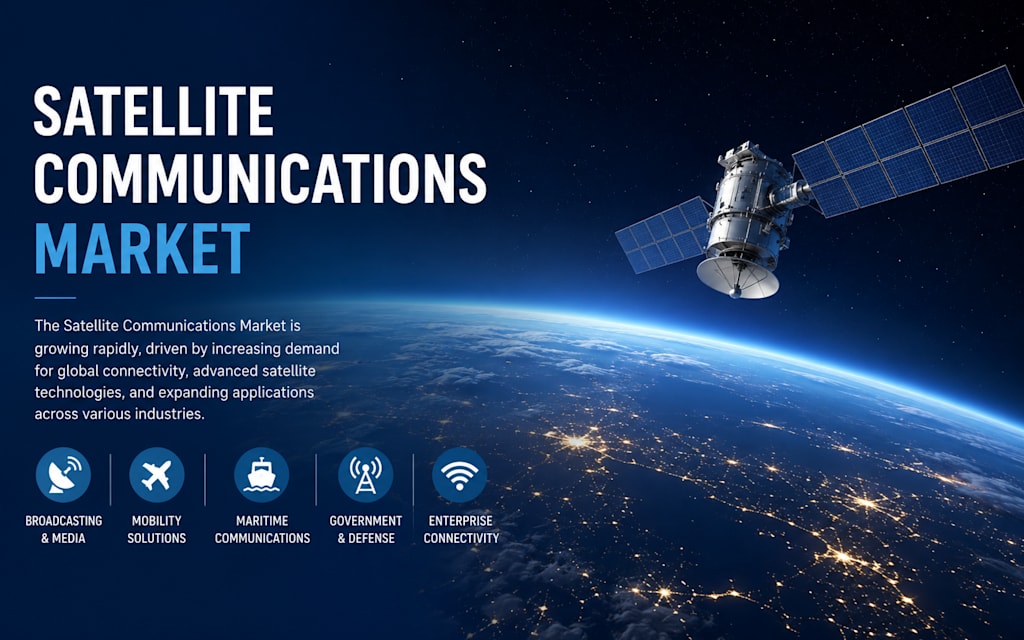
A phone call reaches a remote island in seconds. A cargo ship in the middle of the ocean receives weather updates instantly. Emergency responders reconnect communication lines after a natural disaster. Most people never see the technology behind these moments, yet satellites make them possible every single day.
Communication no longer depends only on cables and cell towers. Orbiting high above Earth, satellites form an invisible web that supports navigation, broadcasting, internet access, defense operations, and global connectivity. At the center of this transformation is the Satellite Communications Market, where space technology and digital infrastructure are becoming deeply interconnected.
Why Satellite Communications Matter More Than Ever
Modern life depends on uninterrupted connectivity. Businesses, governments, airlines, shipping fleets, and remote communities all require communication systems that operate beyond the limits of terrestrial infrastructure.
Satellite communication systems provide wide coverage, resilience during emergencies, and access to regions where traditional networks remain limited. They are essential for aviation tracking, maritime operations, military coordination, remote education, and disaster recovery.
According to Mordor Intelligence, the Satellite Communications Market is projected to grow steadily during the forecast period as global demand for broadband access, secure communication, and real time data transmission continues to rise.
Understanding Satellite Communications Market Size and Share
The Satellite Communications Market size is driven by rising demand for data intensive applications and global connectivity services. Communication satellites support television broadcasting, internet backhaul, navigation systems, and enterprise networking across industries.
The Satellite Communications Market share is influenced by investments in low Earth orbit satellite constellations, government space programs, and expanding commercial satellite services. Demand spans both civilian and defense sectors, making the market highly diversified.
North America remains a major contributor due to strong aerospace investments and established satellite operators. Asia Pacific is emerging rapidly as countries expand digital infrastructure and satellite based communication services across rural and underserved regions.
These regional developments continue to strengthen the role of satellites in global communication ecosystems.
Satellite Communications Market Trends Reshaping Connectivity
Several Satellite Communications Market trends are transforming how global communication systems operate.
One major trend is the expansion of low Earth orbit satellite networks designed to reduce latency and improve broadband speeds. These constellations aim to deliver internet access to remote and underserved locations worldwide.
Another trend is the integration of satellite systems with 5G infrastructure. Hybrid networks combining terrestrial and satellite communication are improving coverage reliability and supporting connected devices across industries.
Miniaturization is also accelerating deployment. Smaller satellites reduce launch costs and allow operators to expand networks more efficiently.
Artificial intelligence and advanced analytics are improving signal optimization, predictive maintenance, and bandwidth management, helping operators maximize efficiency.
Together, these innovations reflect a broader Satellite Communications Market analysis focused on scalability, resilience, and real time global connectivity.
Challenges Facing the Industry
Despite strong momentum, the industry faces several challenges. Launch costs, orbital congestion, and spectrum allocation remain major concerns for operators and regulators.
Cybersecurity is another growing issue. As communication networks become increasingly connected, protecting satellite infrastructure from interference and cyber threats becomes critical.
Weather conditions and signal disruptions can also impact service quality, particularly in sensitive applications such as aviation and defense communications.
To address these challenges, companies continue investing in advanced encryption, network redundancy, and more efficient satellite architectures.
Satellite Communications Market Forecast and the Future Ahead
The Satellite Communications Market forecast points toward continued expansion as connectivity becomes a global necessity rather than a luxury. Remote work, digital education, autonomous systems, and connected infrastructure will all rely on stronger and more resilient communication networks.
Future satellite systems are expected to deliver faster speeds, lower latency, and deeper integration with cloud computing and IoT ecosystems. As demand for seamless global communication grows, satellites will remain essential to bridging digital divides and supporting real time information exchange.
The future of communication is not only on the ground. Increasingly, it is orbiting above us.
About the Creator
Enjoyed the story? Support the Creator.
Subscribe for free to receive all their stories in your feed.
Comments
There are no comments for this story
Be the first to respond and start the conversation.