
Sam Altman Didn’t Sleep for Two Nights. Here’s What That Actually Tells Us.
A leaked podcast moment, a funding round on the ropes, and the quiet shift in how AI sells itself.
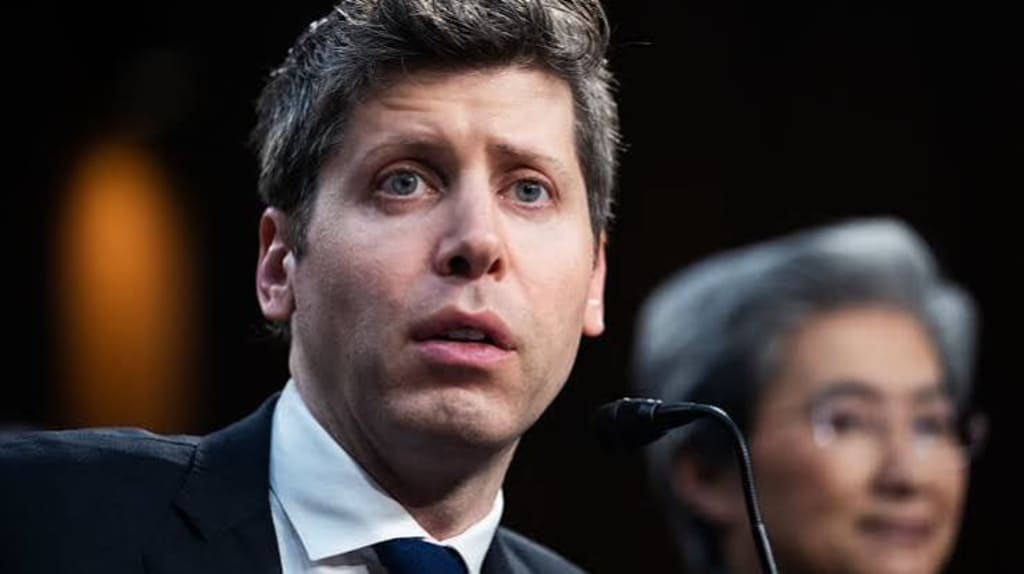
Sam Altman said a new internal OpenAI model kept him up for two nights. The line spread fast. It’s short, visual, emotional, and it came from the CEO. Readers don’t need benchmarks or peer review to fill in the conclusion: this model must be absurdly powerful.
The podcast story is dramatic enough. OpenAI set up an internal test channel called “Hold-my-beer” — meaning “hold my beer, I’m about to do something crazy.” Researchers threw their hardest unsolved problems at the new model. It knocked them down one after another, across multiple disciplines, including the Navier–Stokes equations. Altman said the team went through a “collective shock.”
Insomnia here becomes a metaphor: the capability is so strong it keeps people awake. Emotion becomes a stand-in for evidence. What readers remember is “Altman didn’t sleep for two nights,” not “how this result was produced, whether it can be reproduced, whether it has been independently verified.” So the first move is to take “insomnia” down from the position of a technical conclusion and put it back where it belongs: a carefully chosen narrative symbol.
The fuller picture is in the details. According to reports, the result that shocked the team was not a single model having a solitary flash of insight and solving the Navier–Stokes equations. A closer description: OpenAI used roughly 10,000 AI agents working together to complete the relevant proof in 88 hours, then used GPT-6 Astra to spend 17 hours completing Lean formal verification, at a compute cost in the tens of millions of dollars.
The leap was less about a single model’s reasoning ability than about engineering coordination: combining massive compute, multiple agents, and long-running parallel inference into a pipeline capable of producing academic-grade results. Altman steered the conversation toward “an army of agents with millions of dollars in compute,” “robots making chips and photovoltaics,” and “data centers replicating themselves.” What excited him underneath was a system crossing a threshold at scale. The fans in the server room did not stop; tasks were still queuing in the channel.
This path matters. It shows AI’s role in research moving from “assistive tool” toward “industrial production of results.” But the impact comes from the system, not from the magic of a single point of intelligence. Reducing this to “the new model is too strong” misses the critical information: this path is extremely expensive, extremely dependent on compute organization, and extremely dependent on verification.
The result itself is not without controversy. Tristan Buckmaster, a professor at New York University, publicly questioned it. He said he and an Anthropic researcher had previously obtained results in a similar direction, and he suspected whether OpenAI’s model had been exposed to relevant research session data. OpenAI’s response: it “cannot completely rule out that relevant product data may have participated in training in some way.” The breakthrough also did not provide a complete proof that outsiders could independently examine. It still awaits verification. None of this denies the value of the result. It pulls the “excited to insomnia” narrative back to a more modest level: a frontier demonstration built with enormous resources, carrying controversy and a verification gap. Calling it an independently reproducible scientific conclusion would be premature. Calling it pure PR would miss a genuinely advancing engineering path.
If insomnia is understood only as “shock at how powerful the capability is,” then the other half of Altman’s answer is lost. On the podcast he said that on one side he felt excitement and happiness, and on the other more sadness, melancholy, and a sense that “something is ending.” His interlocutor, Patrick Collison, used a metaphor: in 1950s Ireland, a plow horse watching a tractor drive into the field.
That metaphor shifts the “AI solves scientific problems” narrative from a capability display to a replacement narrative. Altman respects the spirit of mathematicians who “spend a lifetime on one Millennium Prize problem.” He also acknowledges that the era of “the human brain thinking hard for ten years to sharpen one sword” in research is being replaced by a compute pipeline. Insomnia can therefore be read as the interweaving of two emotions: shock at the boundary of the system’s capability, and clarity about what that capability means wherever it passes. Half a glass of dark beer is still on the table; the condensation runs down the glass.
Look only at the podcast and it’s easy to miss the capital situation OpenAI was in. Around this interview, OpenAI was pushing a huge financing round. Its valuation target was cut from $1.4 trillion to $1.25 trillion. Its financing target was cut from $30 billion to about $20 billion. The reasons included a sell-off in AI-related stocks and the diversion of investor attention by competitor Anthropic’s upcoming IPO. Anthropic’s own IPO valuation expectation was also cut from about $2 trillion to about $1.5 trillion.
At this point in time, an internal model story about “the CEO not sleeping for two nights” objectively serves to inject narrative fuel into a financing window. This does not mean the story is false. It reminds us that Altman’s public statements are never only a record of personal feeling; they are also signals released within a particular capital rhythm. Someone on Zhihu speculated that “insomnia is caused by anxiety, which means the model is getting worse.” That speculation is not entirely unreasonable at the level of motive. But attributing insomnia solely to “the model is not good enough” ignores the two threads that also run through the interview: the “sense of an ending” and the “qualitative change in the compute system.” Financing documents are spread on the table; the page corners are curled.
The most honest reading of this affair may be to refuse the either-or.
It does not directly equal “OpenAI has pulled out a crushing new model.” A more accurate description: OpenAI has demonstrated a path for industrially producing research results with massive numbers of agents and compute. Its impact comes from system scale and organization; the magic of a single point of intelligence cannot explain it. At the same time, this path comes with verification controversy, data-contamination doubts, and an extremely high cost threshold.
It also does not directly equal “Altman is pure bluffing and the model is getting worse.” The “excited to insomnia” narrative does contain real engineering progress and quantifiable compute investment. But “insomnia” itself is a carefully chosen narrative symbol. It carries excitement, farewell, and the urgency of a financing window at the same time. It should not be consumed as an objective indicator of a leap in model capability.
As for “injecting a shot of adrenaline into the industry and getting the stock price up” — this is exactly where the current AI narrative is most fragile. When technical disclosure increasingly relies on the CEO’s personal emotions to transmit, what deserves attention is not how many nights he slept, but whether that “Hold-my-beer” system, outside the podcast, can produce something that withstands independent verification.
The podcast ends. The channel name is still in the internal system. The verification materials have not been made public. The financing documents are still on the table. Melatonin can treat insomnia; it cannot treat valuation anxiety.
About the Creator
Jin
Writer of reamstories
https://reamstories.com/jin
Enjoyed the story? Support the Creator.
Subscribe for free to receive all their stories in your feed. You could also become a paid subscriber, letting them know you appreciate their work.
Comments
There are no comments for this story
Be the first to respond and start the conversation.