
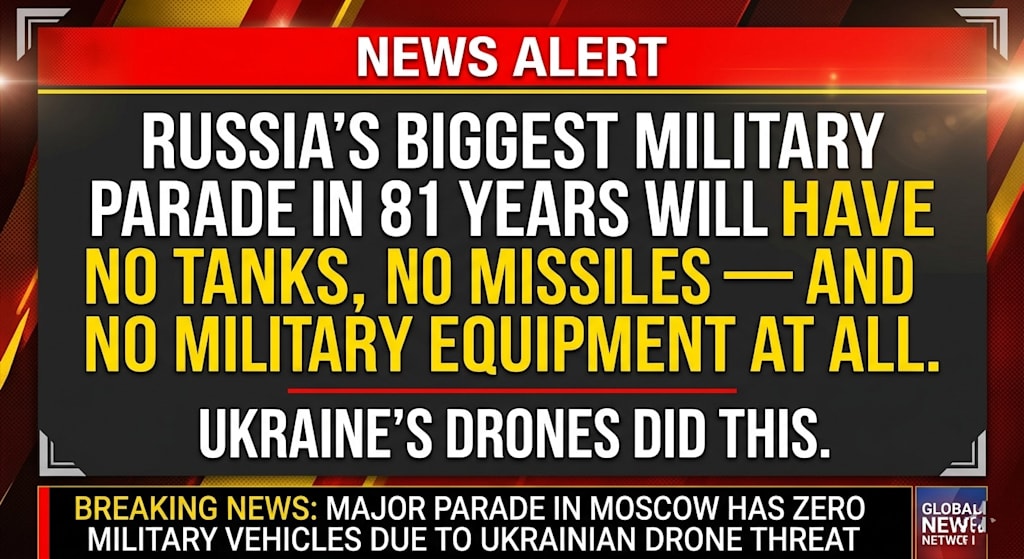
Russia's Biggest Military Parade in 81 Years Will Have No Tanks, No Missiles — and No Military Equipment at All. Ukraine's Drones Did This.
For the first time in nearly two decades, Moscow's Victory Day parade on May 9 will display no heavy military hardware. Russia says it's for security reasons. Ukraine says it's because they're scared. The stripped-down parade tells the real story of this war more clearly than any battlefield map.
Every year since the early 2000s, Russia's Victory Day parade on May 9 has been among the most choreographed displays of military power on earth. Columns of T-90 and T-72 tanks roll across Red Square's cobblestones. Intercontinental ballistic missile launchers — Yars ICBMs capable of carrying multiple nuclear warheads — lumber through the gates of the Kremlin. S-400 air defence systems and Iskander ballistic missile complexes trundle past the reviewing stand where Vladimir Putin watches in immaculate military dress. Fighter jets and strategic bombers carve formation passes overhead. The world watches. The message is unmistakable: Russia is powerful, Russia is armed, Russia cannot be threatened.
This year, that message cannot be sent. Russia's Defence Ministry confirmed last week that the 2026 Victory Day parade — marking the 81st anniversary of the Soviet Union's victory over Nazi Germany — will proceed with no tanks, no missiles, no armoured vehicles, and no heavy military equipment of any kind. The official explanation cites security concerns, given Ukraine's increasingly sophisticated long-range drone capabilities. The informal explanation, offered by Kremlin-connected officials and Russian military analysts, is the same: the risk of a Ukrainian drone strike on the parade column, on Red Square itself, or on the reviewing stand where Putin and foreign dignitaries stand is assessed as too high to accept. So the weapons stay home.
"They cannot afford military equipment — and they fear drones may buzz over Red Square. This is telling. It shows they are not strong now." — President Zelensky, May 5, 2026
Ukrainian President Zelensky, who has spent over four years being told that Ukraine is outgunned, outmanned, and ultimately outmatched by Russia's military machine, did not let the moment pass without comment. Speaking at the European Political Community summit in Yerevan, Armenia, he drew the global audience's attention to the parade decision with characteristic precision: Russia's decision not to display military equipment at its own Victory Day celebration is, he argued, the clearest possible evidence of the war's real trajectory. Russia is not the invincible military superpower it has spent twenty years projecting itself to be. It is a state that cannot safely parade its own weapons 1,200 kilometres from the front line.
The drone threat is real and documented. In the 24 hours before Tuesday's ceasefire deadline, Ukrainian forces struck military-industrial facilities in Cheboksary — over 350 miles east of Moscow — using Flamingo cruise missiles that Zelensky said had travelled more than 1,500 kilometres. A drone struck a building in Moscow on Monday, and Mayor Sergei Sobyanin reported that over a 14-hour period, 14 more drones targeting the city were intercepted. Russian telecoms operators began warning customers this week of mobile internet blackouts in Moscow in the lead-up to May 9 — the same countermeasure Russia used in 2025, when it blocked mobile internet for days to prevent real-time coordination of drone attacks. Banks sent similar warnings about disruptions to financial messaging services during the parade window.
Some regional parades in smaller Russian cities have been cancelled entirely. Others have been scaled back so drastically that they resemble ceremonial gatherings rather than military demonstrations. The contrast with the 2022 parade — held just two months after the full-scale invasion of Ukraine began, when Putin stood above a full column of weapons and appeared to be presiding over a war being won — could not be more stark. Four years and more than 1.3 million casualties later, Putin will stand on the same reviewing stand and watch unarmed soldiers march past, while the weapons that define Russia's military identity sit locked in maintenance yards or destroyed on Ukrainian soil.
The stripped-down parade will not stop the war. It will not change the front line. It will not bring back the 22 Ukrainians killed on Tuesday or the hundreds of thousands who have died on both sides since February 2022. But it tells a truth that no press release or battlefield report can convey with the same clarity: the war is not going the way Russia said it would. The parade without weapons is the admission Russia never planned to make. Ukraine's drones made it for them.
About the Creator
Enjoyed the story? Support the Creator.
Subscribe for free to receive all their stories in your feed.
Comments
There are no comments for this story
Be the first to respond and start the conversation.