
Rubio Just Walked Into the Vatican to Meet the Pope That Trump Has Been Attacking for Weeks. What Happens in That Room Could Reshape U.S. Catholic Politics — and Global Diplomacy.
Marco Rubio is a Catholic. So is the Pope. So is roughly half the U.S. Supreme Court. So are the millions of swing voters who helped elect Trump twice. The Rubio-Leo meeting today is not just a diplomatic formality. It is a high-stakes attempt to repair a relationship Trump has been publicly torching for two months.
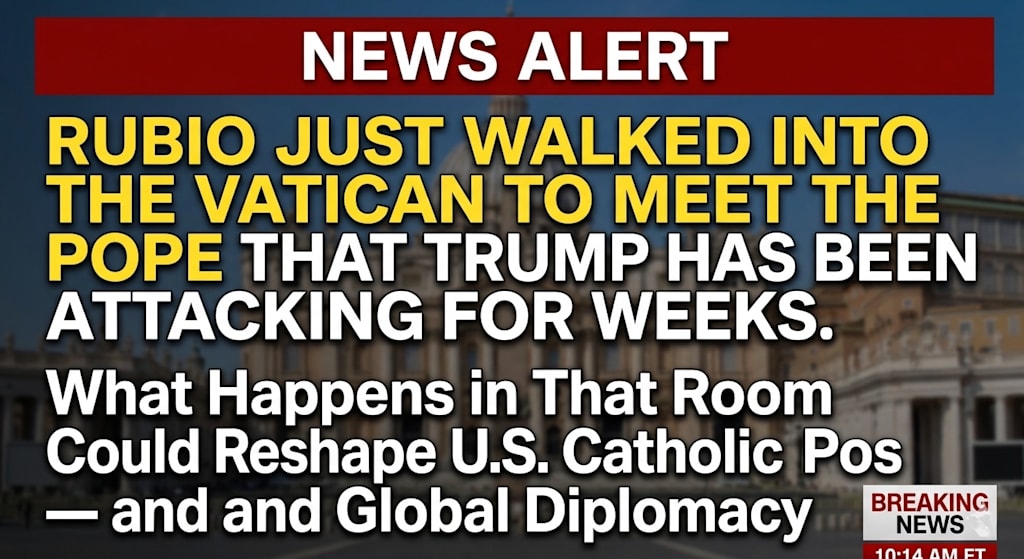
When Marco Rubio walks through the doors of the Vatican on Thursday, May 7, he will be carrying considerably more than a diplomatic portfolio. He will be carrying the weight of an increasingly damaging public feud between the American President and the American Pope — a feud that has been conducted entirely on Trump's terms, through social media insults, radio interviews, and truth social posts that have accused the head of 1.4 billion Catholics of "endangering Catholics," being "weak on crime," "terrible for foreign policy," and thinking it's "just fine for Iran to have a nuclear weapon." Pope Leo XIV has never said any of those things. What he has said, repeatedly and with theological precision, is that the Iran war fails the Catholic Church's just-war criteria, that diplomacy was not exhausted before the strikes began, that civilian casualties are disproportionate and morally unacceptable, and that nuclear weapons must never define the future of humanity.
Rubio has publicly denied that his visit is an attempt to "smooth things over." He told the White House press corps that the meeting will focus on "shared concerns" including religious freedom in Africa and the distribution of humanitarian aid to Cuba. "We distribute it through the Church," he said, referring to aid to Cuba. That framing is diplomatic cover that nobody watching the meeting believes. The Vatican meeting is happening because the Trump-Pope feud is causing measurable political damage, and the most senior Catholic in the Trump Cabinet has been dispatched to contain it. Steve Millies of the Catholic Theological Union told TIME: "Rubio's performance on this trip is something to watch closely — as the role of Secretary of State in trying to turn the temperature down and making it a little easier for Catholics to line up with the Republican Party."
"If Leo were irrelevant, he wouldn't merit a word. Instead, he is called out, named, fought: a sign that his word cuts deep." — Vatican official Antonio Spadaro, May 2026
The political stakes are enormous. American Catholics number approximately 72 million people — roughly 22 percent of the U.S. population. They are not a monolithic voting bloc. They lean Republican in many suburban markets, but they are also heavily represented in working-class communities in the Rust Belt and the Midwest that Trump needs for midterm success. A sustained, visible feud with the first American-born pope — conducted in Trump's characteristic language of personal attacks and deliberate misrepresentation — risks alienating exactly the moderate Catholic voters whose support was decisive in both the 2020 and 2024 elections. CNN's Rome correspondent Elise Ann Allen noted: "He has to be careful, because he has to remember that it's the moderate Catholics who got him elected in both elections."
The broader diplomatic significance of the Rubio-Leo meeting extends well beyond U.S. Catholic voters. The Holy See — the Vatican's governmental body — maintains diplomatic relations with 183 countries and has unique influence in regions where the U.S. needs cooperation: sub-Saharan Africa, Latin America, Southeast Asia, and the Middle East. Vatican diplomats and papal representatives have historically served as back channels, mediators, and moral anchors in conflicts where secular governments cannot operate effectively. The Pope's public framing of the Iran war as a moral failure — not merely a policy disagreement — activates networks of Catholic institutions, hospitals, schools, and charities in Iran-adjacent countries and among populations with deep personal stakes in the conflict's outcome. That influence cannot be discounted as merely symbolic.
Pope Leo has said he "perhaps" may comment on the meeting with Rubio afterward. He has also, according to CNN's live diplomatic coverage, held a video call with Ukrainian soldiers in which he told them he "prays for them and supports them," and that he hopes peace will "soon be achieved." That call — conducted in the same week as his confrontation with the Trump administration — illustrates the breadth and independence of Leo's moral platform. He is not anti-American. He is anti-war. The distinction matters — and it is precisely the distinction the Trump administration has been trying, unsuccessfully, to erase.
What Rubio says to Leo in that room — and what Leo says back — may determine whether Washington and the Vatican find a working diplomatic language before Trump's Iran deal push enters its final critical phase. The Pope's blessing for a peace deal, if forthcoming, would carry moral weight in a region and a world that needs all the moral authority it can find. His public condemnation of a failed deal would carry weight in the opposite direction. The Secretary of State knows this. He walks into the Vatican not as a diplomatic victor, but as a supplicant — asking the Pope to do what the Pope has been doing all along, and hoping it gets framed differently this time.
About the Creator
Enjoyed the story? Support the Creator.
Subscribe for free to receive all their stories in your feed.
Comments
There are no comments for this story
Be the first to respond and start the conversation.